· 10 min read
Why Used Sneakers From Japan Look Nearly New
The condition gap between Japanese-market resale sneakers and their Western counterparts isn't luck — it's the downstream result of specific cultural habits that begin the moment a shoe enters a Japanese home.
Japan's sneaker resale market produces better physical condition because Japanese owners treat their shoes differently from day one — not because resellers grade more carefully, but because the upstream behaviours that determine wear are simply different. The grading system is just the label on the outcome. What follows is an explanation of the causes.
Why do Japanese sneaker owners keep their shoes in such good condition?
The short answer is that sneaker culture in Japan developed inside a broader set of values around objects, documentation, and care that has no direct equivalent in the US or European market. Japan's pre-owned grading vocabulary — the S-rank, the SA, the meticulous condition descriptions — exists because the market demands that level of precision. That demand exists because buyers in Japan expect condition to be real, not approximate.
Sneakers have had cult followings in Japan since the 1990s, and outside the US, Japan is one of the only markets where limited-edition styles have had region-exclusive releases. That history matters: a market built on limited, collectible product trains its participants to treat ownership as stewardship. A pair bought at a lottery release in Harajuku is not a commodity to be worn into the ground — it is, from the moment of purchase, a potential future resale item or a piece of personal archive.
In Japan, certain sneakers gradually cross a threshold — they stop functioning solely as footwear and begin to exist as objects to be preserved, documented, and studied rather than consumed. Crucially, this transition is governed by cultural recognition, not age alone or price. The result, for a buyer sourcing from Japanese resale channels, is that even a worn pair has typically been handled with a level of intentionality that a casually resold US pair has not.
How does Japan's indoor shoe culture affect sneaker wear?
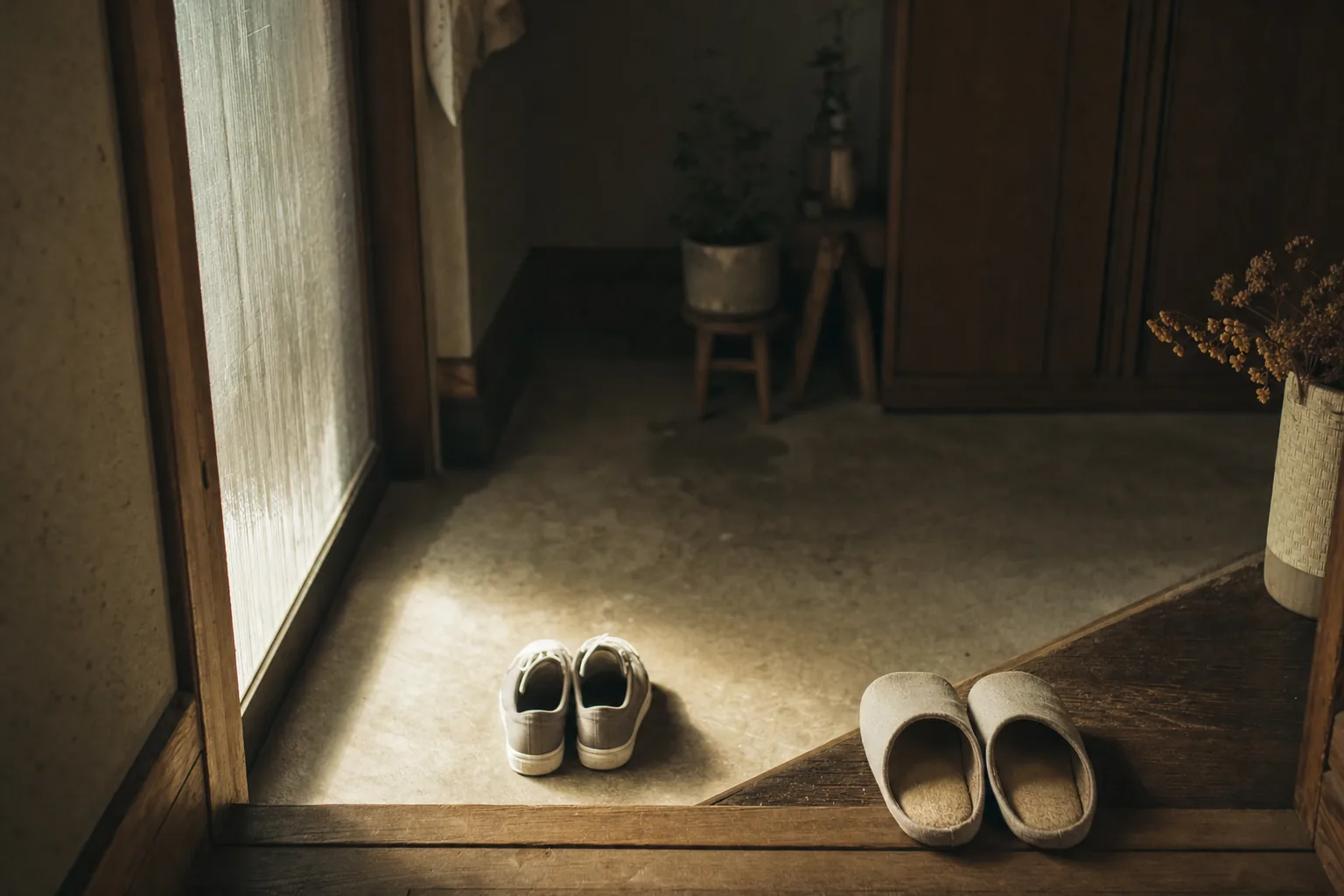
Directly and measurably. Taking off shoes before entering Japanese homes, traditional restaurants, temples, and many other indoor spaces is one of Japan's most fundamental etiquette rules. The genkan — the lowered entryway — serves as a transition zone where shoes are removed before stepping up into the clean interior. This is not optional behaviour; never stepping with outdoor shoes onto the raised indoor floor is a serious breach of etiquette.
The practical consequence for sneaker condition is significant. A collector in Tokyo who wears a pair to a dinner, removes them at the genkan, and replaces them with house slippers has subjected those shoes to far fewer hours of compression, flex, and outsole contact than a US owner who keeps the same pair on all evening. Multiply that across dozens of wearings and the outsole wear, midsole compression, and upper creasing diverge substantially. A Japanese-owned pair graded S ("almost new, used several times") will often show less physical wear than a US pair the seller describes as "lightly used."
Japanese children bring their uwabaki — soft indoor shoes — to school every day, changing out of their outdoor shoes at the entrance. The same concept applies in some traditional companies and healthcare settings. This is a population trained from childhood to treat outdoor footwear as a context-specific tool, not a constant companion. That training shapes how adults handle their sneaker collections.
What does 'dead stock' actually mean when found in a Japanese resale shop?
In global sneaker vocabulary, deadstock refers to sneakers that are brand new, never worn, and usually in their original box with all the authentic tags and accessories intact. In Japan's domestic resale ecosystem, the term carries additional weight because the supply of genuine deadstock is higher than in most other markets.
The reasons are structural. Japan received a significant volume of region-exclusive and limited-edition releases throughout the 1990s and 2000s. Japan was a hotbed for sneakers, and Nike would drop exclusive products there to expand its reach, capitalize on the booming sneaker scene, and experiment with designs and colorways. Many of those pairs were bought by collectors who never intended to wear them — they were acquired as objects, stored correctly, and eventually entered the resale market years or decades later with original box and accessories intact. A "deadstock" listing from a Japanese consignment specialist is far more likely to mean genuinely unworn than the same label applied to a US eBay listing.
A sneaker cannot become an object without documentation. Boxes, tags, original packaging, and release context allow it to be framed, cataloged, and re-examined. This mindset — that the box is part of the item, not packaging to be discarded — is embedded in how Japanese collectors store and eventually sell their pairs.
If you're looking for a specific Japan-market release that never made it to Western retail, understanding which Japan-only sneaker releases exist is a useful starting point before sourcing.
Do Japanese collectors really rotate sneakers to preserve them?
Yes, and the rotation is deliberate rather than casual. The collector mindset that developed in Japan through the 1990s sneaker boom — when pairs of Air Max 95s were exchanged among a zealous legion of collectors, with some pairs fetching up to $3,000 — trained participants to think about resale value from the point of purchase. A pair worn on consecutive days accumulates midsole compression faster than the same pair worn once every two weeks across a ten-pair rotation.
The practical effect on condition is real. Wearing actually helps: flexing pushes moisture out of the foam — so a rotated pair that is worn occasionally and then stored correctly will often outlast a pair that sits sealed in a box for years. Japanese collectors tend to understand this, which is why the "worn several times" S-rank pair from a Japanese resale shop can show less midsole degradation than an "unworn" pair that was stored in a damp US basement.
Japan's sneaker scene emphasizes artisanal quality and exclusivity, and that emphasis shapes how collectors approach wear. The goal is not to avoid wearing — it is to wear in a way that preserves the object's integrity. That distinction produces a different physical outcome.
How does Japan's climate-controlled storage compare to typical US or EU closets?
This is where the condition advantage becomes most concrete. Yellowing is oxidation — UV light and oxygen react with clear and white materials over time — and sole rot is hydrolysis, where moisture breaks down the polyurethane in midsoles and glue. Both processes are accelerated by heat, humidity, and light exposure. The ideal storage environment is cool, dry, and dark.
Japanese apartments are typically compact, well-insulated, and equipped with air conditioning as standard. The common US storage location for a casual owner's sneaker collection — a garage, an attic, a basement — is precisely the environment that accelerates degradation. High humidity in basements creates a breeding ground for mold and mildew, while garages and attics experience extreme temperature fluctuations that stress materials. A Japanese owner storing pairs in an interior closet in a climate-controlled apartment is, by default, doing what sneaker preservation guides recommend as best practice.
The numbers matter here. The ideal storage environment is cool (65–70°F), dry (below 50% humidity), and dark. Japanese urban apartments routinely meet those conditions through ordinary habitation. US suburban garages, where temperature swings of 40°F between seasons are common, do not. The midsole on a 2005 Nike Dunk stored in a Tokyo closet and the same model stored in a Phoenix garage will look materially different by the time either enters the resale market.
Why are box and accessory completeness rates higher on Japanese resale sneakers?
Because the box was never treated as disposable. In Japan's collector culture, boxes, tags, original packaging, and release context allow a sneaker to be framed, cataloged, and re-examined — without documentation, the sneaker remains footwear. That framing is taken seriously. A Japanese collector who paid a premium for a limited release at a lottery drop is not going to discard the box — the box is evidence of provenance, and provenance is part of the object's value.
The contrast with typical Western resale is stark. In the US and European markets, a significant proportion of pre-owned sneakers arrive at resale platforms without original boxes, with mismatched laces, or missing hang tags. The presence and condition of the original box, wrapping paper, and any included accessories such as extra laces or hangtags are vital — a complete package significantly enhances the value of deadstock shoes. Japanese sellers understand this at a market level; the completeness rate on Japanese-sourced pre-owned sneakers reflects that understanding.
This matters practically. A pair sourced from Japan with original box, tissue paper, hang tag, and both lace sets is a categorically different resale item from the same model sold without box in the US. The Japanese pair carries more documentation, more provenance, and more protection against authenticity questions — all of which are relevant to authenticating pre-owned items sourced from Japan.
What condition grades should I expect on sneakers sourced from Japan vs. the US?
Japan's domestic resale market uses a standardized letter-grade system that is more granular than the descriptions typically applied to US resale listings. Here is how the grades map in practice:
| Japanese Grade | What It Means | Typical US Equivalent Listing Language |
|---|---|---|
| N (Brand New) | Unworn, original packaging, no display wear | "Deadstock / DS / Brand New" |
| NS (Near New / Display) | Unused but may show minor shelf wear or age | Rarely distinguished from DS in US listings |
| S (Almost New) | Worn a few times, minimal visible wear | "VNDS" or "Like New" — often overstated |
| SA (Near Almost New) | Small scratches or stains, close to S | "Excellent Used" or "9/10" |
| A (Good Used) | Normal use wear, still solid condition | "Good" or "8/10" — often understated |
| AB (Frequently Used) | Visible wear, minor flaws acceptable | "Used" or "7/10" |
| B (Considerably Used) | Noticeable damage from use | "Fair" or "6/10" |
The critical difference is not the labels — it is the baseline. A Japanese S-rank pair has typically been worn a handful of times by someone who removed them at the door, stored them in a dry interior space, and kept the box. A US "Like New" listing has no such implied history. The Japanese grade is a description of a known condition; the US label is a seller's self-assessment with no structural accountability behind it.
Japan's pre-owned grading defines S as "almost new — a pre-owned item used several times." That specificity — "several times" rather than "lightly used" — reflects a market culture where condition descriptions are taken seriously because buyers know what they mean and hold sellers to them.
Is the condition difference real enough to justify sourcing from Japan?
For collectors and buyers who care about physical condition, yes — and the advantage compounds with the age of the pair. A 2003 Japan-exclusive Nike Dunk sourced from a Tokyo consignment specialist will, on average, show less midsole yellowing, less upper creasing, and more complete original packaging than the same model sourced from a US private seller. That is not a universal guarantee — individual pairs vary — but it is a structural tendency rooted in the cultural and storage factors described above.
The advantage is most pronounced in three scenarios: pairs from the 1990s and early 2000s that were stored in Japanese apartments rather than US garages; Japan-exclusive releases that never entered Western retail and therefore have no comparable Western resale supply; and deadstock pairs where box completeness is part of the value. For recent general-release models available in both markets, the condition gap narrows, though the grading precision advantage remains.
The friction is access. Japanese sellers frequently list domestically, in Japanese, on platforms that do not ship internationally — a dynamic explored in detail in why Japanese sellers refuse international buyers. That access gap is precisely what a sourcing service addresses: the Tokyo-based evaluation, the condition check against the stated grade, and the international shipment that a domestic-only listing cannot provide.