· 11 min read
Japan-Only Pre-Owned Items You Can't Find Elsewhere
A category-by-category look at the specific pre-owned luxury objects — Japan-domestic bags, discontinued watch references, regional ceramics, kimono-era textiles — that surface in Japan's resale ecosystem and have never meaningfully entered Western secondary markets.
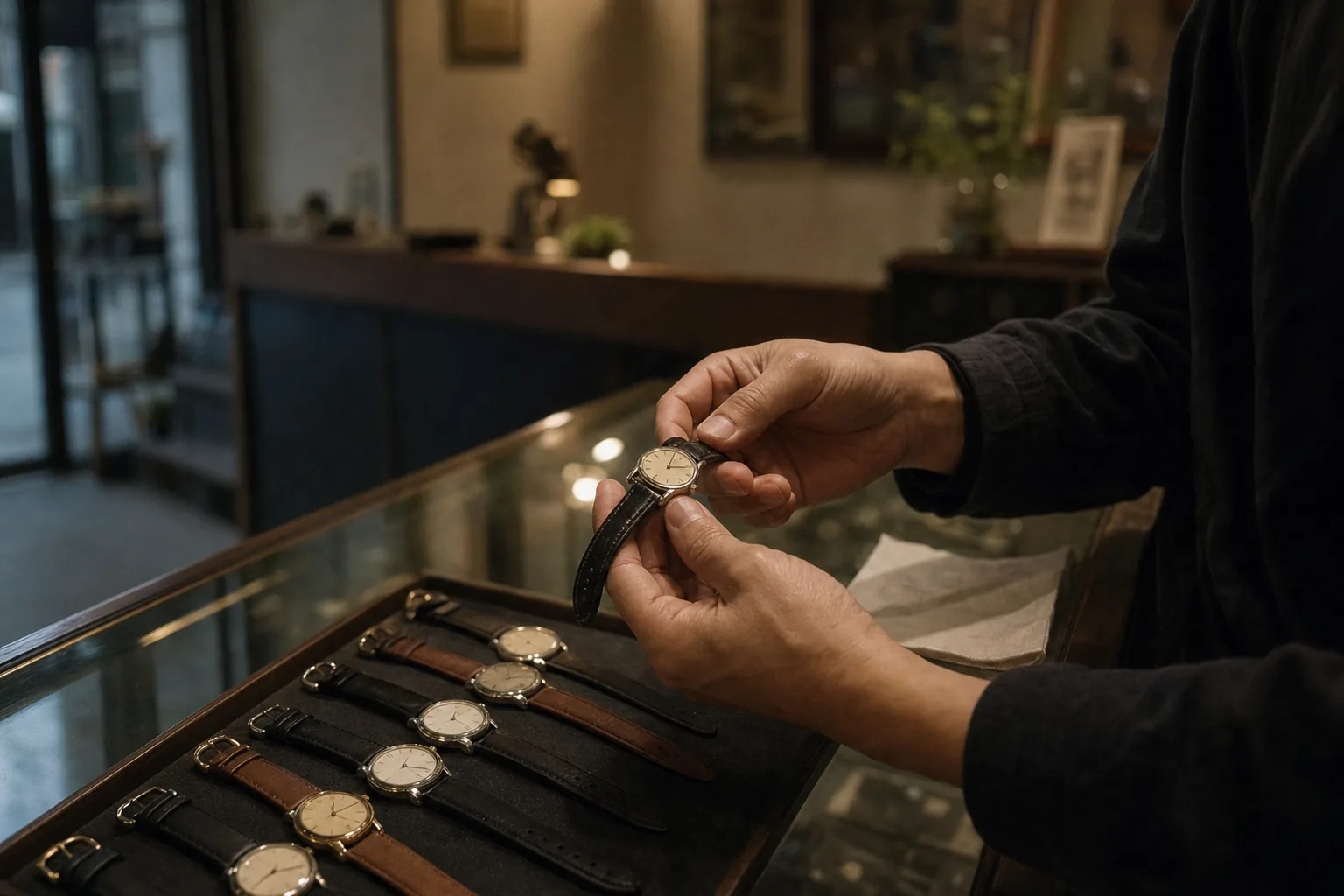
The Grand Seiko SBGW235 was listed only on the Japanese version of the Grand Seiko website. It never appeared on the international site. If you wanted one, Japan was the only place to find it — and the pre-owned pool there is where it stays. That single fact describes a much wider phenomenon: an entire inventory of luxury objects that originated in Japan, circulated among Japanese buyers, and now surface only in Japan's domestic resale ecosystem. The gap is not about price or condition. It is about what exists.
If you want to understand the full shape of Japan's resale market, the complete guide to buying second-hand luxury in Japan covers the mechanics. This article is about something narrower: the specific categories of objects that are simply not available anywhere else.
What kinds of luxury items exist in Japan's resale market that never reach the West?
The short answer is: anything that was sold only through Japanese boutiques, produced for the Japanese domestic market (JDM), or distributed through gift-giving channels that have no Western equivalent. These are not items that are merely hard to find abroad — they are items whose entire resale supply sits inside Japan because that is where every unit was originally purchased.
The categories break into five broad groups: designer bags in Japan-exclusive editions, discontinued watch references from Japan's domestic market, traditional craft objects that circulate through temple markets and estate sales, vintage film cameras and Japan-spec electronics, and textiles from the kimono era. Each has a different reason for staying put, but the result is the same: a buyer in the US or EU cannot source them from Western resale channels because those channels have no supply.
Which designer bag editions were sold only through Japanese boutiques?
Louis Vuitton has released Japan-exclusive editions at several points in its history — pieces with regional motifs, compact silhouettes tailored to Japanese preferences, and collaborative editions that were explicitly not part of the global rollout. The 2021 Louis Vuitton x Rei Kawakubo Monogram Empreinte tote, for instance, was a Japan-exclusive collaboration. The brand's 20th-anniversary pieces in Japan — including the all-vachetta Petit Bucket Bag — were produced for the Japanese market and distributed only through Japanese boutiques. These do not appear in Western pre-owned inventories because they were never sold in Western boutiques to begin with.
Hermès has an equivalent history. A clear transparent vinyl Kelly produced in the 1990s was a Japan limited edition, sold through Japanese department stores, and is documented as such on the rare occasions it surfaces at all. Japan's second-hand Hermès market is also where the Hermès pieces Japan keeps for itself tend to remain — styles that were allocated to Japanese boutiques in colorways or leathers that never entered the global production run. The discontinued Herbag Mini, certain Picotin colorways, and vintage Bolide configurations from the 1980s bubble era circulate in Japan's domestic resale pool in volumes that have no parallel anywhere else.
Japan's second-hand market features unique, Japan-exclusive designs that are hard to find elsewhere. The supply exists because Japanese consumers who bought these pieces during the 1980s economic boom have been releasing them into the resale market steadily ever since — and because those consumers bought from Japanese boutiques, the pieces carry Japanese provenance that confirms their origin.
What discontinued watch references stay locked in the Japanese domestic resale pool?
Grand Seiko is the clearest example. As Chrono24's editorial notes, many Grand Seiko models were sold only in Japan, while others were modified in appearance and completely renamed for export. The domestic-only variant count reflects, in part, how many JDM references the brand produced across its history that never appeared on international retailer lists.
Three references illustrate what this means in practice for a buyer today:
- SBGW235 — The Japan-only companion to the SBGW231, listed exclusively on the Japanese Grand Seiko website. It shares the 37mm manual-wind case and caliber 9S64 but was never offered through international retailers.
- SBGJ231 — A Hi-Beat GMT with a midnight-blue Iwate-inspired dial, circulated only in Japan. The movement is the 9S86 at 36,000 vph. Its documentation confirms purchase at a Japanese Grand Seiko boutique.
- SBGH283 — Available only in Japan at the Grand Seiko Studio Shizukuishi, as Time and Tide Watches confirmed when profiling JDM Grand Seiko references collectors seek out.
The SBGW231 itself — the hand-wound dress watch that Monochrome Watches called "the Japanese Calatrava" — was sold primarily in Japan before its successor SBGW301 replaced it in early 2024 with a worldwide release. Pre-owned SBGW231 examples now list almost entirely from Japan, with the remainder held by individual collectors who imported them. That ratio reflects the supply reality: the domestic resale pool is where they live.
For a deeper look at which current and discontinued references were built for the Japanese market, the full breakdown of Grand Seiko models sold only in Japan covers the reference landscape in detail. The broader category of Japanese precision watchmaking — including the craft traditions behind these dials — is covered in Japanese luxury watches, pens, and eyewear.
Why do Japan-only limited goods rarely escape into Western auction houses?
The mechanics are straightforward. Western auction houses and consignment platforms source their inventory from Western collectors, Western estates, and Western boutique returns. An item that was never sold in the West has no entry point into that supply chain. A Japan-exclusive Louis Vuitton piece purchased at the Ginza flagship in 1998 would need to have been carried out of Japan by a traveler, resold to a Western collector, and then consigned to a Western auction house — three transfer steps, each of which reduces the probability of the item appearing in a New York or London sale room.
The same logic applies to Grand Seiko JDM references. A collector in Munich cannot walk into a German watch dealer and trade in a SBGJ231 they bought in Tokyo, because German dealers have no established demand or pricing infrastructure for a reference they have never stocked. The item goes back to Japan — either shipped to a Japanese resale platform or held until the collector travels again.
There is also a cultural dimension. Japanese sellers often prefer domestic resale channels, and the reasons Japanese sellers refuse international buyers are well-documented: language barriers, return policy uncertainty, and a preference for buyers who can physically inspect the item. This keeps the supply domestic even when the seller is willing to part with the piece.
What traditional craft and textile categories are unique to Japanese resale?
Meiji-era ceramics are the category Western collectors most consistently underestimate. Arita and Imari porcelain produced for domestic use — not for the export trade — carries different decoration, different scale, and different provenance from the pieces that entered Western collections through 19th-century trade. The domestic pieces circulate through Japan's temple and shrine markets, where antique markets offer items mainly from the early 17th century to the present day, including pottery, lacquerware, kakejiku hanging scrolls, kimonos, and old books. That supply has no Western equivalent because these objects were made for Japanese households, used in Japanese households, and are now sold through Japanese domestic channels.
Vintage kimono and obi are the other major textile category. The Toji Temple Flea Market in Kyoto, held on the 21st of each month, is specifically known for its selection of antique and vintage textiles, including kimono, obi, and furoshiki. Meisen silk kimonos from the Taisho and early Showa periods — geometric, modernist, and produced in large quantities for urban Japanese women — are abundant in Japan's resale market and nearly absent from Western vintage textile dealers. The fabric itself has no Western analog, and the garments were never exported in meaningful numbers.
Lacquerware (urushi) from named regional traditions — Aizu, Wajima, Echizen — follows the same pattern. These pieces were produced for Japanese domestic use, gifted within Japan, and now surface through estate sales and specialist antique dealers. A Wajima lacquer tray from a mid-century Japanese household is not an object that ever passed through a Western auction house.
Which Japanese-market electronics and cameras surface only in domestic pre-owned shops?
Japan's pre-owned camera market is one of the most developed in the world, and it holds inventory that Western camera dealers simply cannot replicate. The concentration of film cameras, lenses, and accessories in Tokyo's Shinjuku and Ginza districts reflects decades of domestic buying, careful storage, and structured resale. Nikon bodies and lenses in grades that Japanese sellers describe as "Top Mint" or "Near Mint+++" — condition standards that align with Japan's meticulous pre-owned grading culture — appear in volumes that no Western dealer can match.
Beyond condition, the domestic market holds Japan-spec variants of cameras that were sold with different firmware, different accessories, or different bundled documentation in Japan versus export markets. The Nikon FM2/T in titanium finish, for instance, was produced in limited quantities and circulates almost entirely through Japanese domestic resale. Compact film cameras by Kyocera and Contax that were sold primarily in Japan attract foreign visitors to Tokyo specifically because those models are unavailable at home.
The same applies to certain audio equipment, vintage game hardware, and precision instruments. Japan's domestic electronics market produced items for Japanese consumers that were never distributed internationally, and those items now sit in the domestic pre-owned ecosystem — in specialist shops, in domestic auction platforms, and in the inventories of individual collectors who have no reason to sell abroad.
Why does cultural gifting in Japan feed the resale supply of items Westerners never see?
The gift-giving infrastructure in Japan — ochugen in summer, oseibo in winter, plus weddings, funerals, promotions, and seasonal obligations — generates a steady flow of high-quality objects into the resale market. A department store gift set containing Arita porcelain cups, a Wajima lacquer box, or a silk furoshiki might be received by a household that already owns equivalent pieces. Rather than discard the gift, the recipient brings it to a resale specialist. The item enters the pre-owned market in near-unused condition, often still in its original box.
This mechanism is entirely domestic. The gifted objects are sourced from Japanese producers, sold through Japanese department stores, given to Japanese recipients, and resold through Japanese channels. A Western buyer has no visibility into this supply unless they are operating within Japan's domestic market. The objects are not unusual or rare in Japan — they are ordinary gifts that happen to be of excellent quality — but they are invisible to Western collectors because the entire transaction chain is Japanese.
The same applies to corporate gifts. Large Japanese companies historically gave branded luxury items — sometimes Hermès scarves, sometimes Grand Seiko watches, sometimes lacquerware sets — to retiring employees or long-term clients. These pieces surface in the resale market years later, often with original packaging and documentation, at prices that reflect their domestic rather than export value. That is the inventory gap: not items that are hard to find, but items whose supply chain has never touched the West at all.
Understanding what categories exist is only part of the picture. The broader landscape of Japan-only products that never leave the country extends well beyond luxury goods into electronics, food, and everyday objects — the same domestic-market logic applies across categories.
What does this mean for a buyer who wants something genuinely impossible to find at home?
It means the inventory gap is real and structural, not a matter of searching harder on Western platforms. A buyer looking for a pre-owned SBGJ231 GMT, a Japan-exclusive Louis Vuitton anniversary piece, a Meisen kimono in wearable condition, or a Meiji-period Arita bowl from domestic rather than export production is looking for something that does not exist in Western resale supply. The objects are in Japan because that is where they were made, sold, and kept.
The practical implication is that accessing this inventory requires operating within Japan's domestic market — through the domestic auction platforms, the specialist consignment shops, the temple market networks, and the pre-owned camera districts that collectively hold this supply. That is a different task from browsing a Western resale platform, and it is where the value of having a presence inside that market becomes concrete.
| Category | Example objects | Why it stays in Japan |
|---|---|---|
| Designer bags | LV x Rei Kawakubo 2021 tote; Hermès clear vinyl Kelly (1990s); LV 20th-anniversary vachetta Petit Bucket | Sold only through Japanese boutiques; never distributed internationally |
| Watches (JDM references) | Grand Seiko SBGW235, SBGJ231, SBGH283 | Listed only on Japanese GS website or sold only at Japanese boutiques/studios |
| Ceramics | Domestic-use Arita and Imari porcelain; Wajima lacquerware; Meiji-era sake cups | Produced for Japanese households; never entered export trade in volume |
| Textiles | Meisen silk kimono (Taisho/Showa); vintage obi; Edo-period furoshiki | Circulate through temple markets and estate sales; no Western resale infrastructure |
| Cameras & electronics | Nikon FM2/T titanium; Japan-spec Contax/Kyocera compacts; domestic-firmware variants | Japan-spec production; foreign collectors must enter domestic market to find them |
| Gift-channel luxury | Corporate-gift Grand Seiko sets; department store Hermès scarves; lacquerware gift sets | Entire transaction chain is domestic; no Western visibility into supply |
FindLuxuryJapan sources pre-owned items individually from within Japan's domestic market — auctions, specialist shops, and vetted partner networks — and ships globally with tracking and insurance. Every item is evaluated against our pricing, condition, and authenticity models before you approve anything. The sourcing fee is 10% of the item price, minimum ¥5,000, quoted before purchase and fixed from that point.