· 13 min read
The Complete Guide to Luxury Thrift and Vintage Shopping in Japan: Where to Find Designer Deals in Tokyo and Beyond
A format-by-format, district-by-district map of Japan's pre-owned luxury ecosystem — the market structure, grading system, and category strengths that make it unlike any resale market in the world.
The Grand Seiko SBGW235 was listed on the Japanese version of the Grand Seiko website and sold mostly in Japan — a cream dial, blued seconds hand, and Gay Frères-style metal bracelet on the same 37mm manual-wind case as its international sibling. Outside Japan, you would not find it at retail. You would find it in a glass case in a pre-owned watch specialist on a Ginza side street, graded, priced, and ready to ship. That is what this market does: it surfaces objects that never existed in your home market, in condition that makes them feel new.
Japan's second-hand luxury market moves over ¥300 billion annually, and the structure behind it — licensing law, kaitori buy-back culture, B2B dealer auctions, standardized grading — produces a buying environment that has no equivalent in Europe or North America. This guide maps that structure. It does not list shops, because the shops are not the story. The market format is.
What makes Japan's luxury thrift market different from resale markets anywhere else?
Three things separate Japan from every other pre-owned luxury market: institutional structure, supply quality, and grading consistency. Every business that buys secondhand goods for resale must hold a police-issued license — the kobutsusho kyoka (古物商許可). The application is submitted to the local police station, making the licensing authority also the law enforcement authority. That is a deliberate structural choice with no parallel in the US or EU resale industries.
On the supply side, Japan's resale culture is fed by a concept known as mono wo taisetsu ni suru — cherishing your belongings — which means items re-enter the market in condition that Western consumers would consider essentially new. Wealthy Japanese consumers regularly trade in near-new luxury goods through the kaitori (買取) system: a network of commercial buy-back operations that purchase items directly from owners for cash, authenticate them, and feed them into the resale chain. Those items then move through licensed dealer auctions — B2B events that are closed to anyone without a dealer license, and where some of the rarest pieces surface.
The penalties for operating outside this system are severe. Selling counterfeit goods under Japan's Trademark Law carries imprisonment for up to ten years or a fine of up to ¥10 million for individuals, with corporate fines reaching ¥300 million. That enforcement context is why licensed Japanese chains reject items that fail authentication rather than discounting them — a practice that differs structurally from how most Western consignment stores operate.
If you want a deeper look at how authentication actually works at the shop level, the guide to authenticating designer pieces before you buy in Japan walks through the physical inspection points that separate a legitimate listing from a risky one.
Which cities and districts are the real centres of pre-owned luxury in Japan?
Tokyo holds the largest volume and the widest range of formats, but Osaka and Kyoto each have structural advantages that make them worth understanding separately.
Within Tokyo, four districts define the market:
- Ginza is the premium tier. Consignment specialists here carry authenticated luxury with verified provenance documents — Hermès, Chanel, Rolex, Cartier — at prices that are higher than other neighborhoods but still below Western resale equivalents. The density of serious inventory is unmatched anywhere in Japan.
- Aoyama sits between Ginza's formality and Harajuku's edge. It is the strongest neighborhood for European designer clothing and shoes, with several consignment boutiques that receive pieces from Tokyo's fashion-industry network. Rare and limited-edition items surface here more regularly than in chain stores.
- Shimokitazawa is the entry point for vintage fashion. Dozens of independent stores cover everything from 1980s Japanese designer labels to international archive pieces at prices that start low and reward patience.
- Omotesando and Harajuku's backstreets offer a middle register: curated independent boutiques with strong European and Japanese luxury fashion selections, at prices that reflect the curation rather than the chain-store volume model.
Osaka's Shinsaibashi district is a major centre for pre-owned luxury, and buyers there often report lower asking prices than equivalent Tokyo stores for the same graded items — a difference attributed to lower overhead costs and local consumer price expectations. This makes Osaka particularly valuable for high-volume accessories: belts, scarves, small leather goods, where the savings compound quickly across multiple purchases. The adjacent Amerika-Mura neighborhood contains independent vintage stores with an emphasis on Japanese domestic designer labels.
Kyoto's resale scene is smaller, but it regularly yields older, less-circulated inventory from estate sales — valuable for buyers seeking rare vintage pieces that have never entered the high-volume Tokyo resale chain.
Nakano Broadway in Tokyo deserves a specific mention for watches. Nakano Broadway is well known for specialty shops focusing on pre-owned luxury watches, including Rolex and Omega, and it tends to have fresher morning inventory than Ginza because local collectors prioritize it first.
For a broader map of how these districts relate to each other across the full luxury retail spectrum, the guide to where serious luxury buyers actually go in Japan covers the geography in detail.
What retail formats carry pre-owned designer goods — and how do they differ?
Japan's pre-owned luxury market operates through five distinct formats, each with different price levels, inventory sources, and authentication standards.
| Format | Typical inventory source | Authentication level | Price vs. Western resale |
|---|---|---|---|
| Large chain resellers (multi-floor, nationwide) | Kaitori buy-back, estate consignment | In-house specialists by brand category | 20–40% below |
| Ginza / Aoyama consignment specialists | Private consignment, kaitori | Highest — provenance documentation standard | 10–25% below |
| Independent vintage boutiques | Estate sales, private sellers, dealer auctions | Variable; strongest in specialist stores | Wide range |
| B2B dealer auctions (licensed only) | Aggregated kaitori from nationwide network | Pre-screened by auction house | Wholesale — below retail price |
| Domestic consumer-to-consumer platforms | Individual sellers | Buyer-dependent; no institutional authentication | Lowest asking, highest risk |
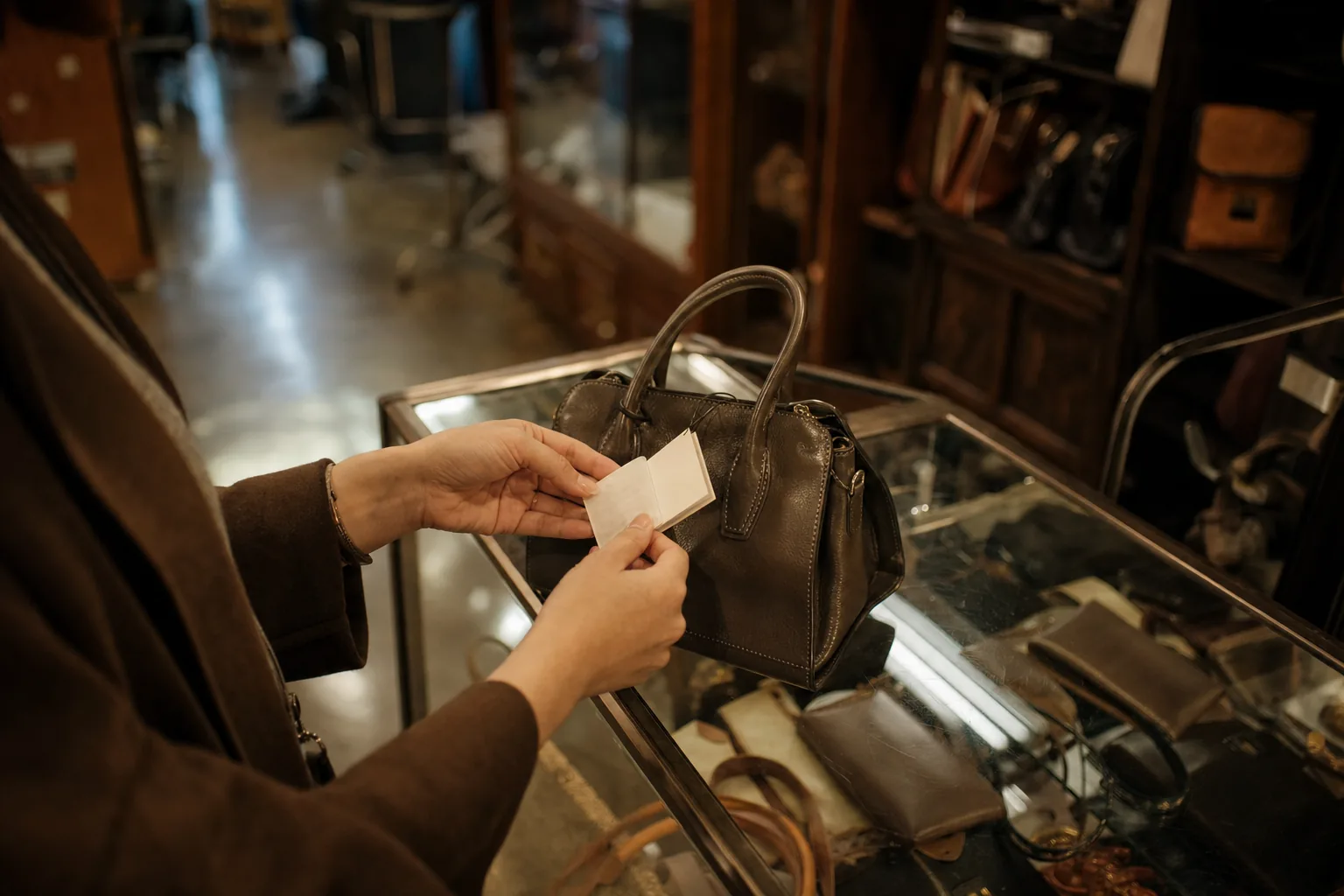
The large chain resellers are the backbone of the market. They operate multiple floors in major cities, with inventory organized by brand and displayed in locked glass cases individually tagged with condition grade, original retail price, and current asking price. In 2023, Japan's overall reuse market grew by 7.8% year-on-year to reach 3.1227 trillion yen, and the large chains account for a disproportionate share of that growth. Many employ specialists who focus exclusively on a single brand category — one authenticator for Hermès, another for Chanel, another for Rolex.
The B2B dealer auction layer is invisible to retail buyers. Licensed dealers use these auctions to source inventory from across Japan — estate sales in Kyoto, kaitori collections from Osaka, private consignments from Tokyo — and the pieces that surface here are often the ones that never reach a shop floor. Access requires a kobutsusho license, which is impossible for non-residents to hold.
Which designer categories does Japan's second-hand market do best?
Hermès leather goods, Rolex sport references, and vintage Chanel offer the strongest price advantage in Japan's second-hand market. But the category picture is more specific than that.
Hermès bags: Japan is one of the world's largest Hermès markets by volume, which means the secondary supply is deep. Birkins and Kellys in standard leathers and colors appear regularly in Ginza consignment specialists. The price gap versus Western resale platforms runs to around 30% on equivalent-grade pieces for many configurations.
Rolex: The pre-owned market is where the real Rolex opportunity sits in Japan. Authorized dealers in Tokyo prioritize long-term local clients for high-demand sport references — Submariner, GMT-Master II, and Daytona are routinely marked "Exhibition Only" at authorized dealer counters, meaning tourists can view but not purchase. The pre-owned and parallel import channel is where those references actually trade, with well-documented, well-preserved pieces at prices that can still beat most other markets.
Japanese domestic watch references: The Grand Seiko SBGW235, with its cream dial and Gay Frères bracelet, was sold mostly in Japan and is a consistent presence in Tokyo's pre-owned watch market. The SBGJ231 GMT was similarly listed as a Japan-only reference. Japan's domestic resale price for Grand Seiko models is considerably lower than their international secondary market equivalents, making Japanese watch shops particularly rewarding for collectors who know the references.
Vintage Japanese fashion: Comme des Garçons, Yohji Yamamoto, Issey Miyake — archive pieces from these designers appear in Shimokitazawa and Aoyama at prices that reflect the domestic market rather than the international collector premium. A Pleats Please piece that trades for multiples of its original price on Western platforms may sit at a fraction of that in a Shimokitazawa boutique.
Chanel accessories: Scarves, belts, costume jewelry, and small leather goods are where the volume advantage is most pronounced. Japan's deep Chanel market produces consistent supply in excellent condition, and the price-per-piece advantage compounds when buying multiple items.
For more on what Japan's domestic designer scene produces — both vintage and current — the guide to Japanese luxury brands by lifestyle, shoes, leather, and fashion covers the domestic label landscape that feeds the pre-owned market.
What condition standards and grading systems should you expect?
Japan uses a standardized grading scale across most major licensed resale stores. The framework runs N → S → SA → A → AB → B → C → D, where N means brand-new unused with tags, S means near-new or virtually unused, and A grade represents excellent used condition with minimal wear. The industry widely uses this system, where N represents brand-new unused, S means near-new, and A grade is the best value-for-money choice with good overall condition.
What makes this system valuable is its consistency. A B-grade item at one major chain and a B-grade item at another will be in roughly the same condition, because industry standards have normalized around shared expectations. Western resale platforms use inconsistent terminology — "Excellent" on one platform does not mean the same as "Excellent" on another. In Japan, the grade is a documented record that can be checked against the physical item.
Japanese graders also disclose flaws in writing on the price tag itself. A tag reading 角スレあり (corner scuffing present) or 金具くすみ (hardware tarnish) is a sign of professional grading — not a warning to avoid the item. That specificity is evidence of an authentication process that found something and disclosed it rather than concealing it. For a full breakdown of what each grade level means in practice, the Japan pre-owned grading system decoded covers every tier with practical examples.
Hardware condition is always described separately from leather or canvas condition. The presence or absence of the original box, dust bag, authenticity card, and receipt is noted item by item. A complete set — box, papers, clochette, lock, keys — commands a meaningful premium over the same piece without accessories.
What price levels are realistic for pre-owned luxury in Japan versus retail?
The honest answer is: it depends on the category, the grade, and the current exchange rate. Hermès leather goods, Rolex sport references, and vintage Chanel offer the best value in Japan's second-hand market, often 20–40% below equivalent prices in Europe or the US after currency conversion. That range is real, but it is not uniform across all items.
Prices for identical-grade items of the same model can vary 10–20% between stores in the same city. Osaka stores frequently price below equivalent Tokyo stores for the same grade. Ginza consignment specialists price above Shinjuku chain stores for the same item, but often offer stronger provenance documentation. The yen's extended period of weakness relative to the US dollar and euro adds a currency layer on top of the structural discount — but exchange rates move, and the advantage narrows or widens accordingly.
Rare and collectible pieces — discontinued watch references, archive fashion from specific seasons, Hermès in unusual leathers or colors — can trade at or above Western resale prices in Japan, because the domestic collector market is sophisticated and well-informed. The price advantage is structural for standard inventory; it is not guaranteed for trophy pieces.
For context on how Japan's retail calendar affects pricing across both new and pre-owned luxury, the guide to seasons, sales, and when to buy in Japan explains the timing dynamics that apply across the market.
Why is this market so hard for international buyers to access on their own?
Four barriers operate simultaneously, and they reinforce each other.
Language. Item tags, condition notes, and auction listings are in Japanese. The critical disclosures — the ones that distinguish a clean piece from one with undisclosed repairs — are written in Japanese on the tag. A buyer who cannot read 角スレあり is a buyer who cannot evaluate what they are looking at.
Licensing. The B2B dealer auction layer — where the rarest and most competitively priced pieces trade — requires a kobutsusho license. Trading secondhand goods without a kobutsusho license is a violation of the Secondhand Articles Dealer Act, punishable by imprisonment for up to three years or a fine of up to ¥1 million. Non-residents cannot hold the license. The auction floor is therefore structurally closed to international buyers acting independently.
Seller reluctance. Many Japanese sellers on domestic platforms do not ship internationally and do not communicate in English. This is not hostility — it is a practical calculation about transaction complexity. The reasons behind it are structural, and they are covered in detail in the guide to why Japanese sellers refuse international buyers.
Verification at a distance. Buying pre-owned luxury remotely requires the ability to evaluate condition from photographs and written descriptions. That skill requires fluency in Japanese grading vocabulary, knowledge of brand-specific authentication markers, and familiarity with the disclosure conventions of individual store formats — none of which a first-time buyer is likely to have.
How does a concierge sourcing service change what is reachable?
A Tokyo-based sourcing team with licensed dealer access changes the equation on all four barriers at once. Language is handled. Licensing is handled — the sourcing team can access dealer auctions, partner shops, and the kaitori network that feeds them. Seller reluctance becomes irrelevant when the buyer is represented by a local party. And condition verification happens in person, against the physical item, before anything is purchased.
FindLuxuryJapan has sourced from Japan's pre-owned market since 2018. The process is straightforward: describe the item — a reference number, a bag configuration, a grade target, a budget — and the Tokyo team locates matches across stores, dealer auctions, and partner networks. Matches are sent within two business days. The customer approves before anything is purchased. The item is then evaluated against our pricing, condition, and authenticity models before it ships globally with tracking and insurance.
The sourcing fee is 10% of the item price, with a minimum of ¥5,000. The fee is quoted before approval and does not change. A request we cannot fulfill costs nothing.
Pre-owned and auction items typically take one to three weeks from match to dispatch, because the right piece is waited for rather than the first available one purchased. Rare or collectible items — a specific discontinued Grand Seiko reference, a Hermès in an unusual leather — can take longer, and that timeline is stated upfront.