· 12 min read
Japan-Only Sneaker Releases You Can't Buy in the US
A concrete, model-level inventory of the Nike, New Balance, Converse, and Japanese-brand releases that drop exclusively through Japan's domestic retail channels and never appear on US shelves through official distribution.
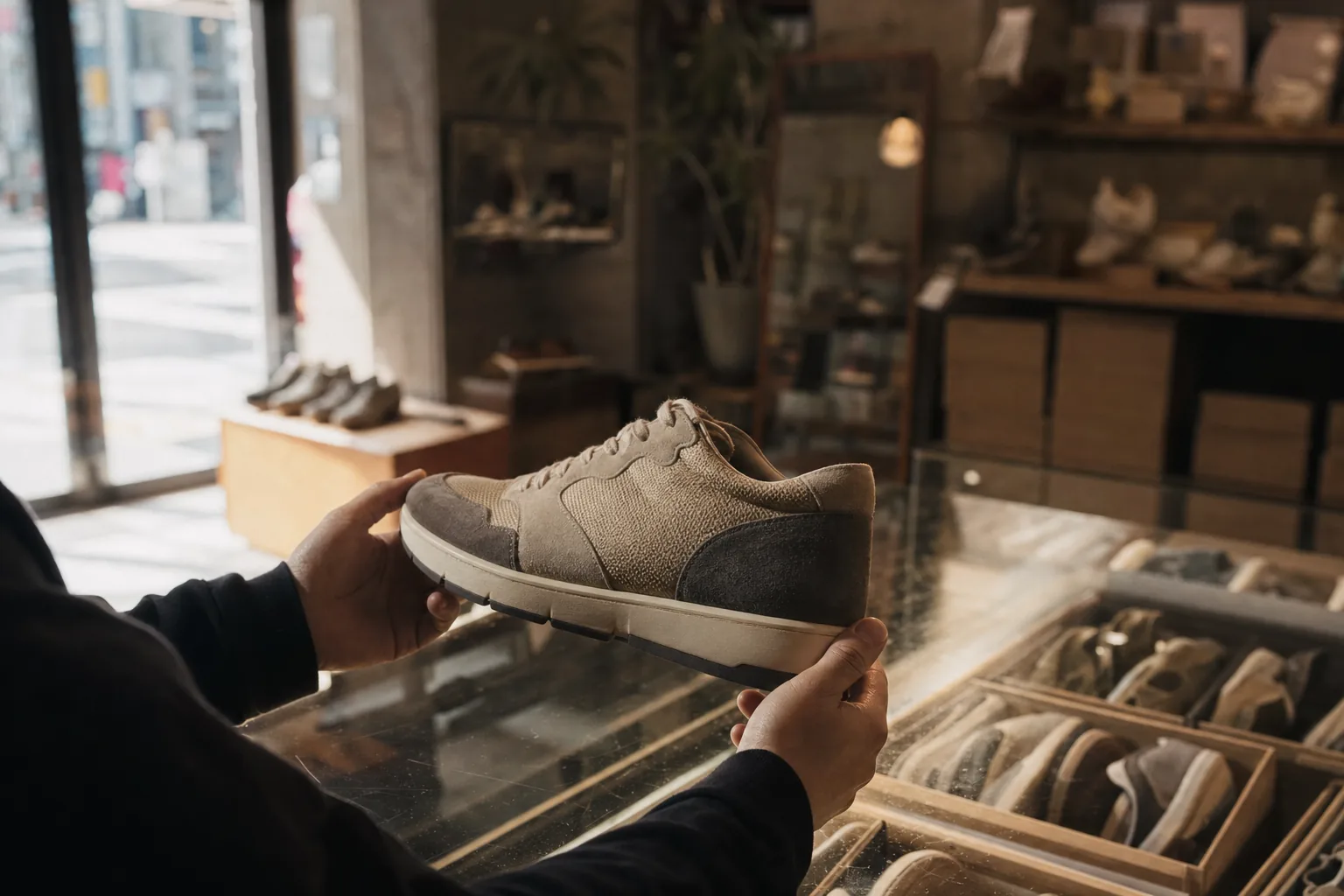
The Nike Dunk Low QS "Tokyo" (style code IB2259-001) dropped on April 29, 2025, exclusively in Japan through atmos and select domestic retailers, at a retail price of $130. No US SNKRS listing. No EU allocation. If you wanted a pair on release day, you needed to be standing in front of one of atmos's eight Tokyo locations, or logged into a Japanese retailer's site. That is the structure of a japan exclusive sneaker release — and it repeats, across brands, dozens of times each year.
What makes a sneaker release Japan-exclusive in the first place?
A Japan-exclusive drop is one where the brand deliberately limits official distribution to Japan's domestic retail network. The mechanism varies: Nike uses its Quickstrike (QS) designation to flag limited-geography releases; New Balance appends "JP" to a model number to signal a Japan-first or Japan-only origin; Converse Japan operates its own product division that develops silhouettes and colourways that never enter the global Converse pipeline. In each case, the decision is commercial and intentional — Japan is treated as a premium testbed where local retailers like atmos have built decades of credibility as collaborators and gatekeepers. The result is a two-tier market: pairs available everywhere, and pairs available only here.
The reason a US buyer cannot simply order these through official channels is that they do not exist in those channels. Nike.com (US) does not list QS Japan releases. New Balance's US site does not carry Japan-market colourways. The items are not region-locked by digital rights management — they are physically absent from US wholesale allocations. Understanding the friction Japanese sellers face when dealing with overseas buyers explains why even the secondary domestic market is hard to access without a local presence.
Which Nike and Jordan releases are Japan-only colourways?
Nike's relationship with Japan's sneaker market runs deep enough to have its own product imprint: CO.JP, which stands for Country of Japan. Releases under this label are produced explicitly for Japanese domestic distribution and do not receive global allocation.
The most referenced example in the archive is the Nike SB Dunk Low Pro "Tokyo" (style code 308268-111), released in January 2004 as part of the "White Dunk: Evolution of an Icon" exhibition. Only 202 pairs were sold via lottery in Tokyo, making it among the rarest SB Dunks ever produced. The muslin canvas upper carried no heel or tongue branding — a deliberate blank-canvas design that has since become one of the most referenced Japan-exclusive drops in sneaker history.
Twenty-one years later, Nike returned to the same concept. The Nike Dunk Low QS "Tokyo" (IB2259-001) was released in April 2025 exclusively in Japan, timed to the Dunk's 40th anniversary and atmos's 20th anniversary. The 2025 model uses ostrich leather overlays, pony hair Swooshes, tumbled leather, suede eyelets, and a ballistic mesh toe box — a premium material stack that sits well above a standard Dunk Low. The gum outsole and canvas heel tab directly reference the 2004 original. Retail: $130. US allocation: none.
The CO.JP designation also covers the Nike Dunk Low CO.JP "What The" (IB2051-400). The shoe originally debuted in 2017 as part of Nike's Japan-exclusive imprint and was re-released for Holiday 2024. The mismatched construction — left foot in "Atmos" Dunk colourway, right foot in "Atmos" Air Force 1 colourway — was released exclusively in Japan because, as atmos Creative Director Hirofumi Kojima has stated, the Japanese collector market is "perfectly aligned to Dunks."
On the Jordan side, the Air Jordan 6 "Slam Dunk" from 2014 paid tribute to the manga series' 31 volumes with imagery of protagonist Sakuragi. While not a definitive Japan-exclusive, it was released in very limited numbers outside Japan, with only a few select Asian stockists receiving pairs — making it functionally unavailable through US retail.
What Adidas and New Balance models never leave the Japanese market?
New Balance has the longest and most structurally significant Japan-exclusive history of any non-Japanese brand. The MT580, released in 1996, was the Japanese exclusive iteration of the Made in USA 585, developed specifically for Japan's domestic market. Its chunky silhouette found its first audience in Harajuku, where the more experimental streetwear crowd embraced it while the mainstream remained skeptical.
The deeper story is the New Balance 1300JP. The original 1300 was released in 1985 and gained a cult following particularly in Japan, where buyers wore it as a mark of status rather than performance. New Balance reissued the 1300JP in 1995 exclusively for the Japanese market, which is how the "JP" suffix entered the official style tag. The shoe was released in Japan every five years until 2010, when the quinquennial drops went global. The 2025 edition (style code U1300JP, Steel Blue/Grey-Eggshell) retailed at $330 and was produced at New Balance's Skowhegan, Maine factory. The 1300JP is now a global release — but its Japan-exclusive origins shaped its identity, and many of the colourways produced between 1995 and 2010 remain Japan-only in the secondary market.
The New Balance 1500 Made in Japan 35th Anniversary (model U1500JP) is a more recent example of a release that stayed domestic. New Balance launched the Made in Japan 1500 35th Anniversary exclusively in Japan, with an upper crafted from locally sourced nubuck and ultra-smooth leather. No US or EU allocation was announced.
Adidas's Japan-market exclusives tend to surface through domestic collaborations rather than standalone model codes. The brand has a long history of producing Japan-only colourways of the Superstar, Stan Smith, and NMD lines through partnerships with Japanese retailers, though these are typically announced through Japanese SNKRS equivalents and domestic streetwear press rather than global channels.
Which Japanese brands produce sneakers you simply cannot find in the US?
Several Japanese labels produce footwear that is structurally unavailable in the US — not because of allocation decisions by global brands, but because the brands themselves have no US distribution infrastructure. These appear in the broader landscape of Japanese luxury footwear but rarely get named in sneaker-specific coverage.
Converse Japan operates as a separate entity from Converse US, producing its own Made in Japan line and Japan-exclusive collaboration capsules that do not enter the global Converse product pipeline. The All Star Localize Hi — released in October 2025 — is available only in select stores in Tokyo and Osaka. The Tokyo edition features vivid orange referencing the Tokyo Tower; the Osaka edition uses blue drawn from the Dotonbori canal district. Both carry city-exclusive interior labeling. The All Star Yunomi Hi and All Star Fujinraijin Hi, released at Converse retailers across Japan on October 17, 2025, draw on traditional Japanese art motifs. None of these entered global distribution.
The Converse Made in Japan line — manufactured domestically with Japanese-sourced materials — runs continuously on Converse Japan's official site with new colourways dropping across 2024, 2025, and into 2026. The "MADE IN JAPAN" heel tag and Japan-flag-inspired insole are specific to this line. A US buyer cannot order from converse.co.jp with a US shipping address.
Mastermind Japan (also styled as mastermind WORLD) applies its skull branding and Vibram outsoles to Converse Chucks in Japan-exclusive configurations, using premium materials that do not appear in global Converse production. The collaboration sits at the intersection of luxury streetwear and sneaker culture, and the resulting pairs surface almost exclusively through Japanese domestic retail and Japan's domestic auction ecosystem.
Where in Tokyo do Japan-exclusive drops actually land?
The geography of Tokyo's sneaker retail is not uniform. Japan-exclusive releases concentrate in three districts, each with a distinct character, and understanding which stores operate in which area matters when sourcing a specific drop.
Harajuku is the origin point for much of Japan's sneaker culture. atmos, the retailer most closely associated with Nike CO.JP releases, has operated in Harajuku for decades. The store's creative director Hirofumi Kojima has co-developed Japan-exclusive Dunks and Air Max colourways that would not exist without atmos's relationship with Nike Japan. Drops here tend to be streetwear-adjacent and draw queues from across the city. The district also hosts independent boutiques carrying domestic-brand collaborations that never surface in global wholesale.
Shibuya carries a broader mix of international and domestic brands, with several multi-floor sneaker retailers stocking Japan-market colourways alongside global releases. The Shibuya Scramble area in particular concentrates retail density in a way that makes it a logical second stop after Harajuku for any serious sourcing trip. The full geography of Tokyo's luxury retail districts — including how Shibuya, Omotesando, and Ginza differ in product mix — is worth understanding before planning a sourcing itinerary.
Shinjuku hosts some of the largest sneaker floor space in Tokyo, including multi-brand retailers that stock Japan-only New Balance and Converse Made in Japan alongside global inventory. Shinjuku's department stores also carry limited-edition colourways that do not appear in the same brands' US department store accounts.
| District | Character | Key Japan-Exclusive Brands Present |
|---|---|---|
| Harajuku | Streetwear-first, collaboration-heavy | Nike CO.JP via atmos, Converse Japan, Mastermind Japan |
| Shibuya | Mixed international and domestic | New Balance Japan, Vans Japan collabs, Nike QS |
| Shinjuku | High-volume, department store adjacency | New Balance Made in Japan, Converse Made in Japan |
How do grading standards affect the condition of Japan-exclusive pairs on the secondary market?
Japan's pre-owned grading system uses an N/S/A/B/C scale. Grade N is new and unused; Grade S is like-new, possibly handled as a display piece but near-mint; Grade A is lightly used with slight signs of wear. The scale matters for sneakers because condition directly determines price, and Japan's graders apply standards that are stricter than those common in US resale.
Japanese graders use magnifying equipment to identify flaws invisible to the naked eye. A pinhead-sized mark that would never be mentioned in US listings drops an item from Grade A to Grade B in Japan. The practical consequence for a US buyer sourcing Japan-exclusive pairs on the secondary market is that a Japanese Grade B item is frequently in better physical condition than what a US seller would confidently list as "excellent." The grading system that governs bags and watches in Japan's pre-owned market applies equally to deadstock sneakers — the same discipline, the same documentation standards. For a deeper look at how this system works across categories, the full breakdown of Japan's pre-owned grading scale covers the N-to-C spectrum with the specificity a buyer needs before committing to a purchase.
For Japan-exclusive sneakers specifically, the most consequential grades are N and S. An N-grade pair has never been worn and retains its original box and lace bag. An S-grade pair may have been tried on but shows no wear on the sole or upper. Both grades command significant premiums over A-grade on Japan's domestic auction sites, and the gap widens further for grail-tier pairs like the SB Dunk Low "Tokyo" (308268-111).
What price levels should a US buyer expect for Japan-only releases?
Retail prices for Japan-exclusive drops are set in yen and tend to cluster in predictable bands. Standard Nike QS Japan releases — like the Dunk Low QS "Tokyo" (IB2259-001) — retail at around ¥20,000 (approximately $130 at mid-2025 exchange rates). Converse Japan-exclusive All Star models retail at around ¥9,900 (approximately $67). New Balance Made in Japan colourways typically sit between ¥20,000 and ¥35,000 at domestic retail depending on material specification.
Secondary market premiums on top of those retail prices vary by model and condition. For current-season Japan-exclusive Dunks, secondary prices on Japan's domestic auction ecosystem typically run 1.5–3x retail in the weeks after a drop, settling lower as supply finds equilibrium. For older CO.JP releases and grail-tier pairs, the premium is structural rather than temporary — the original Nike SB Dunk Low "Tokyo" (308268-111) from 2004, which retailed at $60, now trades at multiples of that figure on international platforms when pairs surface at all.
A US buyer should budget for the item price at secondary market rates plus the cost of sourcing through a service with Tokyo access. The total landed cost for a current-season Japan-exclusive Nike QS in N-grade condition will typically exceed US domestic resale prices for the same model — because US resale platforms do not carry Japan-exclusive colourways in any meaningful volume. That is the structural gap this article describes.
Why can't a US buyer just find these on a domestic resale platform?
The short answer: Japan-exclusive colourways were never imported through official channels, so they are not present in domestic US resale inventory in meaningful numbers. The large US resale platforms aggregate supply from US buyers — which means they reflect what was sold in the US. A Japan-exclusive Nike QS that never received a US SNKRS listing and was never stocked by a US retailer does not have a US supply pool to draw from.
What does appear on US resale platforms is a thin trickle of pairs brought back by travelers or forwarded by intermediaries — typically in limited sizes, at significant premiums, and with no condition documentation that maps to Japan's grading standards. Authenticating a Japan-exclusive pair sourced through a US resale platform is also complicated by the fact that the model may not appear in the platform's authentication database if it was never officially sold in the US.
The more reliable path is to source directly from Japan's domestic market — its auction platforms, partner shops, and retail network — using a service with physical presence in Tokyo. That is precisely the gap FindLuxuryJapan was built to close. A buyer describes the pair they want, including style code and condition grade, and the Tokyo team locates it, evaluates it, and ships it globally with tracking and insurance. The sourcing fee is 10% of the item price, with a minimum of ¥5,000, quoted before the buyer approves anything. Rare or collectible pairs — including older CO.JP Dunks — can take several weeks to months to source, because the team waits for the right match rather than buying the first available pair. The same sourcing model that works for pre-owned luxury goods from Japan's secondary market applies directly to Japan-exclusive sneakers.