· 10 min read
Why Japanese Watch Listings Look Worse Than They Are
Japanese sellers grade pre-owned watches more conservatively than any Western reseller would for the same physical piece — and understanding why turns a confusing listing into a clear advantage.
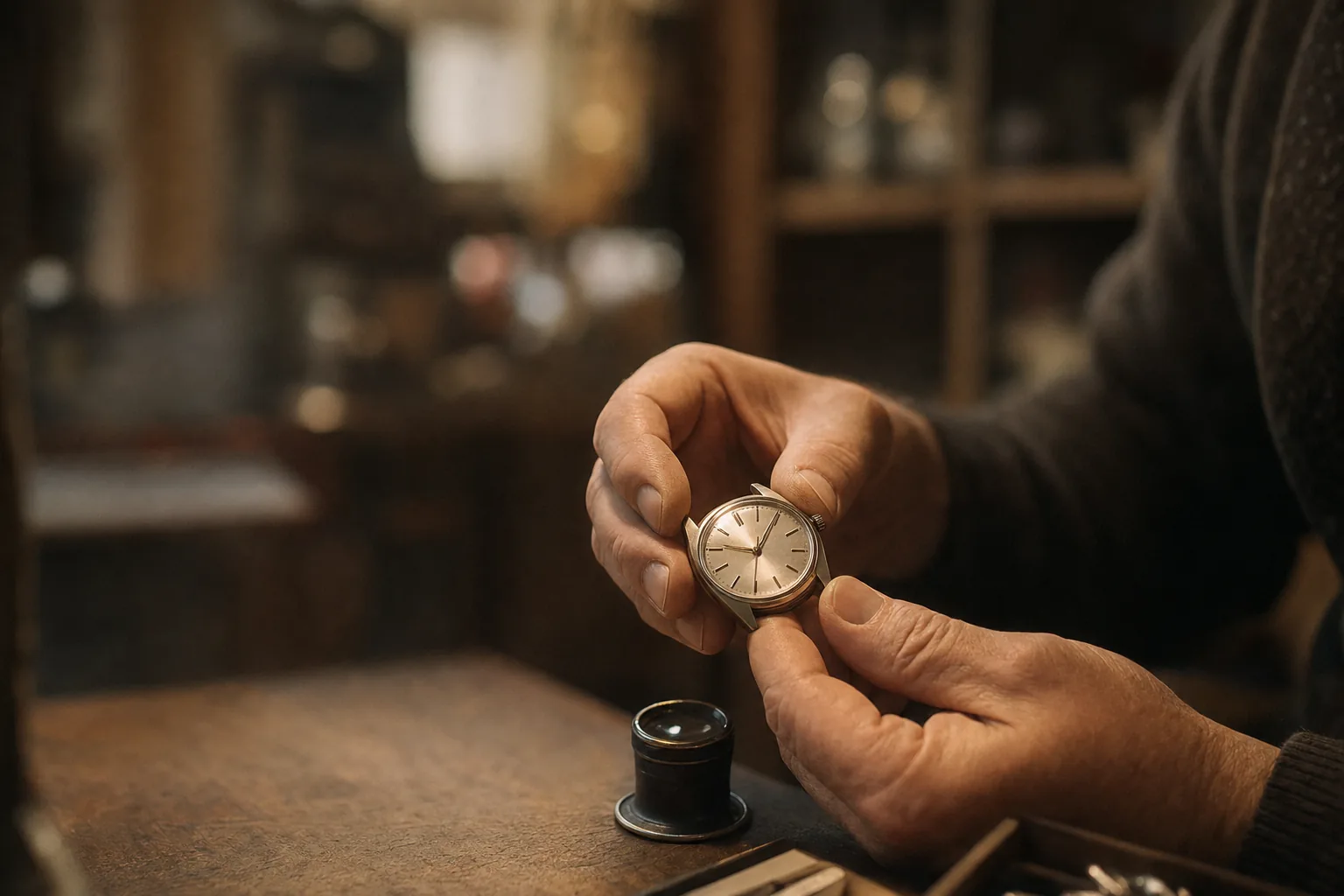
A Japanese watch listing graded "B" can stop an overseas buyer cold. The word suggests mediocrity — something worn hard, perhaps not worth shipping. The problem is that "B" in Tokyo and "B" in New York are not the same thing. They are not even close.
Japanese condition grading is structured around a single operating principle: never overstate. The result is a market where the labels consistently underperform the physical items they describe, and where an informed buyer can extract real value simply by knowing how to read the gap.
Why do Japanese watch sellers grade so conservatively?
The short answer is reputation. Japan's pre-owned grading system runs on trust between sellers and a domestic buyer base whose expectations are, as one experienced collector on WatchUSeek put it, "sky-high and near perfection." A seller who overstates condition loses that trust permanently. A seller who understates it earns a reputation for reliability.
That commercial incentive is reinforced by a legal one. Every business that buys secondhand goods for resale in Japan must hold a Kobutsusho Kyoka (古物商許可) — a police-issued secondhand dealer license that requires identity verification of sellers, transaction records subject to police inspection, and ongoing compliance with the Secondhand Articles Dealer Act. Operating without one is punishable by imprisonment of up to three years or a fine of up to ¥1 million. The institutional weight behind each transaction pushes sellers toward caution, not optimism.
The cultural layer runs deeper still. A watch that has been owned carefully for five years arrives at a Tokyo resale counter in materially better shape than a comparably aged piece entering Western resale channels. The grader then applies conservative standards to an already-excellent item, compressing the grade further downward.
What does a Japanese 'B-rank' watch actually look like in person?
Better than the label suggests — consistently. Collectors on WatchUSeek who have bought from Japanese sellers repeatedly note that "the watch is in better condition than described." One buyer who purchased a Seiko SPB157 and an Omega Seamaster from Japanese dealers on Chrono24 reported that both were "in far better shape than the listings suggested" and described both as "pristine."
That pattern holds because of what triggers a B-grade in Japan. Japanese graders use magnifying equipment to identify flaws invisible to the naked eye — a pinhead-sized mark that would never be mentioned in US listings drops an item from Grade A to Grade B. A hairline scratch visible only under a loupe on a lug face, a faint scuff on the clasp underside, a barely perceptible mark on the case back — any of these will move a watch down a grade. The physical watch is still excellent. The grade just says it isn't perfect.
The Japanese B-rank maps roughly to what Western resellers confidently call "Excellent" or "Very Good." A B-rank watch in Japan typically shows light regular wear consistent with careful use — the kind of piece a Western seller would photograph under flattering light and list as near-mint.
How does Japanese grading conservatism compare to Western resellers?
The table below maps the Japanese letter scale against the vocabulary used by major Western platforms and dealers. The gap is structural, not occasional.
| Japanese Grade | Japanese Standard | Typical Western Label | Western Grading Reality |
|---|---|---|---|
| S / N | Unused, with tags and packaging | "New with Tags" / "Deadstock" | Consistently applied |
| SA | Used once or twice, no visible wear | "Excellent" (often misapplied) | Inconsistently applied |
| A | Light use, marks only under close inspection | "Very Good" (inconsistently applied) | Variable by platform |
| AB | Light-to-moderate use with some wear | "Good" (variable standards) | Often overstated |
| B | Visible wear, clearly used | "Fair" or "Good" (varies by platform) | Frequently overstated |
| C / D | Heavy wear or damage | "Poor" or "As-Is" | Rarely listed at all |
The Western market has no equivalent standardization. There is no internationally recognized watch condition grading standard — dealers, auction houses, marketplaces, and independent watchmakers often use their own grading criteria, which means identical watches may receive different grades. "Excellent" on one platform does not mean the same as "Excellent" on another. A watch marked "Rank A" in Tokyo would likely be sold as "Mint" in New York or Toronto.
Japan's system, by contrast, is consistent enough across licensed resale chains that the same grade at one store and another describes roughly the same condition. That cross-store reliability is rare globally and makes Japanese grades genuinely informative for remote buyers.
What flaws trigger a grade drop in Japan that wouldn't matter elsewhere?
The specific triggers are worth understanding because they reveal how far the conservatism extends. Japanese graders inspect watches under loupes and strong light as standard practice. Flaws that would simply not appear in a Western listing — because the seller never looked for them — are documented and priced into the grade in Japan.
Common grade-drop triggers that Western sellers routinely ignore:
- Micro-scratches on lugs — visible under magnification but not to the naked eye in normal light
- Clasp underside wear — the contact point between clasp and wrist, rarely photographed by Western sellers
- Hairline case back marks — from watch tools during previous service or battery changes
- Minimal bracelet stretch — even a link or two of perceptible play moves a grade
- Crown and pusher wear — light finishing wear on the crown that has no functional consequence
- Crystal micro-scuffs — polishable marks that a Western seller would polish out and not mention
Age provides no excuse in this system. A twenty-year-old piece must meet the same standards as one from last year to achieve the same grade. This is why Japan's watch inspection process catches details that most Western buyers would never think to check — and why the grade reflects a level of scrutiny that simply has no parallel in Western resale.
Japanese listings also disclose specific flaws in writing, separate from the grade itself. A tag or listing noting 角スレあり (corner scuffing present) or 風防スレ (crystal scuffing) is not a warning to avoid the piece — it is evidence that the grader found something and disclosed it rather than concealing it. That specificity is a feature, not a problem.
Is a lower Japanese grade still better than a higher Western grade?
For most grades, yes — and the collector community has recognized this pattern for years. Japanese dealers rate the condition of merchandise as if they were selling to a Japanese buyer, and their evaluations are so much more critical than people from other cultures. The practical consequence is that a Japanese B-grade watch and a Western "Excellent" watch can be physically indistinguishable — or the Japanese piece can be cleaner.
The conservatism also applies to what the Japanese market produces in the first place. It is common to find 20-year-old watches in Japan that look like they left the factory yesterday, complete with their original, unpolished chamfers. The starting condition of the inventory entering the Japanese resale market is higher than the starting condition of inventory entering Western resale. The conservative grading is then applied on top of that already-better baseline.
The one caveat: this advantage applies most clearly to mainstream and mid-tier references. For trophy pieces — discontinued sport references, rare Grand Seiko spring drives, Patek complications — the Japanese domestic collector market is sophisticated enough that pricing already reflects the condition premium. The grade gap matters most where Western buyers are comparing a Japanese B to a Western "Very Good" on a broadly available reference.
If you're sourcing a specific Japanese pre-owned watch reference, FindLuxuryJapan's Tokyo team evaluates condition against the Japanese standard before any purchase is approved.What role does seller reputation play in Japanese grading culture?
In Japan's domestic market, reputation is the primary competitive asset for a resale dealer — more than price, more than inventory breadth. Japanese dealers provide highly detailed descriptions and images, allowing buyers to make informed decisions from afar — and buyers can expect full disclosure of a watch's condition, service history, and any modifications.
That disclosure culture is self-reinforcing. A dealer who understates condition builds a reputation for pleasant surprises. A dealer who overstates — even once, even slightly — risks the kind of negative feedback that travels quickly in Japan's collector community. The asymmetry of consequences pushes every rational seller toward conservatism.
The kobutsusho licensing system amplifies this. Licensed dealers maintain transaction records subject to police inspection. Their URL is registered with the police. Their business identity is publicly verifiable. In that environment, the cost of a single dishonest transaction extends far beyond a bad review — it touches the legal basis of the business itself. Japanese luxury listings can look opaque from the outside, but the institutional framework behind them is more rigorous than anything a Western reseller faces.
The large chain resellers operate multiple floors in major cities, with inventory organized by brand and displayed in locked cases individually tagged with condition grade, original retail price, and current asking price. Their grading is consistent because their staff are trained to a shared internal standard, and because a chain's reputation rests on that consistency being maintained across every location.
Which condition signals matter most when reading a Japanese watch listing?
The letter grade is the starting point, not the whole picture. Japanese listings typically layer additional information on top of the grade, and reading that layer is where the real evaluation happens.
The grade itself: Use the table above to translate. A Japanese SA or A is exceptional by any global standard. A B is solid and likely cleaner than a Western "Very Good."
Written condition notes: Any Japanese text describing specific flaws is a disclosure, not a disqualifier. A listing that says 文字盤極美 (dial in excellent condition) alongside a B-grade body tells you the grade was pulled down by case or bracelet wear, not the dial. That is useful information.
Original accessories: Japanese listings note whether the original box, papers, warranty card, and receipt are present — item by item. A complete set commands a premium and provides authentication value. Missing accessories are always disclosed rather than omitted.
Service history: Many Japanese dealers note whether a watch has been serviced, and by whom. A recent service from an authorized service center is a meaningful positive that Western listings rarely document at all.
Polishing disclosure: Japanese sellers distinguish between polished and unpolished cases — a distinction that matters significantly for vintage pieces and for buyers who prioritize original finishing. A listing that says 無研磨 (unpolished) is confirming that the case geometry is original. This level of detail is essentially absent from Western resale listings at the same price point.
The same conservative grading principle that applies to watches runs across Japan's entire pre-owned market — the culture of careful ownership and honest disclosure is not category-specific.
Why does conservative grading work in Japan's favour for serious buyers?
The conservatism creates a systematic mispricing that runs in the buyer's direction. Because Japanese sellers grade down relative to Western norms, and because Japanese pricing is based on those conservative grades, the watch that arrives is consistently better than the price implied. That gap is real, repeatable, and exploitable by anyone who understands it.
The alternative — Western grading inflation — works the other way. Condition terms such as "unworn," "mint," "excellent," and "very good" do not always mean exactly the same thing from one seller to another. A watch listed as "Excellent" by a Western reseller carries no institutional guarantee that the label means anything specific. The buyer is trusting the seller's self-interest, which points toward optimism rather than accuracy.
Japan's system points in the opposite direction. The seller's self-interest — reputation, licensing, repeat business in a tight community — points toward accuracy and conservatism. The buyer benefits from that alignment every time a package arrives in better condition than the listing suggested.
For buyers who want access to this market without navigating Japanese-language listings, condition disclosures in kanji, and domestic-only auction channels, FindLuxuryJapan's Tokyo-based sourcing team evaluates each piece against the Japanese grading standard before approval — so the grade you see is the grade you can trust.