· 10 min read
Japanese Luxury Watches, Pens, and Eyewear: The Unsung Masters of Precision Craftsmanship
Three categories — watches, fountain pens, and eyewear — where Japanese makers have achieved world-class precision that remains largely invisible to Western buyers, grounded in specific references, founding dates, and the techniques behind them.
The Grand Seiko SBGA011 was never sold outside Japan. It launched in 2005, sat in Japanese boutiques for five years before international distribution began in 2010, and by then a community of watch enthusiasts had already named it the Snowflake — a nickname Seiko had never used itself. That gap between what exists in the Japanese market and what reaches the rest of the world is not an accident. It is structural, and it applies equally to fountain pens and eyewear. What follows is a precise account of what you cannot get at home, and why.
What makes Japanese precision craftsmanship different from European luxury?
European luxury houses built their reputations on heritage marketing and controlled scarcity. Japanese makers built theirs on the tolerance stack — the measurable gap between what a specification calls for and what the finished object actually delivers. Grand Seiko's Zaratsu hand-polishing produces flat surfaces accurate to the point where light either reflects or does not; there is no middle state. Sabae's eyewear workshops divide a single frame into around 200 distinct production processes, each handled by a specialist who does nothing else. The result is not artisanal in the European sense of one craftsman, one object — it is a networked precision system that produces objects no single workshop could achieve alone. The Western luxury industry has no direct equivalent of either model.
The deeper difference is distribution strategy. Many of the finest Japanese objects are produced in quantities calibrated for the domestic market, with export an afterthought or a deliberate omission. That is why sourcing them requires either a trip to Japan or a partner with access to the Japanese market — a point worth keeping in mind as you read through the specific pieces below. If you are already tracking items across these three categories, FindLuxuryJapan's Tokyo-based sourcing team can locate and evaluate specific references on your behalf.
Grand Seiko: which references and dials are only found in the Japanese domestic market?
Grand Seiko maintains two tiers of exclusivity below its publicly announced global releases: Japan-only catalogue models and studio-exclusive pieces sold only at the watchmaking facilities themselves. The SBGW235 is a clear example of the first tier — a companion to the internationally distributed SBGW231 (37.3mm, caliber 9S64, manual-wind) that swaps the silver dial for cream, adds a traditionally blued seconds hand, and fits a Gay Frères-style metal bracelet. It was listed only on the Japanese version of the Grand Seiko website and has never had a meaningful international retail presence.
The SBGH283 is the clearest example of the second tier. It is exclusive to Studio Shizukuishi in Iwate Prefecture — the facility designed by architect Kengo Kuma that houses all of Grand Seiko's 9S mechanical watchmaking. You can only buy the SBGH283 new by visiting the studio in person. It does not appear in international boutiques, is not available through Grand Seiko's global retail network, and surfaces on the secondary market almost exclusively from Japanese sellers. Limited-edition releases such as the SBGW324, SLGA034, SLGA037, and SLGW008 — each produced in runs of between 20 and 100 pieces — are similarly Japan-only, and some sold out at their Tokyo launch event before any international coverage appeared.
The pattern across all of these is the same: Grand Seiko uses the Japanese domestic market as the primary venue for its most restrained, most technically specific work, while the global market receives the brand's more expressive seasonal dials. Collectors who want the former need access to Japan. For a closer look at how Grand Seiko fits into the broader landscape of Japanese precision watches, the companion overview of Japanese luxury watches covers the category in more depth.
What is the Grand Seiko Snowflake, and when was it actually introduced?
The Snowflake — reference SBGA011 — was introduced to the Japanese market in 2005 and globally in 2010. The nickname "Snowflake" was given to it by collectors, not by Grand Seiko. The dial is a stamped brass plate with a silver-plated finish engineered to replicate the texture of fresh snow on the Hotaka mountains surrounding Seiko's Shinshu Watch Studio in Nagano Prefecture. The movement is the Spring Drive caliber 9R65, accurate to ±1 second per day.
In 2017, when Grand Seiko became an independently operating brand, the SBGA011 was succeeded by the SBGA211. The design is essentially identical; the change was branding — the dual "Seiko / Grand Seiko" dial was replaced by a single Grand Seiko logo. Some collectors prefer the SBGA011 specifically for its dual branding, which reads as a more balanced dial composition. The SBGA011 is now discontinued, and pre-owned examples appear primarily through Japanese auction platforms and specialist dealers.
| Reference | Year | Movement | Case | Status |
|---|---|---|---|---|
| SBGA011 | 2005 (Japan); 2010 (international) | Spring Drive 9R65 | 41mm titanium | Discontinued; pre-owned only |
| SBGA211 | 2017 | Spring Drive 9R65 | 41mm titanium | Current global release |
| SBGW231 | 2017 | Manual 9S64 | 37.3mm steel | Current global release |
| SBGW235 | 2017 | Manual 9S64 | 37.3mm steel | Japan domestic only |
| SBGH283 | Current | Mechanical 9S | Studio Shizukuishi exclusive | Studio-exclusive only |
Namiki and Pilot: what is the real history behind Japan's most celebrated maki-e pens?
Namiki Manufacturing Company was founded in 1918 by Ryosuke Namiki — a mechanical engineering professor at Tokyo Nautical College — and his partner Masao Wada. The Namiki brand as a distinct pen line was launched in 1925, the same year the company patented its urushi lacquering process for fountain pens and began applying maki-e decoration. The company renamed itself Pilot Pen Co., Ltd. in 1938; Namiki survived as the brand name for the maki-e line. In 1930, Pilot signed a distribution contract with Alfred Dunhill Ltd., giving rise to the Dunhill-Namiki fountain pen and opening the European market to Japanese lacquer art for the first time.
Today, Namiki maki-e pens are made at Pilot's Hiratsuka plant in Kanagawa Prefecture, where around 20 specialists work exclusively on maki-e decoration. The technique involves applying layers of urushi lacquer to an ebonite barrel, then dusting gold, silver, and other metallic powders into the wet lacquer using fine brushes. The Namiki Emperor — the largest production format — takes months to complete and is priced accordingly. It is available internationally through specialist retailers, but the most elaborate commissions and the rarest decorated pieces remain concentrated in the Japanese market, where the collector base for urushi work is deepest.
Sailor, Platinum, and Nakaya: what do Japan's other master pen makers offer that you cannot buy at home?
Sailor was founded in 1911 by Kyugoro Sakata in Kure, Hiroshima — a naval port city whose engineering culture shaped the company's approach to precision nib work. Sakata had been introduced to the fountain pen by a visiting British sailor, which gave the company its name. Sailor's headquarters returned to Kure in April 2021, where a newly reconstructed factory completed in autumn 2022 now houses both manufacturing and an archive. The factory produces Sailor's gold nibs by melting gold, silver, and copper at 1,000°C to create the base alloy — a process that has not changed in its essentials since the company's founding.
What does not travel well is Sailor's domestic-only nib work. The Naginata-Togi nib — ground by a single specialist to produce a line that varies from hairline to broad depending on writing angle — is available in Japan in configurations and grinds that do not appear in the international catalogue. Sailor's Profit 21 in Kaga maki-e, produced in collaboration with Kanazawa lacquer artists, is sold almost exclusively through Japanese stationery shops and is rarely seen at international retailers.
Nakaya Fountain Pen, founded in 1999 by former Platinum Pen artisans, operates at the other end of the volume spectrum. Each pen is individually handcrafted — the ebonite body shaped by hand, then coated in multiple layers of urushi lacquer using techniques including tame-nuri, takamaki-e, raden (mother-of-pearl inlay), and chinkin (engraved lacquer). Nakaya accepts custom orders through its website, but the most elaborate maki-e commissions are effectively only accessible through the Japanese market, where the waiting lists are managed and the specialist dealers who handle bespoke requests are based.
Platinum's #3776 Century is the brand's best-known international model, but the company's Izumo urushi line — named for the Shimane Prefecture lacquer tradition — is stocked in depth only in Japan. If you are building a collection across these pen makers, the guide to Japan's serious luxury shopping districts maps the stationery and pen retailers in Tokyo and beyond where these pieces actually appear on shelves.
Japanese eyewear from Sabae: why do opticians and collectors seek out frames made in this single city?
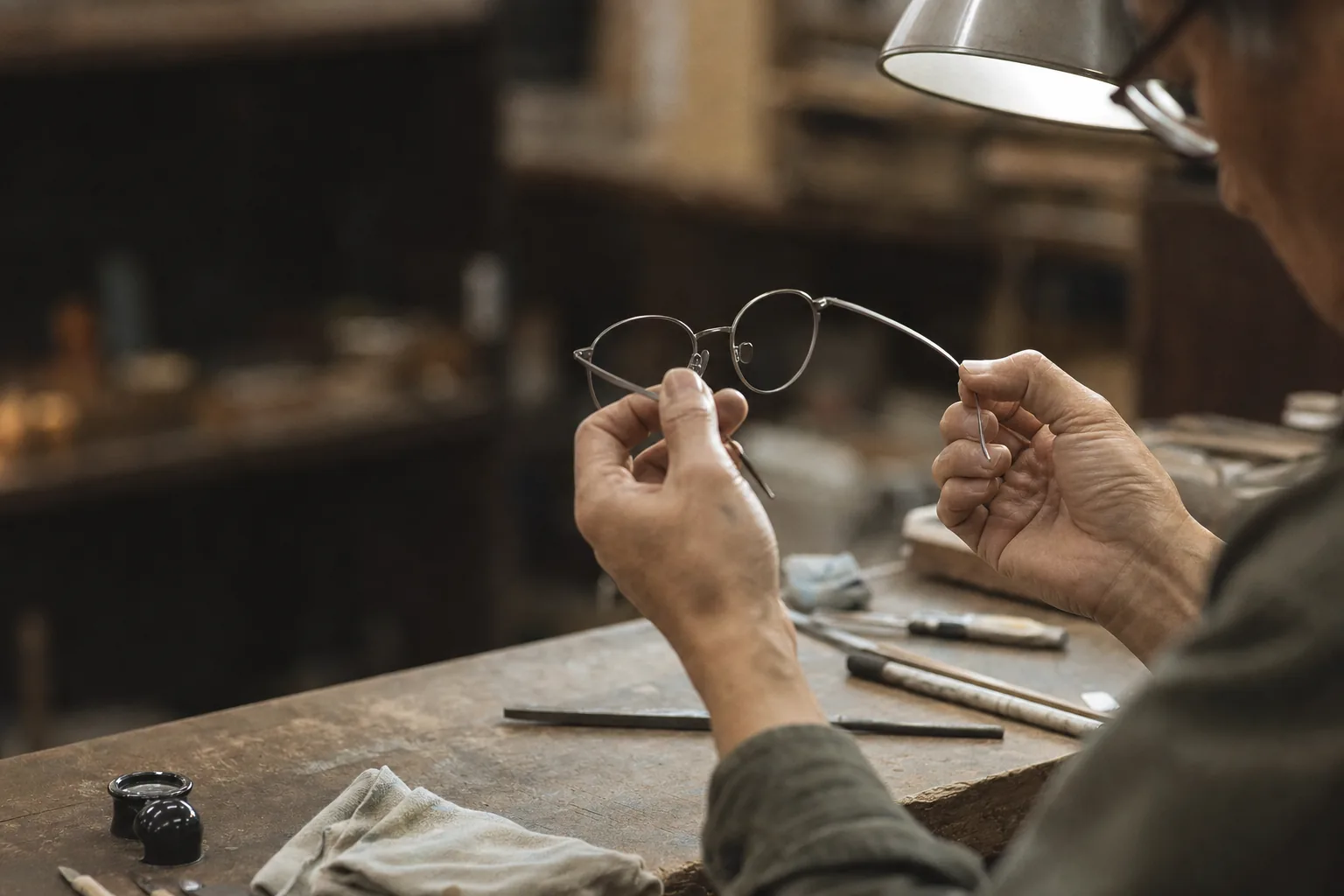
Sabae, a city of around 68,000 people in Fukui Prefecture on Japan's main Honshu island, produces approximately 96% of all eyeglass frames manufactured in Japan. The industry started in 1905 when skilled eyeglass artisans were brought to the city to give farmers a winter trade. Over 120 years, that side business became a precision manufacturing cluster of more than 170 specialist companies, each responsible for specific stages of a production process that involves around 200 distinct steps per frame.
The structural reason Sabae frames are sought by opticians is the division of labor. A single pair of frames passes through multiple independent workshops — one for cutting, one for polishing, one for hinge fitting, one for nose pad attachment — each staffed by craftspeople who spend entire careers on a single operation. In the 1980s, craftsmen working in Sabae were the first in the world to develop the technology for producing frames using titanium — a material that is lighter and less likely to cause metal allergies than conventional alloys, and one that has since become standard across the global premium eyewear market. Major European luxury brands and American eyewear companies outsource frame production to Sabae workshops, meaning the frames bearing those labels are often made in the same facilities as the Japanese-branded pieces — but without the Japanese name on them.
The brands that are hardest to find outside Japan include smaller Sabae workshops that sell direct or through Japanese optical shops: makers like Masunaga, whose frames have been produced in Fukui since 1905 and whose domestic catalogue runs significantly deeper than what reaches international stockists. The Japanese luxury category rankings place eyewear among the most undervalued categories for international buyers precisely because so little of the domestic range is exported.
Which specific pieces across these three categories are hardest to find outside Japan?
The honest answer is that difficulty correlates with specificity. The more precisely you define what you want — a particular reference, a particular nib grind, a particular lacquer finish from a specific atelier — the more likely it is that the piece exists only in the Japanese market. The pieces below represent the clearest cases across all three categories.
Watches: The SBGH283 (Grand Seiko, Studio Shizukuishi-exclusive) and the SBGW235 (Japan domestic catalogue only) are the two clearest examples of watches that require Japanese market access to buy new. Limited editions produced in runs under 100 pieces for the domestic market — such as the SBGW324 — typically sell out before any international coverage appears.
Pens: The Namiki Emperor in elaborate maki-e (months of production, sold through a small number of specialist retailers), Nakaya's custom maki-e commissions (managed through Japanese dealers and the company's own artisans), and Sailor's Naginata-Togi nib in domestic-only configurations. Sailor's Kaga maki-e collaborations are a specific case where the distribution is almost entirely domestic.
Eyewear: Sabae-made frames from workshops that do not export directly — including bespoke and semi-bespoke frames produced for Japanese optical shops — and the domestic-only depth of catalogues from makers like Masunaga, whose international presence represents a fraction of what is available in Japan. The premium here is not just the object but the fitting: Sabae's adjustment tolerances are calibrated for the Japanese market's expectation of a precise, personalized fit that most international opticians cannot replicate.
The common thread is that none of these pieces are impossible to acquire from outside Japan — they simply require either a visit or a sourcing partner with access to the Japanese market. For buyers who already know what they are looking for, FindLuxuryJapan's Tokyo team locates specific references across watches, pens, and eyewear, evaluates condition and authenticity, and ships globally. The process starts with a description or reference number; the team responds within two business days with matched options. A request that cannot be fulfilled costs nothing.
For buyers who want to understand the broader pre-owned market before committing to a specific piece, the guide to authenticating pre-owned Japanese luxury covers what to look for across categories.