· 11 min read
Watch Authentication: What Japan's Inspectors Check
Japanese watch appraisers run a layered inspection — movement serials, dial originality, case geometry, crown function, and purchase documentation — that catches fakes and franken-watches long before they reach the sales floor.
The SBGW231 was never sold outside Japan. Neither were dozens of Grand Seiko and Credor references that surface regularly in Tokyo's pre-owned market. But the reason serious buyers source watches from Japan isn't just inventory — it's that the inspection protocol standing between a watch and its grade tag is materially different from what most Western resellers apply. Understanding what that protocol covers, and why it catches things a generic certificate of authenticity misses, is the point of this piece.
What does a Japanese watch appraiser actually look at?
A certified Japanese appraiser treats the watch as five separate objects: the movement, the case, the dial and hands, the crown and pushers, and the documentation. Each layer is assessed independently before a grade is assigned. Japan's pre-owned grading vocabulary — N (brand new), NS (unworn), S (excellent), SA (polished), A (very good), AB (good) — exists precisely because the inspection is granular enough to distinguish between, say, a watch with original case geometry and one that has been refinished for resale. Gallery Rare's published condition chart illustrates how Japanese resellers separate "S" (excellent, no noticeable scuffs or dents) from "SA" (polished for resale), a distinction most Western grading systems collapse into a single "excellent" tier.
The separation matters because condition grading is not a universal legal standard — it is industry shorthand, and one seller's "excellent" may be another's "very good," especially when the watch has been polished, serviced with replacement parts, or worn more heavily than photos suggest. Japan's graded system forces the appraiser to answer specific questions rather than assign a vibe.
How do inspectors verify a movement is original and untampered?
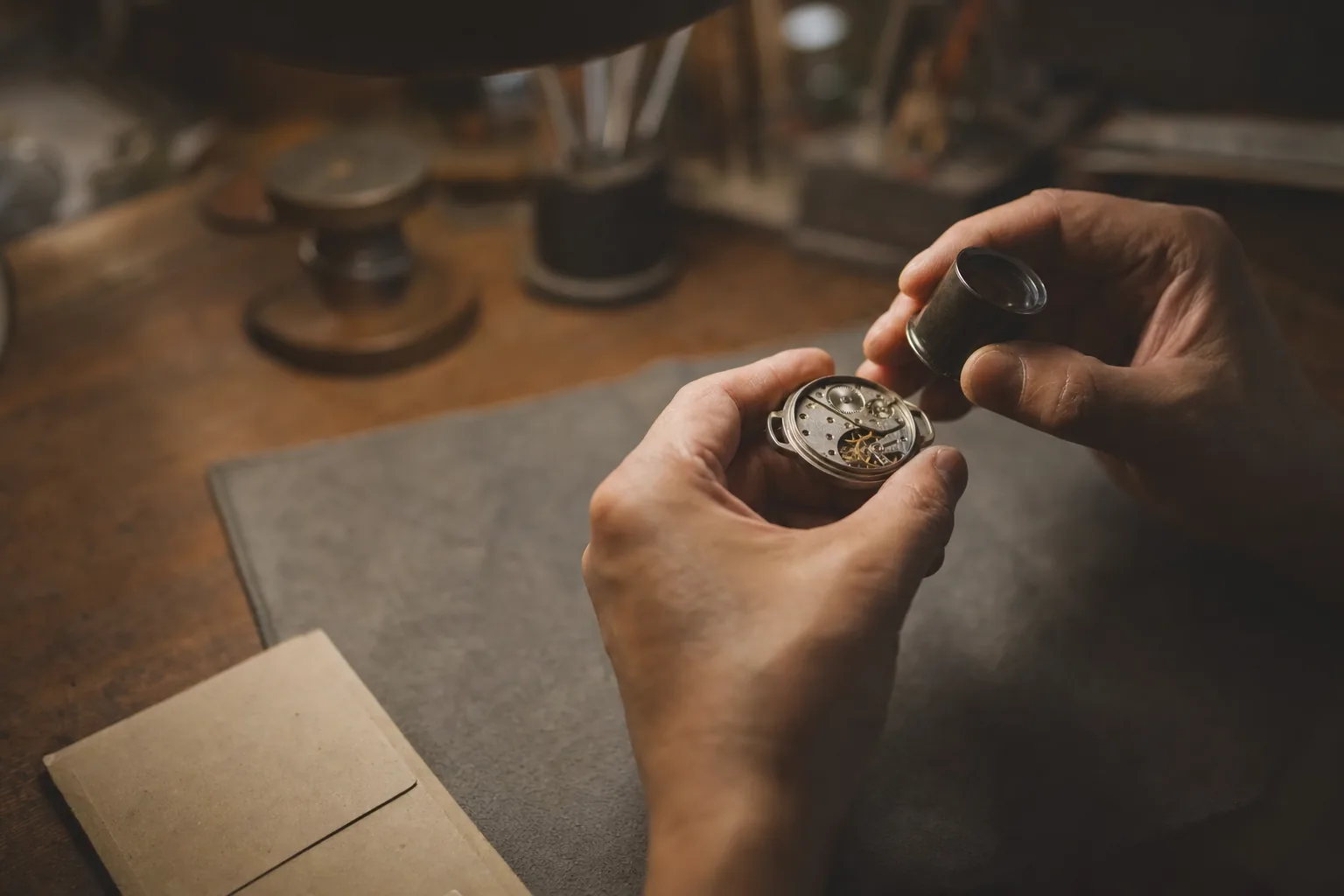
Opening the case back is non-negotiable. The appraiser reads the caliber stamp on the movement plate, confirms it matches the reference's documented specification, and cross-checks the movement serial number against the case serial. On authentic pieces, serial number engravings are laser-etched with precise, hair-thin lines; counterfeits often show slightly blurred or uneven characters under magnification.
Beyond the serial, the appraiser examines finishing. Removing the caseback reveals the movement's full identity: caliber stamps, serial numbers, finishing, production codes, and modification marks. A correct period movement matches the case era, has factory finishing consistent with the production year, and shows wear patterns appropriate to the watch's age. Service marks scratched or engraved into the movement plate document the watch's service history — a heavily-marked movement indicates frequent maintenance, which correlates with higher likelihood of part replacement during those services. The appraiser also puts the movement on a timegrapher: rate deviation, amplitude, and beat error are recorded, not estimated.
Japanese appraisers run this check on every piece. Every watch undergoes rigorous inspection before it reaches the customer, and buyers can expect full disclosure of a watch's condition, service history, and any modifications. That disclosure obligation is what makes the movement check meaningful — there is nowhere to hide a replaced rotor or a non-factory mainspring.
If you want a watch sourced from Japan's pre-owned market with this level of inspection already applied, FindLuxuryJapan evaluates each piece using pricing, condition, and authenticity models before securing it.Why does dial originality matter more than most buyers realize?
A replaced or refinished dial is the most common value-killer on pre-owned watches, and it is also the easiest defect to miss in photographs. Detection requires comparing typography, minute track design, lume color, and printing characteristics against documented period-correct specifications. Japanese appraisers examine dials under magnification specifically for these markers: the font weight of the brand name, the exact shade of the lume on the hour markers, the spacing of the minute track, and whether the applied indices sit flush with the dial surface.
A redial — a dial that has been reprinted or replaced to hide damage — often passes a casual visual check because the overall layout looks correct. What it cannot replicate is period-correct aging. A franken-watch with replacement components shows patina inconsistency: bright white lume on hands paired with cream-colored dial markers, or matched dial and hand patina paired with a fresh-looking bezel pearl. Examining patina consistency under varied lighting is one of the most reliable detection methods because it cannot be effectively replicated. The appraiser checks dial against hands against bezel insert as a system, not as individual parts.
The market rewards originality: an unpolished case with sharp lugs, an original (non-refinished) dial, and a documented service history all command premiums. Conversely, heavy wear, a redial, aftermarket parts, or an over-polished case can discount a watch 10–30% or more versus a clean example of the same reference. That price gap is exactly what a Japanese grade is designed to communicate — and why the dial check is a formal step rather than an afterthought.
What tells a refinished case from an unpolished one?
Lug geometry is the primary indicator. For Grand Seiko, pay particular attention to broad polished planes, sharp transitions between finishes, lug edges, dial texture, indices, hands, case back, bracelet links, clasp, crown, crystal, and evidence of refinishing or replaced components. An unpolished case retains the factory geometry — sharp bevels, crisp transitions between brushed and polished surfaces, lug edges that hold a defined profile. A refinished case rounds all of those over.
Multiple aggressive polishes round sharp edges, soften lug profiles, blur engraved markings, and reduce overall case dimensions. Some cases have been so heavily refinished that engraved reference numbers and serial numbers are nearly illegible — a major red flag indicating either heavy use or deliberate obfuscation of the watch's identity. Japanese appraisers inspect the case under raking light, which reveals surface geometry that flat overhead lighting conceals. Strong display lighting can hide fine scratches or exaggerate polished surfaces — which is why inspection happens in neutral light, not under the shop's display LEDs.
The SA grade in Japan's system exists specifically to name this condition honestly. A watch graded SA has been polished for resale. It is not presented as equivalent to an unpolished S-grade piece, and the price reflects the difference. Most Western grading systems have no equivalent distinction — both would appear as "excellent" in a listing.
| Inspection Point | Japanese Appraiser Check | Typical Western Reseller Check |
|---|---|---|
| Case geometry | Lug sharpness, bevel definition, raking-light inspection; SA grade assigned if polished | Visual scan; "excellent" applied to both polished and unpolished examples |
| Movement serial | Cross-checked against case serial and production-year database; timegrapher reading recorded | Often visual only; timegrapher check not universal |
| Dial originality | Font, lume shade, minute-track spacing, and patina compared against period-correct spec | Visual inspection; patina cross-check rarely performed |
| Paperwork | Original warranty card with dealer stamp, Japanese department store receipt, serial match required | Box and papers noted as present/absent; content rarely verified against watch |
| Crown and pushers | Function-tested at each position; screw-down torque checked | Typically checked only if buyer requests it |
How is the serial number cross-checked against manufacturer records?
Serial number verification in Japan goes beyond confirming that a number exists on the case. The appraiser confirms that the serial on the case back, the serial on the movement, and the serial on the warranty card all match — and that the production date implied by the serial is consistent with the reference's known production run. The serial and reference numbers on the card should match the caseback and crown tube engraving exactly. Even a single digit discrepancy is a dealbreaker.
Serial numbers on the case, movement, and (where applicable) caseback inside should align in production date. A case serial dated 1972 paired with a movement serial from 1985 confirms movement substitution. Some brands stamped serial numbers across multiple components specifically to enable this kind of verification. Bracelets often have date codes that should match the watch generation. A Japanese appraiser checks all of these alignment points as a matter of protocol, not as a response to suspicion.
For Japanese domestic market models — Seiko, Grand Seiko, Credor — the serial structure encodes the production month and year in a format that experienced appraisers read directly. A serial that places the movement in a production window inconsistent with the reference number is an immediate flag, regardless of how convincing the watch looks externally. This is the check that catches movement swaps in watches that otherwise appear completely original. The Japan-only Grand Seiko references that never had an international retail presence are particularly worth scrutinizing here, because their serial ranges are less familiar to non-Japanese buyers and therefore easier to misrepresent.
What paperwork do Japanese shops require that Western resellers often skip?
The standard documentation set in Japan's pre-owned watch market is more demanding than what most Western resellers treat as sufficient. At minimum, a reputable Japanese consignment specialist will record the original warranty card (with dealer stamp and purchase date), the original Japanese sales receipt, and any manufacturer service records. Japanese dealers understand that buying a luxury watch is an experience, and they often provide original boxes, papers, and even manufacturer service records. If a watch lacks these accessories, the dealer will typically disclose this information upfront.
The Japanese department store receipt is a particular advantage. Original receipts from Japanese department stores are common with resale goods in Japan — a distinct advantage over Western markets where provenance is harder to document. A receipt from a major Tokyo department store, dated and itemized, is a form of provenance that the Western secondary market almost never produces. It places the watch in a known retail environment, with a known purchase date, and ties it to a retail chain whose own authentication standards are well understood.
The warranty card check goes further than confirming the card exists. The date on the warranty card should also make sense. It does not need to match an estimated production year precisely, since watches can remain with an authorized dealer for months or even years before sale. But the timing should be plausible. A card dated decades before the reference was introduced, or one printed in a format not used by the brand at that time, deserves closer review. Japanese appraisers apply exactly this scrutiny — a warranty card is not accepted as evidence of provenance simply because it is present.
What is a 'franken-watch' and how does Japan's inspection catch one?
Franken-watches are the hardest problem in pre-owned watch authentication because every individual component may pass a surface check. The dial is real. The movement is real. The case is real. What is not real is the combination. Frankenwatches are caught by checking whether every visible component matches the production year of the case. The foundation of this detection is reference number archaeology: every vintage watch reference has a documented production span, and within that span, specific dials, hands, bezels, bracelets, and movements were used at known periods.
Japan's inspection protocol catches franken-watches through the serial alignment check described above, combined with a component-by-component comparison against the reference's documented specification. The appraiser is not simply asking "is this dial real?" but "is this dial correct for this reference in this production year?" Those are different questions, and only the second one catches a watch assembled from genuine parts that do not belong together. A generic certificate of authenticity answers the first question. Japan's inspection answers the second.
Why does passing Japan's inspection mean more than a generic certificate of authenticity?
A generic certificate of authenticity confirms that a watch is not an outright counterfeit. Japan's inspection protocol confirms that the watch is what it claims to be — the specific reference, in the stated condition, with original components, supported by traceable provenance. Those are not the same thing, and the difference is material at resale.
Unlike some markets where condition grading can be vague or inconsistent, Japanese dealers provide highly detailed descriptions and images, allowing buyers to make informed decisions from afar. The grading system's separation of polished from unpolished, the mandatory disclosure of any component changes, and the paperwork requirements collectively produce a condition record that a buyer can act on — not just a certificate that a watch exists.
For collectors, the practical consequence is that a watch graded S by a Japanese appraiser carries a specific meaning: unpolished case, original dial, movement serial aligned with case serial, crown and pushers function-tested, and provenance documented. A watch sold with a generic "authenticated" label carries none of those specifics. The former is a buying decision. The latter is a starting point for further research. That gap is why pre-owned watch authentication in Japan has become a reference standard for serious collectors sourcing across markets — and why the complete picture of buying second-hand luxury in Japan extends well beyond the watches themselves.
FindLuxuryJapan's Tokyo team sources pre-owned watches through Japan's domestic auction platforms and vetted partner shops, applying condition and authenticity evaluation before any piece is approved for a buyer.