· 10 min read
Japan's Pre-Owned Grading System, Decoded
Japan's pre-owned grading scale is the most granular, consistently applied condition vocabulary in any resale market — and understanding it changes how you read every listing.
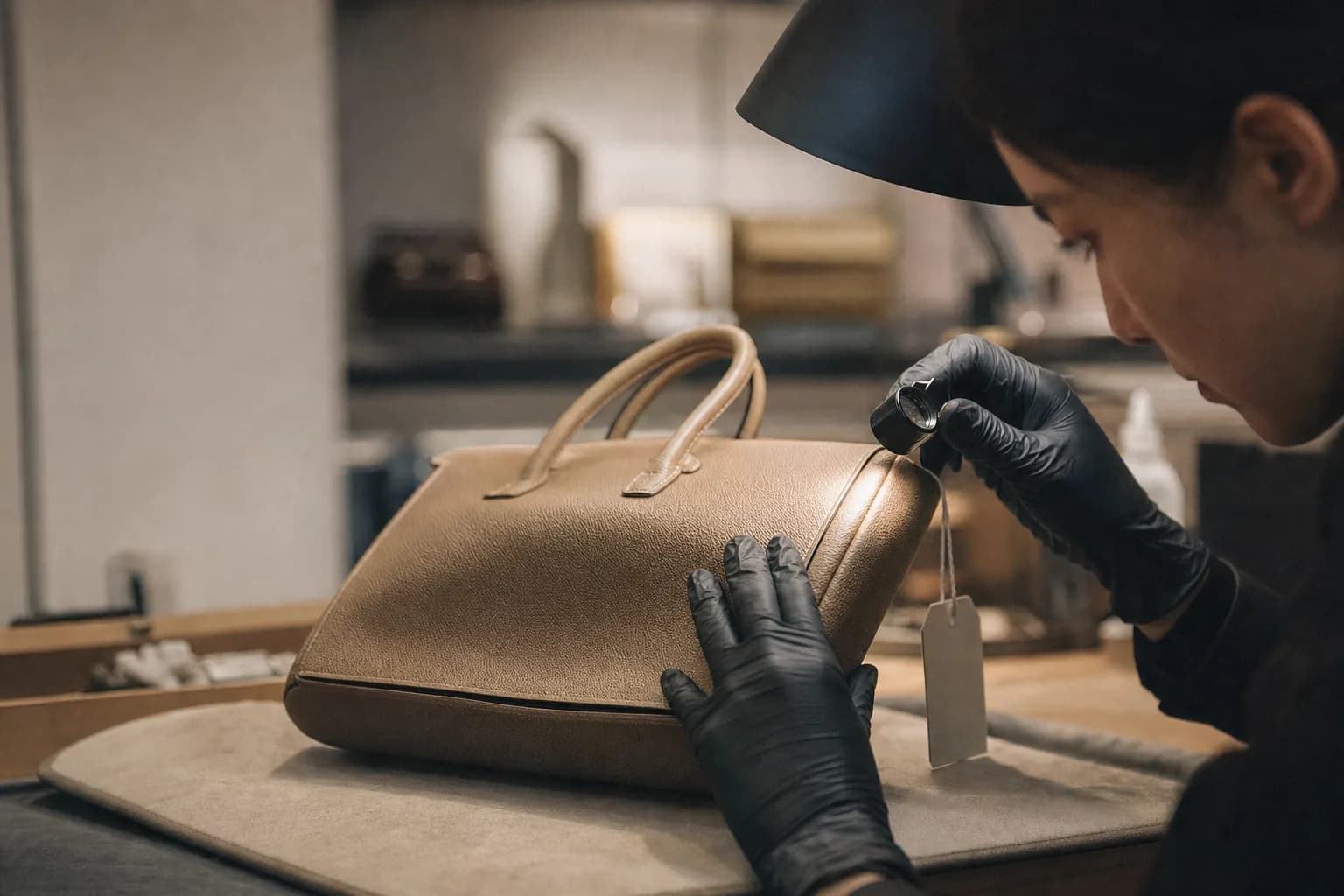
The label on a pre-owned Chanel flap in a Tokyo glass case is not decoration. It is a standardized code, applied by a trained appraiser against a shared industry vocabulary, and it tells you — with more precision than any Western resale platform offers — exactly what physical condition the bag is in. Japan's pre-owned luxury market runs on this system. Knowing how to read it is the difference between a confident purchase and an expensive guess.
What does the Japanese pre-owned grading scale actually look like?
Japanese resale stores use a letter-grade system that runs from N through C, with intermediate grades inserted between the main tiers: N (New), S (Almost New), SA (Excellent, minimal wear), A (Very Good, light wear), AB (Good, clearly used), B (Fair, noticeable wear), and C (Poor, heavy wear). The industry widely uses a five-tier core system — N, S, A, B, and C — where N represents brand-new unused and S means near-new, with sub-grades like SA and AB inserted to capture the significant condition gap between adjacent main tiers.
The table below maps each grade to its physical meaning for a luxury handbag.
| Grade | Common label | Physical condition | Typical accessories included |
|---|---|---|---|
| N | New / Unused | No signs of use; tags, box, or original wrapping present | Full set: box, dust bag, receipt, card |
| S / SA | Almost New / Excellent | No visible wear; may show faint surface marks under magnification only | Usually includes dust bag; box often present |
| A | Very Good | Light wear; very minor scratches or scuffs barely noticeable | Dust bag common; receipt less common |
| AB | Good | Some exterior scratches; normal signs of use; hardware intact | Dust bag may be absent |
| B | Fair | Noticeable wear, scratches, or stains; still fully usable | Accessories often absent |
| C | Poor | Heavy wear; many obvious scratches and stains; may need repair | Accessories rarely present |
How do appraisers in Japan decide which grade a piece receives?
Appraisers at licensed Japanese resale chains examine items systematically before assigning a grade — they do not eyeball from a distance. Japanese graders literally use magnifying equipment to identify flaws invisible to the naked eye, and a pinhead-sized mark that would never be mentioned in a US listing drops an item from Grade A to Grade B in Japan. Age provides no excuse in this system — a 1985 piece must meet the same standards as one from 2015 to achieve the same grade.
Beyond magnification, appraisers check the exterior leather or material for scratches, corner scuffing, and color transfer; hardware for tarnish, plating wear, and scratches on locks, feet, and zipper pulls; stitching for consistency and any signs of re-stitching; and the interior lining for ink transfer, staining, and odor. Condition notes are then written onto the price tag in Japanese — phrases like 角スレあり (corner scuffing present) or 金具くすみ (hardware tarnish) appear as standard disclosures on the tag itself, not buried in a listing description that a buyer might skip.
What is the difference between an S-rank and an N-rank item — and does it matter?
N-rank means the item was never used — it arrives with tags, original wrapping, or in a sealed box, and shows no signs of handling. S-rank means the item was used, but so briefly and carefully that no wear is detectable without magnification. In practice, the price gap between N and S is meaningful: an SA-grade item is priced roughly 10–15% below brand-new retail, reflecting the fact that it has technically left its original owner's hands even if it looks identical to new.
For most buyers, S or SA is the sweet spot. The price is lower than N, the condition is indistinguishable to the eye, and the item has already passed through the appraisal process that confirms its authenticity. N-rank pieces are rarer — they represent items that were purchased and never carried — and command a premium that only makes sense if original packaging completeness matters to the buyer, for example for future resale documentation.
Why do sub-grades like A+ and AB exist, and what do they tell a buyer?
The main grades — S, A, B, C — span wide condition ranges. A bag that has been carried twice and a bag that has been carried fifty times can both technically qualify as "A" if neither shows heavy wear, but they are not the same purchase. Sub-grades like SA (between S and A) and AB (between A and B) exist to compress that range into something more precise.
SA signals a piece that is closer to S than to A — essentially no visible wear, but not meeting the strict "never used" threshold of a true S. AB signals a piece where use is clearly visible but has not yet reached the level of noticeable damage or staining that would push it to B. For a buyer shopping remotely, the difference between A and AB on a Hermès Kelly is not cosmetic — it is the difference between light surface patina and clearly visible corner scuffing. The sub-grade removes ambiguity that the main grade alone cannot resolve. If you are building the case for why authentication and condition grading work together, the sub-grade system is the most concrete example: it forces appraisers to make a call on a narrower range, which is harder to misapply.
Japanese price tags for resale items typically list the grade, specific condition notes, original accessories included, and whether the original receipt is present — giving a buyer multiple independent signals about the item's history rather than a single subjective label.
How does a Japanese grade compare to condition labels used in the US or Europe?
The core problem with Western resale condition labels is that they are platform-specific and self-reported. The same bag listed as "excellent condition" on two different Western platforms can carry a price gap of hundreds of dollars — a direct consequence of each platform defining its own condition tiers, with sellers on peer-to-peer platforms applying those definitions themselves. A Japanese B-grade item at one major chain will be in roughly the same condition as a B-grade item at a competing chain, because industry standards have normalized around shared expectations. That cross-store consistency does not exist in any Western market.
The calibration gap runs in one specific direction: Japanese grades are stricter. What American sellers confidently call "excellent condition," Japanese sellers grade as merely "good." A Japanese A-grade item often exceeds what Western platforms would label "excellent." This means a buyer who understands the Japanese scale can accurately compare items across stores and across borders — something that is structurally impossible when condition labels are platform-defined and seller-applied.
The practical consequence is concrete. A bag listed as "very good" on a Western peer-to-peer platform was graded by the seller, who has a financial incentive to describe it favorably. The same bag graded A in a licensed Japanese chain was assessed by a trained appraiser with no stake in the outcome, using magnification, against a shared industry standard, with the result written on the tag and legally tied to the sale. Those are not equivalent signals.
Which categories — bags, watches, jewellery — are graded most rigorously, and why?
Bags, watches, and fine jewelry receive the most rigorous grading treatment in Japan's licensed resale sector, for a straightforward reason: they are the highest-value categories and the ones most likely to be counterfeited or to have undisclosed repairs. Watches add a mechanical dimension to the grading assessment — movement condition, crown function, case scratches, and bracelet stretch are all evaluated separately from the dial and crystal, and a watch with a perfect exterior but a serviced movement will carry a notation. For buyers interested in the precision behind Japanese horology, the depth of Japanese watch expertise extends directly into how pre-owned movements are assessed.
Fine jewelry grading checks stone security, prong condition, hallmarks, and any signs of re-sizing or re-plating. Bags receive the most granular written disclosures — corner condition, handle darkening, interior lining, hardware plating, zipper pull wear, and the presence or absence of every original accessory (lock, keys, clochette, strap, rain cover, box, dust bag, receipt). Japan's major chain stores perform in-house authentication for every item accepted for resale, and items that fail authentication are rejected entirely rather than sold at a lower grade — a structural difference from many Western consignment operations, where unauthenticated items may still reach the sales floor.
What physical details push a piece from one grade down to the next?
The grade boundaries are where the system's precision becomes most useful. Between S and A, the threshold is whether any wear is detectable without magnification. A single visible scratch on the exterior leather, however small, moves a bag from S to A. Between A and AB, the threshold is whether use is "clearly visible" — corner scuffing that can be seen in normal lighting, handle darkening from skin oils, or light marks on the interior lining all push a piece into AB territory. Between AB and B, the threshold is whether wear is "noticeable" rather than merely present — more obvious scratches and stains on the exterior, strong signs of use, though the item remains fully functional.
Hardware is a frequent grade-decider. Tarnish on gold-tone hardware, plating wear on a lock, or a scratched zipper pull will appear as a written notation and can pull an otherwise clean bag from A to AB. Interior condition carries similar weight — ink transfer, pen marks, or odor are grounds for a lower grade even when the exterior looks pristine. This is why the written condition notes on Japanese price tags matter as much as the letter grade itself: the grade tells you the tier, and the notes tell you exactly which boundary condition pushed it there. If you want to understand what those notes can reveal — and what they can occasionally conceal — the process of identifying undisclosed repairs on authenticated Chanel bags illustrates the level of detail a legitimate listing should contain.
Why does a grade issued in Japan carry more weight than a self-reported condition description?
The structural answer lies in who issues the grade, under what legal framework, and with what consequences for misrepresentation. The Kobutsusho license — Japan's mandatory secondhand dealer permit, issued by the local police station — requires licensed dealers to maintain a transaction ledger recording the date, item description, quantity, price, and seller identity verification for every acquisition. That ledger is subject to police inspection. Trading secondhand goods without this license is a criminal offense punishable by up to three years' imprisonment, a fine of up to ¥1 million, or both. The licensing authority is also the law enforcement authority — a structural feature with no equivalent in the US or European resale sector.
This legal framework creates accountability at the point of grading. A Japanese appraiser who assigns an inflated grade is not just making a marketing decision — they are producing a document that can be checked against the physical item and that sits inside a regulated transaction record. The grading transparency is structural: it creates a documented record that can be checked against the physical item, which is an additional deterrent to misrepresentation. That is why Japan's licensed resale sector produces a lower misrepresentation rate not because Japanese sellers are more honest by nature, but because the system they operate within makes dishonesty expensive, traceable, and legally consequential in ways that informal resale channels in most other markets do not replicate.
For international buyers who cannot inspect items in person, this institutional consistency is the most important feature of the Japanese grading system. A grade issued by a licensed Japanese chain is not a seller's opinion — it is a professionally assigned, legally situated condition assessment. That is a different category of information from anything a Western resale platform currently offers.