· 12 min read
Vintage Chanel Totes & Shapes the West Ran Out Of
Japan's licensed resale market holds discontinued Chanel silhouettes — structured totes, the 1990s vanity case, bucket-shoulder styles — that never entered Western resale in meaningful volume.
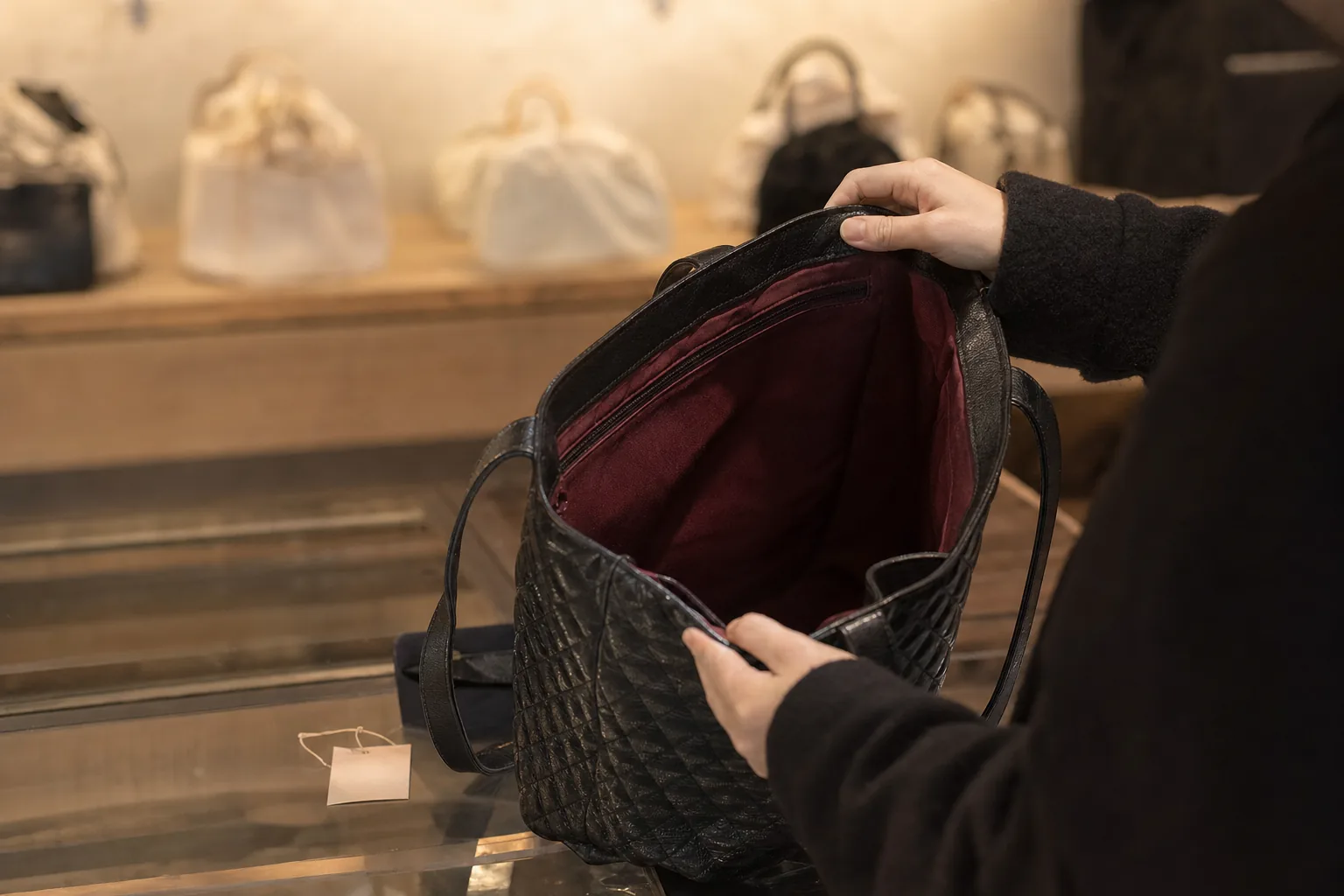
The Chanel Grand Shopping Tote (GST), style code A20995, was discontinued in 2015 — and every one that exists now is pre-owned. What that fact omits is where the surviving stock actually lives. Western resale platforms absorbed the pieces that were already circulating in the US and Europe. Japan's domestic market absorbed a different pool: bags purchased by Japanese consumers in the 1980s and 1990s, stored with characteristic care, and now surfacing through the country's licensed resale network. The silhouettes are not the same ones you find at home, and the volume is not comparable.
This article names the specific shapes — with their defining hardware details and the era markings that place them — and explains why Japan is where you look for them.
If you want a sourcing team to locate a specific vintage Chanel shape from Japan's domestic market, describe what you're looking for and we'll find it.What does a vintage Chanel tote actually look like — and how is it different from current bags?
Vintage Chanel totes from the 1980s and 1990s are prized for their use of 24k gold-plated hardware — a specification Chanel maintained until the latter half of 2008, after which new bags moved to gold-toned (not gold-plated) hardware. That distinction is visible and tactile: the plating on a pre-2008 piece carries more weight and a warmer tone than the lighter finish on current production.
Beyond the hardware, the quilting patterns differ. Early Lagerfeld-era totes often carry larger diamond quilting — sometimes called "maxi matelassé" — with a more pronounced three-dimensional lift than the tighter, flatter quilting that became standard after the mid-1990s. The chain straps on bags from this period are heavier-gauge, and the leather — predominantly lambskin or caviar — was finished to standards that collectors consistently regard as superior to current production. The interior linings, typically burgundy grosgrain or quilted satin, are also distinct from anything Chanel makes today.
Current Chanel boutiques carry none of these silhouettes. The structured tote family, the vanity case in its original boxy form, the bucket-shoulder style — all are discontinued. The only source is the pre-owned market, and the deepest pre-owned market for these specific shapes is Japan.
Which discontinued Chanel shapes does Japan still have in quantity?
Japan's domestic resale network holds meaningful stock of five silhouettes that Western resale channels received in far smaller numbers. Each one circulated heavily among Japanese consumers during its production years and was stored — as Japanese luxury items typically are — with a level of care that keeps condition grades high decades later.
| Silhouette | Production era | Defining detail | Status |
|---|---|---|---|
| Grand Shopping Tote (GST) — A20995 / A50995 | 2004–2015 | Quilted caviar, CC push-lock, structured open top | Discontinued 2015 |
| Petite Shopping Tote (PST) | 1990s–2014 | Smaller GST footprint, same hardware family | Discontinued 2014 |
| Vintage Vanity Case | Early–mid 1990s | Boxy top-handle, large diamond quilting, 24k GHW | Discontinued; original form not reissued |
| Bucket-Shoulder / Drawstring | Early 1990s | Drawstring closure, CC stitched base, chain strap | Discontinued |
| Camera Bag (early Lagerfeld) | 1991–1994 | Boxy zip-top, front pocket, tassel pull, crossbody chain | Discontinued |
| Maxi Matelassé Chain Shoulder | Mid-1980s–early 1990s | Oversized diamond quilting, all-chain strap, no leather weave | Discontinued |
The GST and PST are the most recognizable. The Grand Shopping Tote was discontinued in 2015 and the PST in 2014, ending the entire Shopping Tote family. Japan received large quantities of both during their production years, and the resale market there reflects that absorption — particularly in black caviar with gold hardware, the configuration that holds the strongest value.
The vintage vanity case is the shape most collectors underestimate. Released in the 1990s, this small boxy case with large diamond quilting and a top handle was designed for carrying cosmetics when traveling. The original form — with a puffy leather handle and 24k gold-plated hardware — was never formally reissued. Chanel has revisited the vanity case silhouette in recent seasons, but the current version carries different proportions, different hardware, and a different closure. What Japan holds are the originals.
The bucket-shoulder and camera bag shapes are less discussed but present in Japan's licensed resale network in a way they simply are not in the US or Europe. These were practical, mid-sized bags that sold well in the Japanese market during the early Lagerfeld era and were stored rather than used heavily — making condition grades on surviving examples often better than their age would suggest.
For a broader view of what Japan's domestic resale market holds across luxury categories — not just Chanel — the piece on Japan-only pre-owned items you can't find elsewhere covers the structural reasons why specific categories accumulate here and not in Western markets.
What is the Mademoiselle turn-lock and why does it only appear on older pieces?
The Mademoiselle turn-lock is a rectangular twist clasp with no CC logo. The original 2.55, introduced in February 1955, was secured with this rectangular clasp — a subtle reference to Gabrielle Chanel's status as a single woman, since "Mademoiselle" is the French title for an unmarried woman.
When Karl Lagerfeld joined Chanel in 1983 and redesigned the Classic Flap, he replaced the Mademoiselle lock with the interlocking double-C turn-lock. That change was a deliberate branding decision, and it meant the Mademoiselle lock effectively disappeared from new production. By the 1970s and 1980s, the Mademoiselle lock was phased out in favor of the interlocking CC closure across the flap bag family.
The lock reappeared in 2005 when Lagerfeld created the 2.55 Reissue for the bag's 50th anniversary, but that version carries a subtle "CHANEL" engraving on the clasp — absent from the original — and uses an all-metal Bijoux chain rather than the plain chain of the 1955 bag. Collectors distinguish between the two: the pre-1983 Mademoiselle lock on a genuine vintage piece is unmarked and heavier than the Reissue version.
On vintage totes and shoulder bags from the 1980s, the Mademoiselle lock appears on shapes that were never part of the flap family — structured totes with a push-lock closure, bucket bags with a twist clasp at the drawstring, and vanity cases with a rectangular turn-lock at the lid. These are the pieces where the hardware tells you the era immediately, without needing to read a serial number.
What does 24k gold-plated hardware mean for vintage Chanel bags?
It means the hardware was plated with actual 24-karat gold, not gold-toned lacquer or gold-colored alloy. Until the latter half of 2008, Chanel bags featured 24-karat gold hardware; from that time on, new bags have been made with gold-toned hardware instead. The practical difference is durability and warmth of tone: 24k plating resists tarnish differently, ages differently, and has a specific weight that collectors recognize by handling.
On a well-preserved vintage piece, the 24k hardware will show even wear — a consistent softening of the plating at high-contact points like the turn-lock and chain links — rather than the uneven chipping that indicates a piece has been stored poorly or re-plated. Hardware condition is one of the primary grade-deciders in Japan's resale appraisal system: tarnish or plating wear on a lock will appear as a written condition note and can move a bag from A to AB grade regardless of how clean the leather is.
The hardware specification also functions as a dating tool. Any bag with 24k gold-plated hardware was produced before mid-2008. For pieces from the 1980s and early 1990s — the maxi matelassé totes, the early vanity cases, the bucket-shoulder bags — the 24k plating is original and, on pieces that have been stored rather than carried, often in remarkable condition.
Why did these silhouettes stay in Japan instead of reaching Western resale?
They were bought in Japan, stored in Japan, and sold back into Japan's domestic resale market — a loop that Western buyers were not part of until recently. Japan's luxury consumption in the 1980s and 1990s was enormous relative to the country's size, and the pieces that entered the market during that period stayed within it.
The structural reason is Japan's licensed resale infrastructure. The country has a dense network of professional resale chains — operating under mandatory dealer licenses — that accept, authenticate, grade, and resell luxury items within the domestic market. Items that enter this system are priced and listed in Japanese, on Japanese platforms, and until recently were effectively invisible to international buyers who lacked the language access or the local contacts to find them.
As covered in the guide to luxury thrift and vintage shopping in Japan, the Ginza and Omotesando districts alone contain multiple floors of authenticated pre-owned Chanel across several major resale chains — stock that represents decades of domestic accumulation and that simply does not appear on Western resale platforms in the same volume or variety.
Japanese luxury buyers of the 1980s and 1990s also purchased bags as investments and stored them accordingly — dust bags, original boxes, authenticity cards, and receipts intact. A bag purchased at the Chanel boutique in Ginza in 1991 might re-enter the resale market thirty years later with its serial sticker, authenticity card, and original packaging all present. That provenance trail is part of what makes the Japanese market worth sourcing from.
What condition grades apply to vintage Chanel bags — and what should I expect?
Japan's resale market uses a standardized letter-grade system that runs from N (brand new, never used) through S, SA, A, AB, B, and C. The full breakdown is in the guide to Japan's pre-owned grading system, decoded, but for vintage Chanel specifically, the grades that matter most are S, SA, A, and AB.
On a 30-year-old bag, S-rank means the piece was purchased and never carried — plausible for a Japanese buyer who bought as an investment and stored it immediately. SA means virtually no visible wear without magnification. A means light use with very faint surface marks, hardware bright, lining clean. AB means clearly used: corner scuffing visible in normal light, possible handle darkening, hardware with light tarnish noted on the tag.
For vintage pieces specifically, AB is often the realistic sweet spot. The flaws are disclosed specifically — the Japanese grading system requires written condition notes on the price tag itself, in vocabulary like 角スレあり (corner scuffing present) or 金具くすみ (hardware tarnish) — and the price reflects them. A disclosed AB-grade GST with noted corner wear is a far more transparent purchase than an ungraded piece described vaguely as "good condition" on a Western platform.
Authentication is a separate question from condition. Japan's major licensed resale chains perform in-house authentication for every item accepted for resale, and items that fail are rejected rather than sold at a lower grade. For the specific concerns around undisclosed repairs on pre-owned Chanel — a distinct issue from condition grading — the piece on spotting undisclosed repairs on authenticated Chanel bags covers the physical indicators to check.
How do I know a shape is genuinely discontinued and not just hard to find?
A shape is genuinely discontinued when Chanel has removed it from production and made no announcement of its return. The GST and PST meet this standard clearly: the GST was discontinued in 2015 and no Chanel boutique has stocked it since. No boutique waitlist exists for it. No seasonal reissue has been announced. The only supply is pre-owned.
The vintage vanity case in its original 1990s form is more nuanced. Chanel has revisited the vanity case silhouette in recent collections, so the shape is not absent from current production. But the original — with large diamond quilting, a 24k gold-plated hardware set, a puffy leather handle, and the proportions of the early Lagerfeld era — is not what those current versions are. The serial number places it: a 2-series code (1991–1994) or 3-series code (1994–1996) on the interior sticker confirms the piece predates the mid-1990s production changes.
The clearest confirmation that a shape is discontinued: it does not appear on chanel.com, it cannot be purchased at any Chanel boutique worldwide, and the only available examples carry serial numbers that date them to a specific past production period. All three conditions apply to every shape listed in this article.
How does a sourcing service find a specific vintage silhouette in Japan?
The process starts with a description precise enough to narrow the search: the silhouette name, the hardware color, the leather type if known, the approximate era, and a condition floor. "A vintage Chanel vanity case in black caviar with gold hardware, 1990s, A-grade or better" is a workable brief. "A vintage Chanel bag" is not.
FindLuxuryJapan's Tokyo team sources across Japan's domestic auction platforms, partner shops, and a network of vetted resale specialists. The search covers stock that is not listed internationally — pieces held by licensed dealers whose listings appear only in Japanese, on platforms that require a domestic account or a local intermediary to access. Within two business days of a request, the team sends matched options based on the brief; the customer approves before any purchase is made.
For vintage and pre-owned pieces, the timeline is one to three weeks from match to dispatch, because the right piece is waited for rather than the first available one purchased. The sourcing fee is 10% of the item price with a minimum of ¥5,000, quoted before approval and fixed after it. Shipping and insurance are charged at cost. Japanese consumption tax is included in the quoted item price.
The practical reason to source through Japan rather than waiting for the same piece to surface on a Western platform is volume and condition. Japan's market holds more of these silhouettes, in better condition, with more complete provenance documentation, than Western resale channels do. For buyers weighing different types of Japan-based sourcing arrangements, the comparison of proxy versus concierge services for Japan luxury purchases covers the structural differences and which approach suits which kind of search.
The Tokyo sourcing team at FindLuxuryJapan works across Japan's domestic auction platforms and partner shops to locate specific vintage Chanel shapes — including the silhouettes listed above.If you have questions about a specific shape, hardware configuration, or condition threshold, use the form below and the sourcing team will respond within one business day.