· 12 min read
Authenticated Chanel Bags: Spotting Undisclosed Repairs
Japan's pre-owned grading system discloses repair histories — stitching, hardware, lining — that Western authentication never asks about, and knowing how to read those reports changes what an authenticated Chanel bag is actually worth.
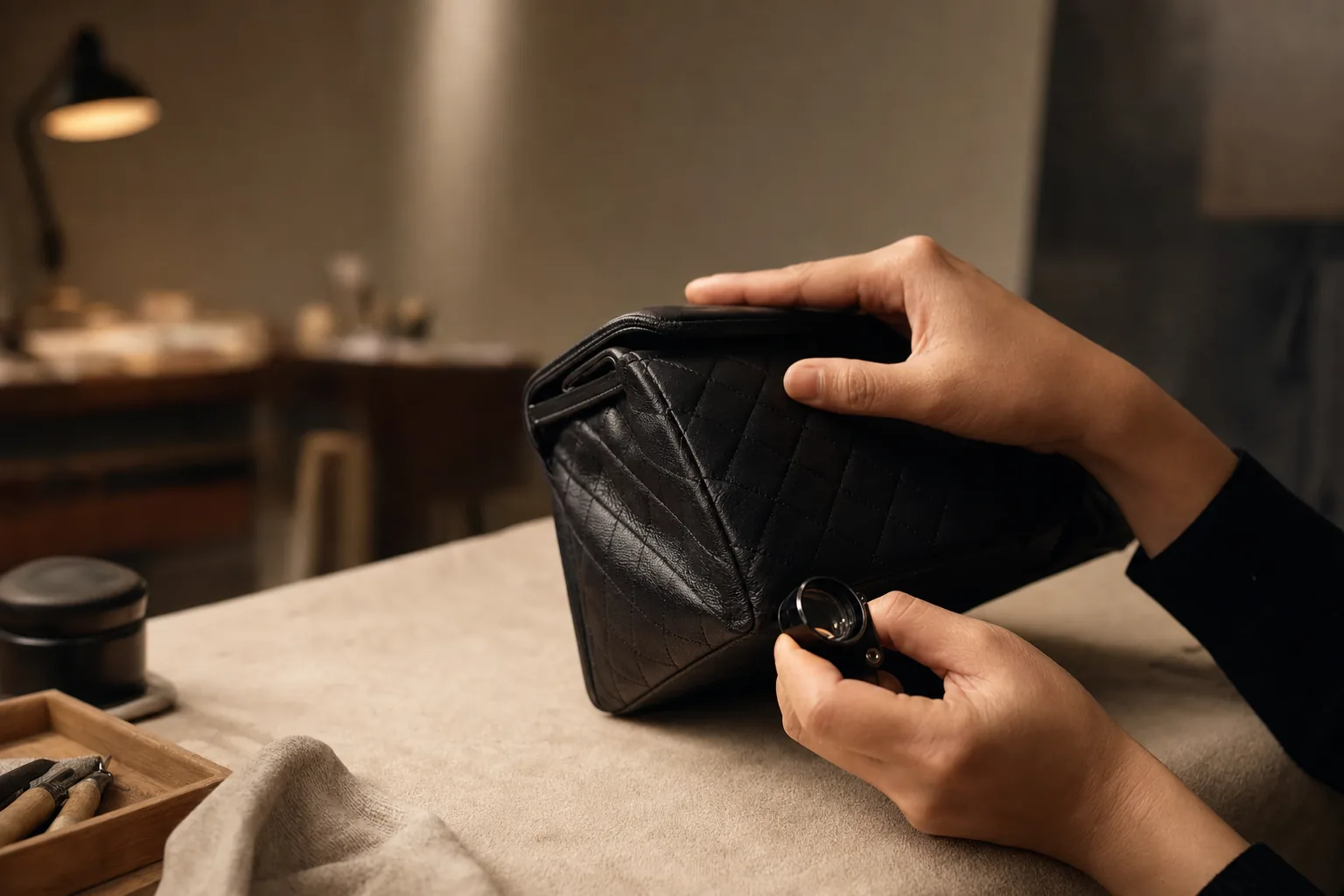
A Classic Flap in black caviar, medium size, A-grade — hologram intact, authenticity card present, serial number verified. The bag is real. What the listing doesn't say is that the chain leather was replaced eighteen months ago, the CC turnlock was re-plated, and two quilting seams near the bottom gusset were re-stitched by a third-party atelier. Standard Western authentication passed it. Japan's grading system would have flagged all three.
That gap is structural, not incidental. Western authentication asks one question: is this genuine? Japan's licensed pre-owned sector asks a second question that most international buyers don't know exists: what has been done to it since it left the atelier?
Sourcing a pre-owned Chanel bag through Japan's domestic market means gaining access to condition reports that answer both questions. This article explains what those reports contain, where repairs hide on specific models, and why the vocabulary used by Japanese graders surfaces information that a standard authentication stamp never will.
What counts as an undisclosed repair on a Chanel bag?
An undisclosed repair is any intervention — stitching, hardware work, leather treatment, lining replacement — that changed the bag's physical state after it left the manufacturer and was not declared in the listing or condition report at the point of sale. The word "undisclosed" is doing the work here. A repair that is clearly noted and priced accordingly is useful information. A repair that isn't mentioned is a liability, because it affects resale value, future serviceability, and in some cases authenticity status.
Chanel's own service documentation draws a clear line: the house states that only Chanel itself can restore its creations while guaranteeing their integrity. Any third-party repair — however well executed — sits outside that guarantee. A bag that has had its CC turnlock replaced by an independent workshop cannot be submitted for official Chanel refinishing or refurbishing, because the brand's service team will identify the non-original component. That's a material fact. In Japan, it gets written down. In most Western resale channels, it doesn't.
The repairs that cause the most problems are the ones that look like original condition: a re-stitched quilting seam that matches the thread color closely enough to pass a casual inspection; a re-plated turnlock that has the right weight and finish; a lining replacement in a fabric that approximates the original. None of these alter authenticity in the counterfeit sense. All of them alter value in the resale sense — and all of them are exactly what Japan's grading vocabulary is built to surface.
Which Chanel models hide repairs most easily?
The models with the highest repair-concealment risk are the ones with the most complex construction and the most repair-prone components. Five stand out.
The Classic Flap (style code A01112, also known as the 11.12) is the most repaired Chanel bag in the Japanese pre-owned market, and the most complex to assess. According to Chanel's own product documentation, the 11.12 requires more than 180 different steps to complete, including the signature "retourné" gesture that turns the bag inside-out during construction. That complexity means repairs touch multiple layers simultaneously: re-stitching a quilting seam on a Classic Flap requires accessing the interior structure in a way that can disturb the lining, the piping, and the edge coating in sequence. A grader who doesn't check all three after a declared stitching repair may miss secondary intervention.
The 2.55 Reissue (introduced in 2005 to mark the original bag's 50th anniversary) presents a different problem. Its Mademoiselle lock and all-metal chain strap are both high-wear components, and the all-metal chain — unlike the leather-interwoven chain on the Classic Flap — shows polishing and re-plating work more readily under direct light. Buyers frequently mistake a professionally polished chain for original condition.
The Boy Bag's push-lock closure is the single most swapped hardware piece in the Japanese pre-owned Chanel market. The plaque-style closure sits proud of the bag's surface and takes direct contact wear; replacements are available from third-party suppliers and, when fitted by a skilled atelier, are difficult to distinguish from original hardware without a close inspection of the engraving depth and the screw-fitting on the reverse.
The Gabrielle Hobo and the Chanel 19 both have multi-chain strap systems that are prone to leather-weave fraying and discoloration. Chain strap leather replacement on these models is a common repair that is frequently omitted from Western resale listings — the exterior of the strap looks correct, but the leather threading through the links is newer than the rest of the bag.
| Model | Most common hidden repair | Where to look |
|---|---|---|
| Classic Flap (A01112) | Quilting re-stitch, lining replacement | Bottom gusset seams, interior corners |
| 2.55 Reissue | Chain re-plating, Mademoiselle lock swap | Chain link interiors, lock underside |
| Boy Bag | Push-lock replacement, piping repair | Plaque reverse, corner piping edges |
| Gabrielle Hobo | Chain strap leather weave replacement | Leather threading through chain links |
| Chanel 19 | Multi-chain strap discoloration treatment | Chain-to-leather junctions, strap ends |
Where do repairs appear that authentication stamps miss?
Standard authentication focuses on the markers that distinguish genuine from counterfeit: hologram sticker, serial number, quilting symmetry, hardware engraving, date code format. Hardware is simultaneously the best clue for authenticity and the most swapped-out component in pre-owned Chanel bags — and that tension is exactly where authentication stamps fail. A genuine CC turnlock that has been re-plated by a third-party atelier is still a genuine CC turnlock. It passes authentication. It fails a condition inspection.
The specific locations where repairs concentrate and hide:
- Bottom gusset seams. The lowest point of the bag takes the most structural stress. Re-stitching here is common on bags used regularly for more than two years. The thread color match is usually close but not exact; under direct light, the tension pattern on re-stitched seams differs from the original machine-assisted hand-stitching used in Chanel's ateliers.
- Chain strap leather threading. The leather woven through the chain links on Classic Flaps and Chanel 19 bags frays and discolors before the rest of the bag shows significant wear. Replacement leather threading is often slightly stiffer and more uniform in color than the original.
- Interior lining at the corners. Lining peeling is particularly common in vintage pieces and in bags that have been stored in humid conditions. A replaced lining is detectable by the stitching pattern at the corners, which rarely matches the original exactly, and by the absence of the characteristic aging that the exterior leather shows.
- Edge coating on corners. The painted edge coating on Classic Flap and Boy Bag corners degrades before the leather itself. Re-coated edges look too uniform compared to the graduated wear visible on the rest of the bag.
- Hardware undersides and screw fittings. Replacement clasps and turnlocks are fitted with screws that leave tool marks not present on factory-fitted hardware. The underside of the Boy Bag plaque is the most reliable place to check for this.
The broader authentication challenge is mismatched wear: a 1990s Classic Flap with pristine hardware but worn leather raises authenticity concerns because the wear patterns are inconsistent. The same logic applies to repairs — pristine chain leather on a bag whose exterior shows five years of honest use is a signal, not a feature.
How does Japan's pre-owned grading system log repairs that Western sellers don't mention?
The foundation is regulatory. Every business buying and reselling secondhand goods in Japan must hold a Secondhand Goods Dealer License (古物商許可, kobutsushō kyoka) under the Secondhand Goods Business Act (古物営業法). The license is issued by the Prefectural Public Safety Commission and requires a background check, a designated business office, and a named manager. Licensed dealers must also maintain a transaction ledger (古物台帳, kobutsu daichō) recording the date, item description, quantity, price, and seller identity for every acquisition. That paper trail creates accountability that informal Western resale channels don't have.
The practical effect on condition reporting is significant. A licensed chain store that buys a Classic Flap from a private seller, has it repaired by an in-house or partner atelier, and then lists it for resale has a documented record of that repair. The grader who assesses the bag for listing knows the repair history because the purchase record and any internal work orders are retained. That information flows into the condition tag.
Japanese graders also apply a more rigorous physical standard than most Western counterparts. Japanese graders use magnifying equipment to identify flaws invisible to the naked eye, and a pinhead-sized mark that would never be mentioned in a US listing drops an item from Grade A to Grade B in Japan. That same rigor applies to repair detection: a re-stitched seam that a Western seller would photograph past is the kind of detail a Japanese grader examines under magnification and records explicitly.
For a full explanation of how the grading scale works across all pre-owned luxury categories in Japan, the decoded guide to Japan's pre-owned grading system covers the N-through-C scale and what each level means in practice.
What does Japanese grading vocabulary actually say about stitching, hardware, and lining work?
Japanese condition reports use specific terms that don't have direct equivalents in Western resale descriptions. Understanding them is the practical skill that separates a buyer who knows what they're getting from one who doesn't.
For stitching work, the key term is 縫い直し (nuinao-shi), meaning "re-stitching" or "stitching redone." A condition report that includes this term is telling you explicitly that thread has been replaced in a specific area. The report will typically identify the location — bottom seam (底部縫い), handle attachment (持ち手縫い付け部), or gusset (マチ部分). This is information a Western listing would either omit entirely or describe vaguely as "minor wear."
For hardware, 金具交換 (kanagu kōkan) means "hardware replacement" and 金具磨き (kanagu migaki) means "hardware polishing." The distinction matters: polishing is cosmetic and reversible; replacement means the original component is gone. A report that says 金具交換済み (hardware replacement completed) is disclosing that a component is not original — which is exactly the information that affects whether Chanel's own service team will accept the bag for future work.
For lining, 内袋交換 (uchibukuro kōkan) means "inner bag replacement" — the lining has been replaced. 内袋補修 (uchibukuro hoshū) means "inner bag repair," indicating patching rather than full replacement. Vintage Chanel bags, particularly those with the original burgundy lining associated with the 2.55, lose significant value when the lining has been replaced, because the replacement fabric is rarely an exact match for the original.
For leather treatment, 色補修 (iro hoshū) means "color repair" or "color touch-up," indicating that dye or pigment has been applied to the exterior leather. This is one of the most commonly undisclosed interventions in Western resale — a bag that has had its corners re-dyed looks clean in photographs but will show the treatment under direct light or on close inspection of the edge coating.
The broader point is that Japanese resale listings from licensed chain stores describe hardware condition separately from leather condition, and photograph serial numbers, date codes, stitching, and hardware rather than just the exterior. That structural specificity is what makes repair history visible.
Why do large chain resellers and department store second-hand floors grade differently from each other?
The large chain resellers operate standardized grading protocols across all their locations. A bag graded A at one branch of a national chain should receive the same grade at any other branch, because the grading criteria are written down, trained to staff, and audited internally. That consistency is a structural advantage: a buyer who understands the chain's grading language can trust it across locations and over time.
Department store second-hand floors — the consignment sections found in some major Japanese department stores — operate differently. They typically accept items on consignment from private sellers and apply their own grading, but the depth of that grading varies. Some department store consignment floors employ specialist assessors for luxury goods; others apply a general retail grading standard that is less granular on repair history. The grade may be accurate for overall condition but silent on specific interventions.
The practical difference: a chain store listing that says "縫い直しあり" (re-stitching present) tells you something specific. A department store consignment listing that says "使用感あり" (signs of use present) tells you very little. Both may carry the same letter grade. The information density is entirely different.
Independent Ginza consignment specialists occupy a third category. Their grading is often the most detailed of all — but it is also the least standardized, because each specialist applies their own framework. The advantage is depth; the risk is that the framework isn't published, so a buyer who doesn't know the specific dealer's conventions can't interpret the report accurately without asking.
What should a condition report include before you commit to a pre-owned Chanel bag?
A condition report worth trusting contains the following, as a minimum:
- Grade stated explicitly using the standardized N/S/A/AB/B/C scale, not a vague descriptor like "good" or "excellent."
- Hardware condition described separately from leather condition, with specific notes on any polishing, re-plating, or replacement of individual components.
- Stitching assessment by location, with explicit disclosure of any re-stitching and the area affected.
- Lining condition noted, including whether any repair or replacement has been made and what material was used.
- Leather treatment disclosed, including any color touch-up, edge re-coating, or surface treatment applied after the bag left the manufacturer.
- Accessories accounted for item by item: authenticity card, dust bag, box, original receipt. Missing accessories affect resale value and should be priced in.
- Photographs of specific details — serial number, date code, stitching close-ups, hardware from multiple angles — not just exterior glamour shots.
A listing that is vague about condition, lacks hardware close-ups, or does not state the grade explicitly is a listing from a seller who either hasn't authenticated the item professionally or doesn't want you looking too closely. Those listings exist in Japan's peer-to-peer channels. They are not what you get from a licensed chain operating under Japan's secondhand goods regulatory framework.
The broader picture of where to shop in Tokyo — and which districts produce the most rigorous condition reporting — is covered in the complete guide to luxury thrift and vintage shopping in Japan, which maps the Ginza specialists, the Shinjuku chain stores, and the Harajuku boutiques by what they actually disclose.
The advantage Japan's market offers isn't just price — it's information. A buyer who can read a Japanese condition report, or who works with someone who can, knows things about a pre-owned Chanel bag that the Western resale market structurally cannot tell them. That information is the real product Japan's licensed pre-owned sector is selling.