· 13 min read
Japanese Second-Hand Luxury Bags: Counterfeits Myth or Reality?
Japan's second-hand luxury market isn't riddled with counterfeits — but the reason has nothing to do with reputation and everything to do with licensing law, mandatory record-keeping, and a grading culture that encodes authenticity before you even pick up the bag.
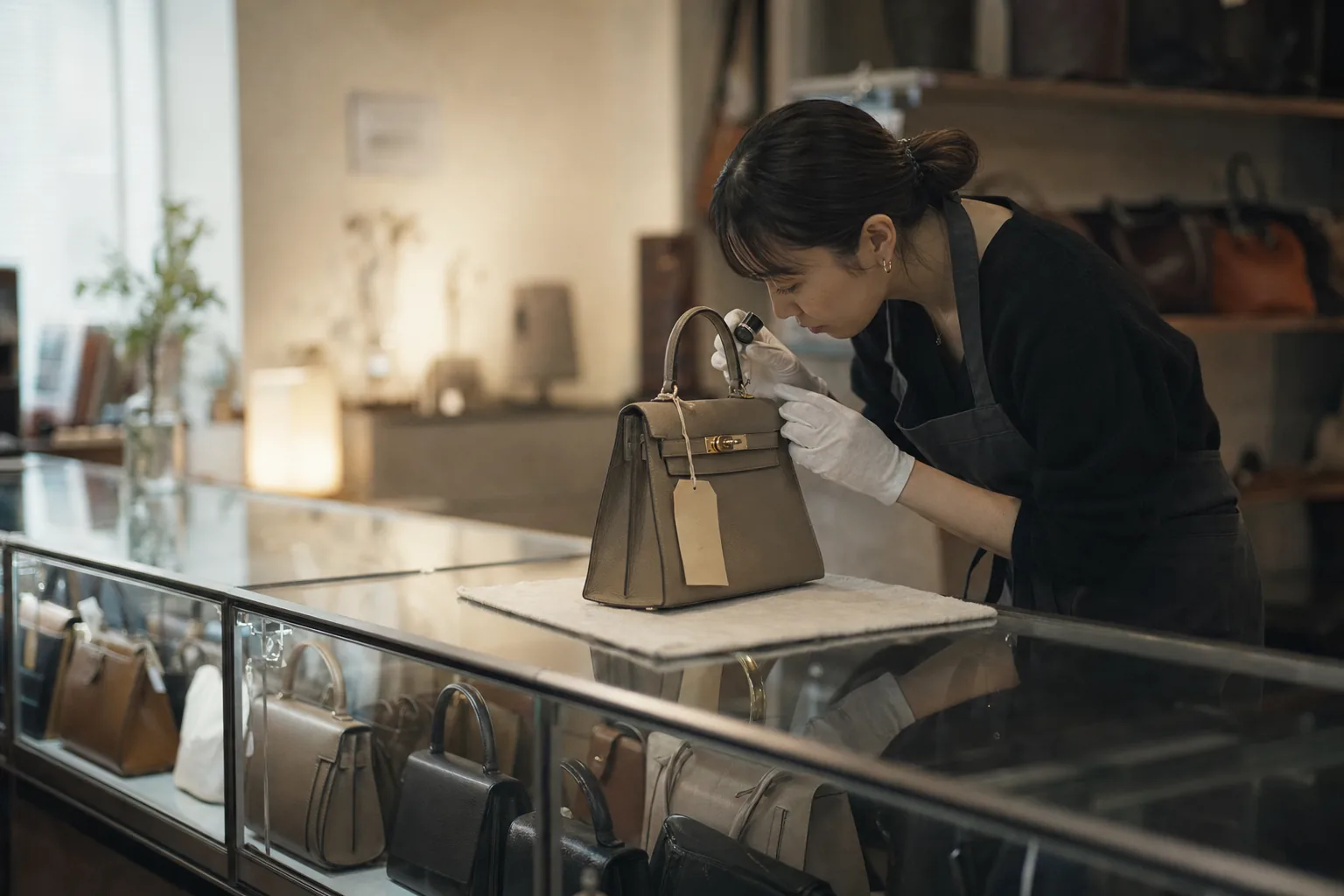
A Hermès Birkin 30 in Étoupe sits in a glass case at a Ginza resale specialist. The tag lists the grade (A), the hardware color (palladium), the presence of the original lock and keys, and whether the clochette is included. The price is roughly 30% below what the same bag would fetch on a Western resale platform. The question most international buyers ask at that point is not "Is this a good deal?" but "Is it real?"
That question deserves a structural answer. Japan's licensed second-hand luxury market is not safer than other markets because Japanese people are more honest. It is safer because the legal and commercial architecture makes passing off a counterfeit genuinely costly — at multiple points in the chain simultaneously.
If you're sourcing a specific pre-owned piece from Japan and want the item evaluated before it ships, FindLuxuryJapan's Tokyo team locates, inspects, and ships authenticated pre-owned bags from Japan's licensed resellers directly to buyers abroad.
Is Japan's second-hand luxury market actually full of counterfeits?
No — not in its licensed, formal segment. Japan's second-hand luxury market is built on strict disclosure laws, trained in-house authenticators, and a cultural premium on institutional honesty that creates structurally low-risk buying conditions. The counterfeit risk that does exist is highly concentrated in specific channels: consumer-to-consumer online platforms, informal flea markets, and unlicensed resellers operating in high-tourism areas.
The distinction matters because "Japan's second-hand market" is not a single thing. It encompasses everything from a multi-floor Shinjuku flagship operated by a national chain to an unlicensed individual listing on a consumer app. Treating those as equivalent is the source of most of the confusion among international buyers.
Japan's pre-owned luxury ecosystem is one of the most trustworthy in the world by global standards — but that reputation applies to the licensed retail segment, not to every transaction that originates in Japan. Understanding what separates the two requires looking at the law, not the surface.
What legal obligations do Japanese resellers have that sellers elsewhere don't?
Every commercial reseller of second-hand goods in Japan must hold a kobutsushō kyoka (古物商許可) — a secondhand dealer license issued under the Secondhand Goods Business Act (古物営業法). Operating without this license carries penalties of up to three years' imprisonment and a ¥1,000,000 fine.
The license is issued not by a trade body but by the police. Applications are submitted to the police station with jurisdiction over the business office — a feature that has no equivalent in most other countries' resale licensing regimes. Every corporate officer must clear a background check, and a designated manager (kanrisha) must be on-site during business hours.
The obligations don't end at licensing. Licensed dealers must maintain a transaction ledger (古物台帳, kobutsu daichō) recording the date, item description, quantity, price, and seller identity verification for every acquisition of secondhand goods. That ledger is subject to police inspection. A seller who brings in a counterfeit Chanel bag is not just risking a civil dispute — they are creating a documented trail that links them to that item by name, date, and verified identity.
That traceability is a significant deterrent that does not exist in informal resale channels, where a seller can list and disappear. The police maintain a publicly searchable database of licensed dealers and registered URLs, allowing consumers to verify online sellers. The result is a market where the incentive structure runs against counterfeits at multiple points simultaneously: at acquisition, at authentication, at grading, and at sale.
How does Japan's professional grading system signal authenticity before you even inspect a bag?
The grading system does more than describe condition — it creates a documented record that can be checked against the physical item. Japan uses condition ranks (N, S, SA, A, AB, B, C, D) to standardize expectations across the resale market. A legitimate listing from a licensed shop states the grade explicitly using this scale, describes hardware condition separately from leather or canvas condition, and notes the presence or absence of the original box, dust bag, authenticity card, and receipt — item by item.
The grading vocabulary is industry-wide rather than proprietary. SA grade means the same as new, with no signs of use, priced roughly 10–15% below brand new. AB grade means good condition with some exterior scratches. B grade means more obvious scratches and stains but still usable. A buyer who understands this scale can evaluate a listing without staff assistance — and can immediately identify a listing that uses vague language where a legitimate seller would use specific grade notation.
That transparency is structurally linked to authenticity. A disclosed Grade B item with a known scratch is far safer to purchase than an ungraded item described vaguely as "good condition." The grading creates a documented record that can be checked against the physical item — which is an additional deterrent to misrepresentation. For a closer look at what that documentation reveals and what it can conceal, spotting undisclosed repairs on authenticated Chanel bags illustrates exactly how much detail a legitimate listing should contain.
Tags on physical items often go further still, noting specific flaws in Japanese: 角スレあり (corner scuffing present) or 金具くすみ (hardware tarnish). This level of disclosure is a feature of Japan's resale culture, not a warning sign.
| Grade | Condition | What it signals for authenticity |
|---|---|---|
| N / SA | Unused or near-new | Full original accessories typically present; easiest to cross-reference with brand documentation |
| A | Lightly used, minimal marks | Date codes and serial numbers intact; hardware shows no alteration |
| AB | Good condition, some exterior scratches | Flaws are disclosed specifically; vague listing at this grade is a red flag |
| B | Noticeable wear | Condition notes should be detailed; price should reflect disclosed flaws |
| C | Heavy wear or damage | Rare in licensed chain stores; more common in independent or auction channels |
Which bag categories carry the highest residual counterfeit risk even in Japan?
The licensed chain segment is not perfectly clean — no market is. Residual risk is real but concentrated. The categories where it persists even within Japan's formal resale system are worth naming precisely.
Hermès exotic-skin bags (niloticus crocodile, matte alligator, ostrich) are the highest-risk category at any price point. The authentication complexity is extreme, the price differential between a genuine piece and a high-quality fake is enormous, and the pool of buyers who can physically verify the skin is small. Counterfeits are getting better and better, and even experienced Ginza specialists note that authentication of exotics requires extended inspection time.
Chanel Classic Flaps and Boy Bags from the 2010s onward are the most frequently counterfeited handbag category globally. Japan's licensed resellers authenticate these rigorously, but the sophistication of current superfakes means that even a well-graded piece warrants independent verification above ¥500,000.
Louis Vuitton monogram canvas — particularly the Speedy, Neverfull, and Alma — is the highest-volume category in Japan's resale market and also the most frequently counterfeited globally. Volume creates noise. Most licensed-shop inventory is genuine, but the sheer number of pieces moving through the market means that errors occur.
Vintage pieces manufactured before the mid-1990s present a different challenge: not counterfeiting, but authentication difficulty. Brands were less consistent about packaging and documentation in that era. A missing authenticity card on a 1988 Chanel 2.55 is not evidence of inauthenticity — but it does require deeper physical inspection to compensate.
The common thread across all four categories is that the risk is not primarily about Japan's market being compromised. It is about the global sophistication of fakes in those specific categories, which creates authentication challenges that any market — including Japan's — must work harder to resolve.
What does a legitimate authentication certificate from a Japanese specialist actually contain?
A certificate from a licensed Japanese resale shop is not an original brand document. It is the shop's own evaluation record — but what it contains is specific enough to be meaningful.
A legitimate certificate from a major chain or established independent typically includes: the item's grade on the standardized scale; a written description of specific condition notes (not just the grade letter); the presence or absence of the original box, dust bag, lock, keys, clochette, authenticity card, and receipt; the shop's license number; the appraiser's identification or stamp; and the date of evaluation. Some chains add a serial or reference number that allows the certificate to be matched to the item in their internal records.
The police maintain a publicly searchable database of licensed dealers, which means the license number on a certificate can be independently verified. A certificate that lacks a license number, omits specific condition notes, or uses vague language where a legitimate document would use precise grade notation is not a legitimate certificate.
What a shop certificate does not do: it does not carry the legal weight of a brand-issued document, and it does not substitute for independent authentication on high-value pieces. For purchases above ¥200,000, third-party verification remains best practice regardless of the quality of the shop's own documentation.
How do large chain resellers and department store second-hand floors differ from peer-to-peer platforms on counterfeit exposure?
The gap is structural, not merely a matter of degree. Licensed chain resellers and department store second-hand concessions operate under the kobutsushō regime with mandatory identity verification of sellers, documented transaction ledgers, and professional authenticators whose role exists specifically to reject counterfeits before acquisition. Japan has mastered the art of second-hand retailing — part of this is owed to "inspectors," credible and knowledgeable professionals who inspect, classify and guarantee the authenticity of pre-owned designer products.
Authentication at the chain level happens before the shop commits to buying — not after. Items that fail authentication are rejected entirely rather than sold at a discount. The commercial incentive reinforces the legal obligation: a chain that is caught selling a counterfeit does not recover from the police investigation, the press coverage, and the license revocation that follow. Japanese commercial culture places exceptional weight on institutional reputation in a way that makes that outcome genuinely catastrophic.
Consumer-to-consumer platforms are a different environment. Individual sellers on C2C platforms are generally not operating as a "business" in the legal sense, which means the kobutsushō licensing requirement often does not apply. No mandatory authentication, no transaction ledger, no license to lose. The platform may offer dispute resolution, but it does not authenticate items directly.
This does not mean C2C platforms are uniformly dangerous — many individual sellers are genuine, and prices can be significantly lower than chain-store inventory. But the protection architecture is absent. Buying from a licensed chain and buying from an individual listing are not the same transaction, and should not be evaluated as though they carry the same risk profile. Understanding Japan's pre-owned grading system in detail helps you read the difference between a professionally graded listing and one that borrows the vocabulary without the substance.
Why do luxury brands themselves treat Japanese pre-owned stock differently from other markets?
The answer lies in how the primary market works. Japan's domestic luxury consumption has historically been among the highest per capita in the world, which means the resale pool draws from buyers who purchased at full retail from authorized boutiques. Japan's secondhand fashion market topped ¥1 trillion for the first time recently, according to a study by Reuse Economic Journal, with sales of luxury vintage goods growing 16% in 2024.
For Hermès specifically, the provenance advantage is concrete. Japan receives the second-largest Hermès allocation globally after France, which means Japanese resale inventory is disproportionately drawn from legitimate boutique purchases. A Birkin that entered the Japanese market came through a controlled allocation system — it was not a gray-market import or a diverted piece.
Hermès Japan publishes a one-leather-bag-per-person-per-day rule, with a maximum of two per person per calendar year across a listed group of bags — one of the few markets where Hermès has published explicit purchase limits. That transparency about the primary market creates a cleaner chain of custody for the secondary market. A piece that can be traced to a specific boutique purchase within Japan's documented allocation system carries stronger provenance than one whose retail origin is unclear.
Luxury brands are also aware that Japan's resale culture keeps their products in circulation at high condition standards. LVMH's 2024 annual results show the Japanese market accounting for 10 percent of the group's global sales — a figure that reflects both primary retail and the ecosystem that surrounds it. A market where pre-owned pieces remain in excellent condition and are authenticated professionally before resale supports, rather than undermines, the primary brand.
What should a buyer sourcing from Japan still verify, even when the channel looks safe?
A licensed chain with a strong authentication reputation is the right starting point — not the ending point. Even within the formal segment, a few categories of verification remain the buyer's responsibility.
Confirm the license number. Every licensed dealer must display their kobutsushō license number at the business office and on their online store. The police maintain a publicly searchable database of licensed dealers and registered URLs — use it. A seller who cannot provide a license number, or whose number does not appear in the database, is operating outside the regulated system regardless of how professional their presentation looks.
Read the grade notation carefully. A tag reading "角スレあり" (corner scuffing present) or "金具くすみ" (hardware tarnish) is a sign of honest, detailed grading. A listing that uses only the grade letter without any supporting condition notes is providing less information than a legitimate shop normally would. That gap is worth investigating before committing to a purchase.
Verify date codes and serial numbers independently. Shop authentication is a strong first layer, not a complete substitute for your own inspection. Date code formats, serial number placement, and hardware font vary by brand, model, and production year. Know the specific markers for the piece you are buying before you evaluate a listing.
Be cautious about "preloved from Japan" marketing outside Japan's licensed system. Legitimate Japanese pawnshops provide specific business documentation. Sellers using generic "preloved from Japan" language often cannot specify their actual source. Geographic origin is not a substitute for documented authentication. A piece that genuinely came through Japan's licensed resale system will have paperwork to prove it.
For high-value purchases, budget for independent authentication. The threshold that warrants it depends on the category — for Hermès exotics or Chanel classic flaps above ¥500,000, independent verification is best practice regardless of the shop's reputation. The cost is modest relative to the purchase price and the risk.
FindLuxuryJapan's Tokyo team sources pre-owned luxury bags through licensed Japanese resellers and runs each item through pricing, condition, and authenticity evaluation before it ships to you — so the verification layer is built into the process rather than left to the buyer to arrange independently.
The structural reality of Japan's domestic resale trade — the kobutsushō licensing regime, the mandatory transaction ledgers, the professional grading culture, and the legal exposure for sellers — makes the licensed segment demonstrably safer than most other resale markets. The residual risk is real but narrow, and it maps precisely onto the channels and categories where those structural protections are absent. That is a much more useful frame than a blanket verdict in either direction. For buyers ready to act on that understanding, Japan's physical resale landscape across Tokyo and beyond offers access to inventory that is genuinely difficult to replicate anywhere else.