· 12 min read
Japan-Only Products That Never Leave the Country
Japan's domestic-only goods extend far beyond luxury fashion — here's a cross-category survey of the electronics, stationery, beauty, and food products that manufacturers deliberately keep off Western shelves.
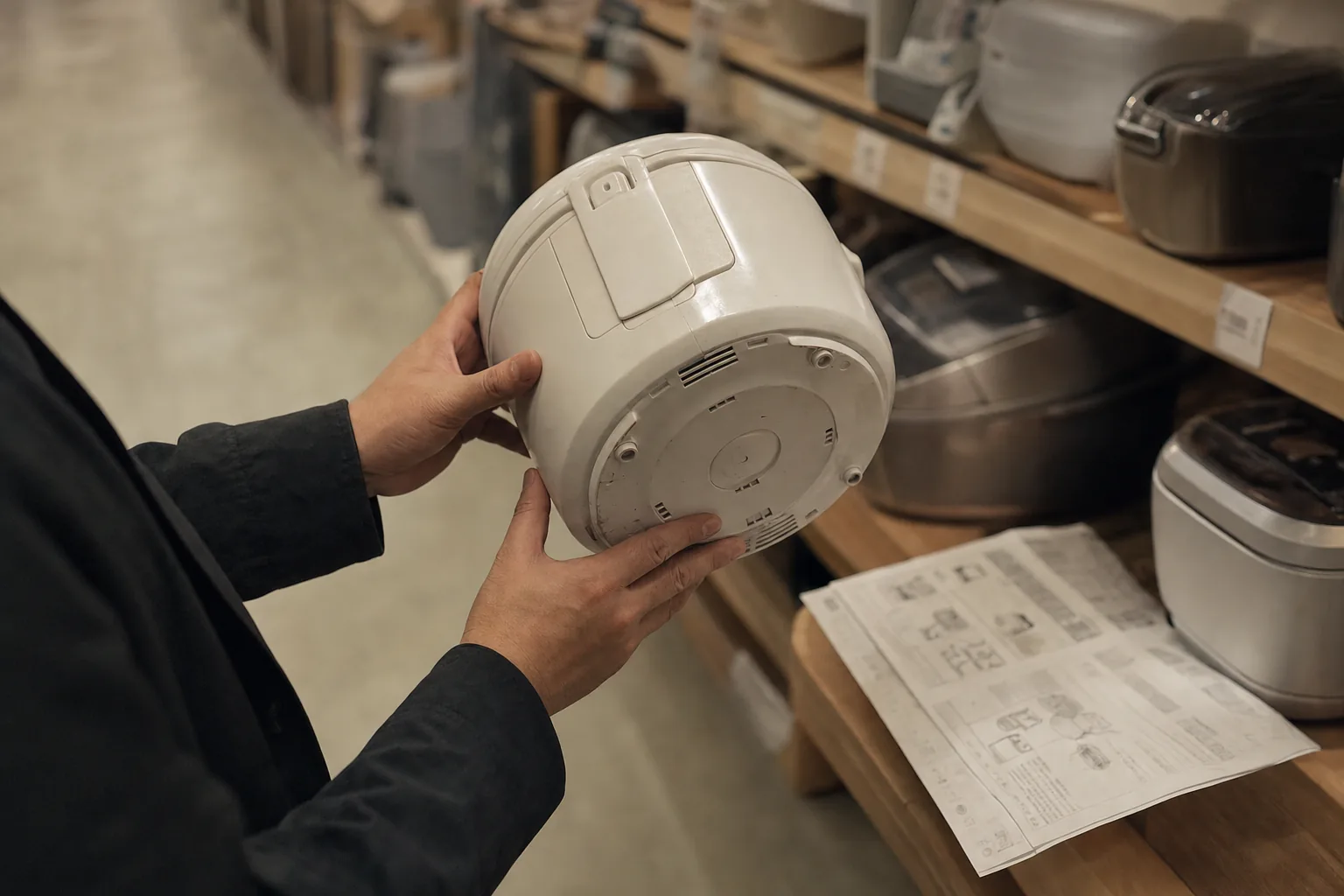
The Sharp Healsio Hot Cook KN-HW24G has been Japan's best-selling automatic cooker for five consecutive years. It cooks without added water, adjusts heat via temperature and steam sensors in real time, and connects to a cloud recipe library. Sharp's Healsio lineup is simply not sold in Western markets. That gap — between a product that dominates a category at home and one that barely registers abroad — is the story of Japan-only goods across nearly every product category.
The reasons are structural, not accidental. Japan runs on 100V AC power; most of the world runs on 220–240V. Japanese radio equipment must be certified by the Ministry of Internal Affairs and Communications under its own SAR and antenna efficiency standards. Domestic-market SKUs carry warranties valid only within Japan. And as one analysis of Japanese supply chains notes, different warranties, different SKUs, different compliance requirements, and sometimes voltage and safety specifications exist specifically to reduce the incentive for grey-market exports. None of this is accidental. It is the architecture of a domestic market that Japanese manufacturers treat as its own ecosystem.
If you want to understand what that looks like in practice — and what it costs to access it from outside Japan — this survey covers six categories where the gap between domestic and international availability is widest.
If you're sourcing a specific Japan-market item from outside the country, FindLuxuryJapan's Tokyo team can locate, evaluate, and ship it to you directly.What does 'Japan domestic only' actually mean for a product?
A product is Japan domestic only when the manufacturer sells it through Japanese retail channels and has made no arrangement — authorized distributor, international e-commerce listing, or licensed export partner — to supply it elsewhere. The product exists; it simply has no official path out of the country.
The practical markers are consistent. The unit runs on 100V and carries a Japanese-standard plug. The manual is in Japanese only. The warranty card is redeemable only at domestic service centers. The firmware, if applicable, is tied to Japanese carrier infrastructure or broadcast standards. Taken together, these features are not oversights — they are decisions. A manufacturer that wanted to sell the product internationally would have resolved each of them before launch. The fact that they haven't is the signal.
This matters because it distinguishes a genuinely domestic product from one that is merely hard to find. A product that is hard to find can be ordered from an authorized international retailer if you look long enough. A domestic-only product cannot — at least not through official channels. The distinction is what makes the Japanese domestic market worth understanding as its own category, rather than as a subset of global retail.
Which electronics are sold in Japan but blocked from export?
The clearest examples sit in kitchen appliances and personal care electronics, where Japanese manufacturers have built product lines that assume 100V power and Japanese-language interfaces throughout. Sharp's Healsio range is the most prominent case: the Healsio Hot Cook anhydrous automatic cooking pot has been used by many people since its launch in November 2015, reaching cumulative shipments of 500,000 units in Japan by March 2022 — with no Western retail launch in that time.
The Panasonic EH-NA0J hair dryer tells a similar story. Panasonic manufactures different models for different markets, and the Japan-spec lineup features the latest nanoe technology that reduces hair damage, improves moisture retention, and leaves hair noticeably smoother. The global NA9C model supports 100–240V but lacks the nanoe X ion generator present in the domestic version. The EH-NA0J was the Japan domestic flagship from 2022 until the EH-NA0K replaced it in September 2025.
In smartphones, Sharp (AQUOS), Kyocera (TORQUE), and FCNT (Arrows) operate almost exclusively in domestic carrier channels. Japan's Ministry of Internal Affairs and Communications certifies radio equipment under SAR, antenna efficiency, and battery safety rules tailored to domestic usage patterns — a certification process that is not transferable to FCC or CE approval without a separate engineering program that most domestic-market brands have no commercial reason to pursue.
| Product | Model / Line | Why not exported | Approx. domestic price (2026) |
|---|---|---|---|
| Sharp Healsio Hot Cook | KN-HW24G / KN-HW24K | 100V only; no Western distributor; Japanese cloud recipe system | ¥44,000–¥80,100 |
| Panasonic nanoe Hair Dryer | EH-NA0J / EH-NA0K | 100V only; nanoe X hardware absent from global models | ~¥28,800 |
| Sharp AQUOS smartphone | AQUOS R-series | MIC-only radio certification; carrier-locked firmware | Varies by carrier |
| Zojirushi premium rice cookers | NW- and NP-series top models | 100V; Japanese-language interface; no export distributor | ¥15,000–¥60,000 |
What stationery and office products never reach Western shelves?
The stationery category has a clean split: the export subset and the domestic subset. The export subset includes the G-2, EnerGel, Jetstream SXN-210, and Sarasa Clip in ten colors — sold internationally at two to four times the Japanese price. The Japanese-market items — Jetstream Edge and Prime, Kuru Toga Dive, Sarasa Nano, limited color sets, Campus notebooks in Japanese paper sizes — have to be bought from Japan.
The reason is straightforward: these products were designed for the Japanese school and office market, which has specific paper standards, writing conventions, and retail price points that don't translate directly to Western distribution. Pilot has been making writing instruments since 1918 and is the largest of the Japanese pen makers, yet a substantial portion of its domestic range has never appeared on a US or European shelf. The same is true of Kokuyo, established in 1905, whose Campus notebooks are the standard school notebook across Japan but whose domestic paper sizes and ruling formats have no direct equivalent in Western retail.
Limited-edition color sets and character collaborations are the most acute case. These are produced in specific quantities for the domestic market, sell through in weeks, and are never restocked internationally. The pen itself — a Sarasa Clip or a Juice — may be available abroad, but the specific colorway is not. For collectors, that distinction is the whole point. The precision behind Japanese writing instruments is one reason these limited runs carry genuine secondary-market value.
Which Japanese beauty and skincare lines are domestic-market only?
The domestic beauty market has two tiers: brands that export a narrowed version of their range, and brands that don't export at all. Most of the major brands are cheaper in Japan and many are Japan-only — formulas differ by market, so the domestic version is often not the one your local shop sells.
The formula difference is the critical point. Hada Labo's Gokujyun line, Curel, and Bioré UV are available internationally in some markets, but the domestic formulations — ingredient ratios, preservative choices, active concentrations — are calibrated for Japanese regulatory standards and consumer expectations, which are not identical to FDA or EU cosmetics rules. The version sold in Japan is frequently not the same product as the one sold under the same name in the US or UK.
Brands that remain almost entirely domestic include HAKU (Shiseido's brightening quasi-drug line), freeplus (Kao's fragrance- and alcohol-free sensitive-skin range), and MINON Amino Moist. Quasi-drug classification in Japan — a regulatory category between cosmetics and pharmaceuticals — creates a particular barrier to export: a product classified as a quasi-drug in Japan requires separate regulatory approval in each target market, a process that most domestic-focused brands have no incentive to pursue. For a deeper look at what's available in the premium tier, the full landscape of Japanese luxury beauty covers the brands that have made the international leap — and what they left behind.
Finding specific domestic-market skincare formulations from outside Japan is exactly the kind of request FindLuxuryJapan handles — describe what you're looking for and our team will locate the domestic version.What food and drink products are restricted to Japan?
Japan's food market has a structural feature that makes domestic exclusivity the norm rather than the exception: konbini. Japan had 55,736 convenience stores as of December 2024, with Seven-Eleven, FamilyMart, and Lawson the three major operators. These chains commission products specifically for their domestic shelf — seasonal flavors, regional editions, private-label lines — that are never submitted to export distributors because they were never designed with export in mind.
The clearest example is Nestlé Japan's regional Kit Kat program. Nestlé Japan's regional Kit Kat line — wasabi from Shizuoka, matcha from Kyoto, sake, Hokkaido azuki, and a rotating cast of prefecture-specific editions — is sold as souvenir boxes rather than convenience-store singles, and does not enter export catalogues. These are not limited-edition marketing exercises for a global audience. They are products conceived for the domestic souvenir channel, produced in quantities calibrated to that channel, and distributed only within it.
Seasonal konbini exclusives follow the same logic. From September, Japanese convenience stores rotate into chestnut, sweet potato, roasted matcha, and Halloween-packaged editions of otherwise ordinary snacks. These sell for a few hundred yen each and disappear after roughly six to eight weeks. The speed of that cycle — product in, product out — is itself the reason they never reach export: by the time an international distributor could clear regulatory and logistics hurdles, the product would already be discontinued.
Regional dairy and soft drinks occupy a similar position. Hokkaido milk, sold through local convenience stores and station kiosks, is a genuine regional product tied to a specific agricultural supply chain. It is not exported because the supply chain that produces it is local by design.
Are there home goods or kitchenware lines that never leave Japan?
Beyond the Healsio cooker, Japan's home goods sector has a consistent pattern: premium rice cookers, futon dryers, and facial care appliances that are engineered for Japanese domestic use and never submitted for international safety certification. Zojirushi and Tiger both manufacture top-tier rice cookers — models in the NW- and NP-series — that are sold only in Japan, priced between ¥15,000 and ¥60,000, and run on 100V. The export versions of these brands exist but are stripped-down relative to the domestic flagship models.
The Iris Ohyama Futon Dryer FK-W1 is another example: a product category that barely exists in Western markets, built for a domestic lifestyle practice (futon airing) that has no direct Western equivalent. There is no export market for it because there is no export demand — the product solves a problem that Western households don't recognize as a problem.
This is distinct from products that are blocked by regulation. Many Japanese home goods are not exported simply because the manufacturer has never identified a viable international market for them. The domestic market is large enough, the product is culturally specific enough, and the cost of international certification is high enough that the calculation never favors export. That combination — large domestic market, cultural specificity, certification cost — is the underlying structure behind most Japan-only home goods.
Why do Japanese brands choose not to export certain products?
The reasons cluster into four categories, and most domestic-only products involve more than one.
Voltage and certification. Japan's 100V standard requires either a separate product design or a voltage converter for international use. Neither is free. International safety certification — UL in the US, CE in Europe — adds time and engineering cost. For a product that sells well at home, the economics rarely justify it.
Regulatory classification. Japan's quasi-drug category, which covers brightening cosmetics, medicated shampoos, and some sunscreens, has no direct equivalent in US or EU law. Exporting a quasi-drug product means reclassifying it under the destination country's rules, which may require reformulation. Many brands simply don't.
Market size and cultural fit. Japan's domestic market of 125 million people is large enough to sustain product lines that would be niche anywhere else. A futon dryer, a waterless automatic cooker, a limited-edition pen collaboration with a manga franchise — these are viable domestic businesses that don't need export revenue to justify their existence.
Distribution architecture. Japanese manufacturers typically sell through established domestic distributor relationships. Exporting through grey-market channels risks those relationships. As one analysis of Japanese supply chains notes, if a distributor is caught shipping products outside approved channels, the manufacturer can terminate the agreement — and in Japan's business culture, that kind of trust breach closes doors permanently. The result is that domestic products stay domestic not just by manufacturer policy but by the collective interest of the entire distribution chain.
Understanding why Japanese sellers guard these channels is also relevant if you're navigating the domestic market from outside Japan — the reasons Japanese sellers refuse international buyers are closely related to the same distribution logic.
How do you even know a product is Japan-market only?
The most reliable signal is the model number. Japanese domestic appliances carry model numbers that end in a suffix denoting the Japanese market — often -J, -JP, or a color code that doesn't appear in any international product database. A Sharp Healsio KN-HW24G or a Panasonic EH-NA0J will return no results on US or European retail sites because those model numbers don't exist in those markets.
For stationery, the tell is the paper size and ruling format. A Kokuyo Campus notebook in B5 with a 6mm ruling is a domestic product; the international equivalent, if one exists, will be in A5 or A4 with different line spacing. For beauty, the quasi-drug mark (医薬部外品) on the packaging is a reliable indicator that the product is formulated to Japanese regulatory standards and is unlikely to have a direct international equivalent.
For food, the konbini seasonal rotation is the clearest signal: if a product appears in September, disappears by November, and is sold only at Japanese convenience stores, it was never intended for export. The same applies to regional souvenir-channel products — anything sold at an airport or station gift shop in a prefecture-branded box is almost certainly domestic only.
The practical implication is that identifying Japan-only products requires reading Japanese retail, not international retail. The gap between what appears on a global e-commerce platform and what is available in a Japanese drugstore or electronics floor is wider than most buyers outside Japan realize. That gap is also where the most interesting purchases sit — the products that solve problems well, sell at domestic prices, and simply never made it onto a global shelf. For buyers who want access to that market without being physically present in Japan, the Japan-only release model that collectors have navigated for years in sneakers applies equally to these everyday categories.