· 11 min read
Hermès Pieces Japan Keeps for Itself
A catalogue of specific Hermès colourways, silk prints, and petit h objects commissioned for or absorbed by the Japanese domestic market — pieces that surface almost exclusively in Japanese pre-owned inventory.
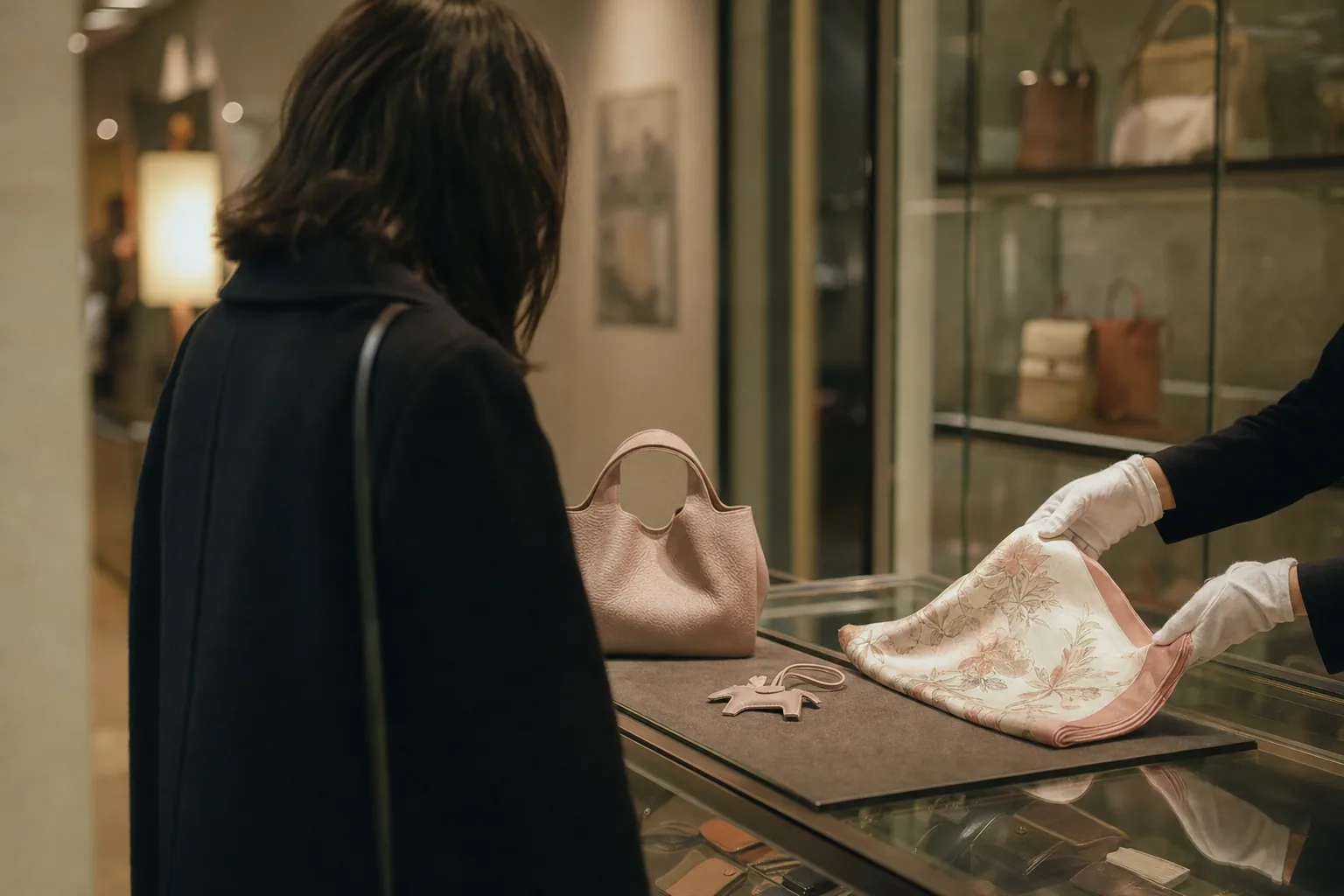
The Ex Libris en Kimonos carré 90 was commissioned specifically to mark the 400th anniversary of Matsuzakaya, the Kyoto kimono house founded in 1611. Hermès worked with the design studio Anamorphee to overlay the house's signature Ex-Libris duc carriage motif onto historic Matsuzakaya kimono patterns. The colorways — a red, a pink, an orange, a black, and a mint, among others — were offered only at Hermès in Japan. No Western boutique stocked them. That is the template for everything in this article: a piece made for Japan, sold in Japan, and now living almost entirely in Japanese pre-owned inventory.
Which Hermès colourways were made exclusively for Japan?
Hermès does not publish regional allocation lists, but the evidence is in the inventory. Japan receives the second-largest global Hermès allocation, and that volume comes with influence over which colorways reach Japanese boutiques first — and sometimes only. Rose Sakura (color code 3Q) is the most-cited example. Introduced by Hermès in 2014, the shade takes its name directly from the cherry blossom — a cultural reference with no equivalent resonance in European or American markets. It became one of the most sought-after pinks the brand has ever produced, and the density of Rose Sakura pieces in Japanese pre-owned channels relative to Western resale platforms is striking.
Bougainvillier, a vivid fuchsia-adjacent pink, follows the same pattern: heavily stocked in Japan, present but thin in Western inventory. Vert Jade, a deep and slightly grey-tinted green, circulates through Japanese pre-owned stores in Clemence and Epsom leathers across multiple silhouettes — Evelyne, Kelly Long To Go, and small leather goods — at a depth that suggests Japan absorbed a disproportionate share of that production run. None of these are formally "Japan-only" in the way a numbered edition would be, but the practical effect is the same: a buyer in the US or EU looking for Rose Sakura in a Picotin 18 or a Bougainvillier Evelyne Amazon is overwhelmingly more likely to find it through Japanese inventory than through any domestic source.
This connects to a broader pattern covered in detail in the article on Japan-only products that never leave the country — the Japanese market's purchasing power and cultural specificity routinely pulls certain production into domestic channels and keeps it there.
If you already know which colorway you're after and want it sourced from Japanese pre-owned inventory, our Tokyo team can locate it and evaluate condition before you commit to anything.
What are petit h Japan-only objects and why do they rarely leave the country?
Petit h was created in 2010 by Pascale Mussard, a sixth-generation member of the Hermès family, as a laboratory where artists and artisans work with surplus and imperfect materials from the maison's workshops. The resulting objects — bag charms, table clocks, puppets, fans, sculptures — are typically one-of-a-kind pieces or very limited editions, and they travel the world in pop-up exhibitions rather than sitting in permanent boutique stock.
Japan has been a recurring destination for petit h exhibitions, and the Kyoto edition — held at Shosei-en Garden — was the first time petit h had been exhibited in Japan outside of Tokyo. Objects created specifically for or during Japanese exhibitions include fans made in collaboration with Sakata Bunsuke Shoten using bamboo and leather, table clocks in crocodile and calfskin, and leather puppets. These pieces were sold on-site at the exhibition and did not enter the global boutique network. They exist in Japanese private collections and, occasionally, in the pre-owned market — but almost never on Western resale platforms, because the original buyers were Japanese and resale happens close to home.
The broader petit h universe also includes cherry blossom–motif charms (marked in pre-owned listings as "Petit H Cherry Blossom, Epsom/Chevre leather") that circulate almost exclusively from Japanese sellers. These are not catalogued on the Hermès global website and have no Western retail history.
Which Hermès silk scarves carry Japan-only motifs?
The Ex Libris en Kimonos carré 90 is the clearest documented case. Issued in 2011 and designed by Anamorphee, the scarf incorporates the Hermès Ex-Libris emblem — the duc carriage and groom — into a patchwork of kimono patterns drawn from the Matsuzakaya archives. Multiple colorways were produced: red, pink, orange, black, and mint, among others. All were sold exclusively through Japanese Hermès boutiques to mark Matsuzakaya's 400th anniversary. The scarf carries a Japanese department-store provenance that is visible in the listings themselves — pre-owned examples consistently appear with Japanese tags and Japanese-market receipts.
Beyond that commission, the Hermès carré programme produces seasonal colorways that reach different markets in different proportions. Japan's appetite for the 70cm format and for motifs referencing nature — cranes, bamboo, seasonal flora — has historically led the Tokyo buying office to request specific colorways of existing designs that were never ordered by European or American buyers. These do not carry a "Japan exclusive" label, but they surface almost entirely in Japanese pre-owned inventory. The Modernisme Tropical and Flamingo Party carrés tagged "Authentic Japan" that appear in resale listings are examples: the motif is global, but the specific colorway was a Japan-market order.
The Hermès carré itself has a long history — first introduced in 1937, the classic 90cm square format has been produced in thousands of designs. The Japan-specific commissions represent a small but highly collectible subset of that archive.
Why does Japan's Hermès clientele drive unique leather and hardware commissions?
Japan's Hermès clientele is among the most loyal and highest-spending in the world, and that spending power translates into purchasing influence. The Japanese market has historically favoured smaller silhouettes — the Birkin 25 over the 35, the Mini Kelly over the Kelly 28 — and softer, more refined leathers like Swift and Chevre Mysore over the harder-wearing Togo that dominates Western markets. Hardware preferences also diverge: palladium (silver-tone) hardware is significantly more popular in Japan than in France or the US, where gold hardware has traditionally dominated.
These preferences produce a feedback loop. When Japanese boutiques consistently sell out of specific configurations — Rose Sakura in Swift leather with palladium hardware, for instance — those configurations get reordered in volume. Over time, the Japanese pre-owned market accumulates a density of those specific combinations that no Western resale platform can match. A buyer looking for a Picotin 18 in Rose Sakura Clemence with silver hardware, or a Constance Mini in Bougainvillier, is dealing with a piece that was almost certainly purchased new in Japan and will resurface in Japanese pre-owned inventory.
The vinyl Kelly — a transparent clear vinyl version documented as a Japan limited edition from the 1990s — is an older example of the same dynamic. It was produced for the Japanese market, sold in Japan, and now appears almost exclusively in Japanese pre-owned listings when it surfaces at all. Hardware finishes on vintage pieces from Japan also tend to differ: the Japanese market received certain brushed gold and matte palladium hardware configurations on Constance and Roulis models that were not offered elsewhere.
This pattern is not unique to Hermès. The article on Grand Seiko models sold only in Japan documents the same mechanism in watches: a market with sufficient purchasing depth shapes what gets made, and what gets made stays close to where it was sold.
What condition grades do Japan-only Hermès pieces typically reach the resale market in?
Japan's pre-owned grading system is standardized across licensed resellers and runs from N (brand new, never used) through S (near-new, used only a few times), SA (excellent, minimal wear), A (very good, light general wear), AB, B, and C. Japanese grading is conservative — an A-grade piece from a Japanese reseller routinely exceeds what a Western seller would call "excellent." Japanese sellers also disclose minor flaws that Western listings would not mention.
The practical result for Japan-exclusive pieces is that they tend to reach the pre-owned market in significantly better condition than equivalent pieces sold in Western markets. Japan's pre-owned grading vocabulary rewards sellers who preserve their pieces: a bag stored in its dust bag, kept away from humidity, and carried rarely will grade S or SA and command a meaningfully higher price than the same bag used regularly. Japanese Hermès buyers are aware of this, and many purchase with eventual resale in mind — which means the care standards are high from day one.
For Japan-exclusive colorways specifically, the condition advantage compounds the rarity advantage. A Rose Sakura Birkin 25 in Swift leather graded S in a Ginza consignment specialist is a different proposition from the same colorway in a Western resale listing graded "excellent" with no standardized definition behind that word.
| Grade | Meaning | Typical Western equivalent | | --- | --- | --- | | N | Brand new, unused, with tags | New | | S | Near-new, used only a few times | Pristine / Like New | | SA | Excellent, minimal signs of wear | Excellent | | A | Very good, light general wear | Very Good to Excellent | | AB | Good, clearly used | Good | | B | Fair, noticeable wear | Fair |Which Japanese cities hold the deepest inventory of domestic-market Hermès?
Tokyo is the primary market, and within Tokyo, Ginza and Shinjuku hold the deepest inventory. Ginza has the best-condition pieces, Shinjuku has the most inventory, and Omotesando has small vintage boutiques with rare finds. The Ginza pre-owned ecosystem is particularly relevant for Japan-exclusive pieces: the consignment specialists on and around Chuo-dori draw from a clientele that bought directly from the Hermès Maison Ginza, and the provenance on those pieces is clean and documented.
Osaka is the second city. The Shinsaibashi and Umeda districts carry significant Hermès pre-owned inventory, and Osaka's Hermès clientele has historically been drawn to some of the same colorways and silhouettes that the Tokyo market favours — meaning Japan-exclusive pieces circulate there too. Nagoya, with its dense concentration of high-net-worth buyers and strong brand loyalty, produces pre-owned inventory that surfaces in both local specialist stores and the national auction networks that feed Ginza and Osaka consignment.
For a buyer outside Japan, the city distinction matters less than the channel. The pre-owned inventory from all three cities flows into Japan's domestic auction platforms and licensed reseller networks, which is where sourcing happens. The complete guide to buying second-hand luxury in Japan maps that ecosystem in detail — the formats, the authentication standards, and how pricing varies by channel.
Why do these pieces almost never appear on Western resale platforms?
Several structural factors keep Japan-exclusive Hermès inventory inside Japan. The first is language: Japanese pre-owned listings are written in Japanese, listed on Japanese platforms, and priced in yen. A buyer in the US or Europe who does not read Japanese and does not know which platforms to check will never encounter them. The second is seller behaviour. Japanese sellers frequently decline international buyers — not out of hostility, but because international transactions introduce complexity around returns, payment, and shipping that most domestic sellers prefer to avoid.
The third factor is the nature of Japan-exclusive pieces themselves. A Rose Sakura Picotin or a Bougainvillier Evelyne does not carry a label identifying it as a Japan-market piece — it looks like any other Hermès bag to a buyer who does not know what they are looking at. Western resale platforms do not have the category infrastructure to surface these pieces as Japan-exclusive. They appear as "Rose Sakura Picotin 18" alongside pieces from any other market, with no signal that the depth of supply in Japan is orders of magnitude greater than anywhere else.
The Ex Libris en Kimonos scarf is a partial exception: its Japan commission is documented and known to collectors, so it does appear on international auction platforms occasionally. But even then, the pieces listed internationally almost invariably originated in Japan — they were purchased there, brought back by a traveller or shipped by a Japanese seller, and then re-listed. The primary market is still Japanese pre-owned inventory.
How does a buyer outside Japan even know a Japan-only piece exists?
Collector forums, auction house catalogues, and the handful of Japan-based English-language resellers who list internationally have collectively documented some of the best-known Japan-exclusive pieces. The vinyl Kelly, the Ex Libris en Kimonos scarf, and the Rose Sakura colorway are known quantities. But the longer tail — specific hardware configurations, regional petit h objects, department-store-commission colorways — is almost entirely undocumented in English. It exists in Japanese-language listings, in the institutional knowledge of Japanese pre-owned specialists, and in the collections of Japanese buyers who have no reason to advertise what they own.
The practical answer is that a buyer outside Japan usually does not know a piece exists until someone who operates inside the Japanese market tells them. That is the core value of working with a sourcing service that has eyes on Japanese inventory in real time — not just the listed pieces on public platforms, but the auction lots, the consignment arrivals, and the dealer-to-dealer transfers that never appear in English-language search results.
Japan-exclusive Hermès pieces are not impossible to find. They are impossible to find without access to the market where they live. The same logic that applies to Japan-only sneaker releases — where the piece exists, it is well-documented, and the only variable is access — applies here, with the additional complexity that some of these Hermès pieces are not even documented in English at all.
Describe the specific piece you're looking for — colorway, leather, hardware, silhouette — and our Tokyo team will search Japanese auction platforms, consignment specialists, and partner networks to locate it.