· 11 min read
Grand Seiko Models Sold Only in Japan
A named catalogue of Grand Seiko references — Shizukuishi studio originals, Ginza district exclusives, and boutique-only pieces — that Seiko allocates solely to the Japanese domestic market and has never listed through its international distribution network.
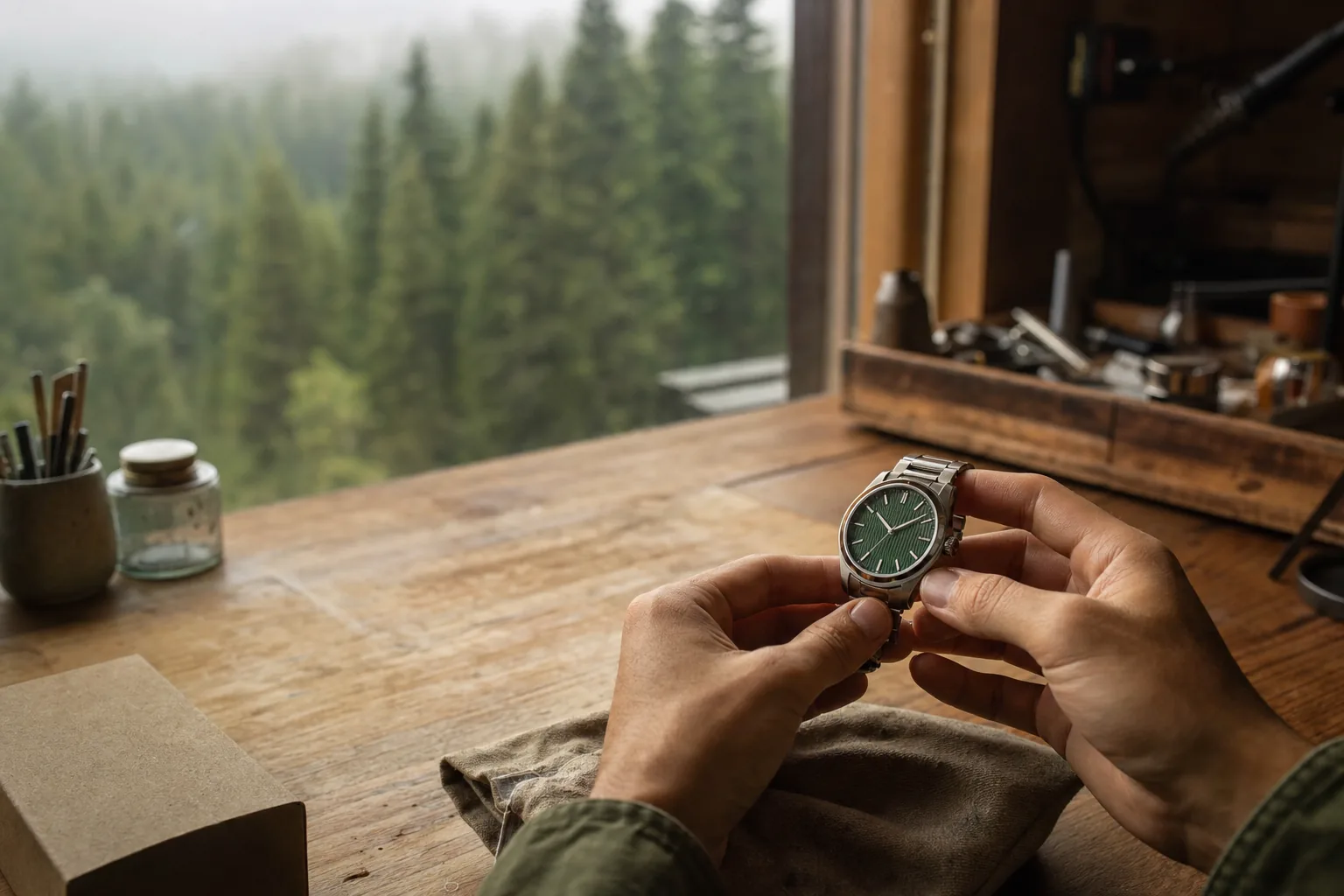
The SBGH283 is not on the Grand Seiko international website. It is not available at any authorised dealer in the US, Europe, or anywhere outside Japan. The only way to buy it new is to walk into Grand Seiko Studio Shizukuishi in Iwate Prefecture. That single fact — one reference, one building, one country — captures how Grand Seiko's domestic exclusivity actually works.
For collectors who follow the brand closely, this is a familiar frustration. Grand Seiko runs a substantial parallel catalogue for the Japanese domestic market (JDM): references that never appear in international price lists, dial series tied to specific studios or districts, and boutique-only editions allocated to individual stores by name. Grand Seiko sits at the top of Japan's domestic watchmaking hierarchy, and the brand's most place-specific pieces reflect that position.
What follows is a focused catalogue of those references — named, with calibres and case materials — and an explanation of the distribution logic behind them.
Japan-based Grand Seiko models are available through our Tokyo sourcing team. Describe the reference you want and we'll locate it within Japan's authorised network.
What does 'Japan domestic exclusive' actually mean for Grand Seiko?
JDM stands for "Japanese Domestic Market" — a term borrowed from the car world — and refers to references that are only sold in Japan. For Grand Seiko specifically, the category splits into two distinct tiers. The first is a standard JDM release: a reference produced in ongoing or limited quantities and sold across Japan's authorised boutique network, but not listed by Grand Seiko USA, Grand Seiko Europe, or any other regional subsidiary. The second is tighter still: a model allocated to a single location — one studio, one district, or one department store — with purchase limits enforced at the point of sale.
Most of the references discussed here exist because a specific Japanese partner — a studio, a flagship, a department store — commissioned or was allocated a piece that its own clientele would want and that the brand chose not to distribute further. That framing matters: a JDM release is not a production error or an oversight. It is a deliberate allocation decision.
The result is that a buyer in New York or Munich cannot walk into an authorised Grand Seiko dealer and order these pieces. They do not exist in those markets' allocation systems.
Which Grand Seiko dial series never leave Japan?
Several recurring dial themes appear only in Japan-market references, tied directly to the landscapes surrounding Grand Seiko's two main production studios. The Shinshu studio in Shiojiri, Nagano Prefecture, produces Spring Drive and quartz movements; the Shizukuishi studio in Iwate Prefecture produces the fully mechanical 9S-series calibres. Both studios generate their own exclusive dial vocabulary.
From Shinshu, the snowflake and ice-forest motifs appear in both global and domestic releases, but the most extreme expressions of those textures — the very fine Kira-Zuri finishes, the lion's mane patterns — are reserved for Japan. The SLGB001 and SLGB003 feature a new Ice Forest dial pattern inspired by the frost-covered trees in the Kirigamine Highlands east of the Shinshu Watch Studio. The SLGB003 is available internationally, but Japan receives additional variants in this series that do not appear in the US or EU allocation.
From Shizukuishi, the green forest dial — inspired by the woodland immediately surrounding the studio — is the defining motif. According to Time and Tide Watches, the SBGH283 has a dark forest green dial with a vertically striped motif, and Grand Seiko explains the watch is inspired by the forestry surrounding Studio Shizukuishi. In 2025, Shizukuishi Watch Studio released an updated pair of exclusive models, the SBGH371 and SBGH373. As Plus9Time documents, both models have green dials with a vertical pinstripe pattern, Ever-Brilliant Steel cases measuring 40 x 13.3 x 46.2mm, and utilise the 9S85 Hi-Beat calibre.
The Ginza district has its own dial language: street-map patterns in ice-blue, referencing the cobblestone grid of the area where Kintaro Hattori opened his first watch shop. These appear exclusively in Ginza-allocated pieces and never in international releases.
What makes the Shinshu Atelier exclusives different from international releases?
The Shinshu Watch Studio — located within a Seiko Epson facility in Shiojiri — produces all of Grand Seiko's Spring Drive and 9F quartz movements. The studio releases a small number of pieces each year that are allocated only to Japanese boutiques, often distinguished by dial textures or colour treatments that do not appear in the international Spring Drive lineup.
The 18K gold Shinshu exclusives are the clearest example. Three 18K gold-cased models were introduced for the Japanese market: the white gold SLGA027 with a blue sunray dial, the yellow gold SLGA028 with a golden coloured sunray dial, and the rose gold SLGA030 with a brown sunray dial. None of these appear in the US or EU allocation. The gold case format, combined with Spring Drive movements, positions them at the upper end of the Shinshu output — and the decision to keep them domestic reflects Grand Seiko's view of where demand for that combination sits.
The quartz exclusives follow a similar pattern. The SBGX357 "Skyflake" has a blue snowflake textured dial with a blue seconds hand inspired by the wind-swept snows of Shinshu reflecting a blue sky, in a titanium case measuring 37 x 10.6 x 44.6mm, utilising a 9F62 quartz calibre. The 9F62 is a high-accuracy quartz movement that achieves ±10 seconds per year — a specification that Grand Seiko's domestic market values highly, even in a non-mechanical watch. Several 9F-powered references in the Elegance Collection exist only in the Japanese domestic catalogue.
If you're tracking a specific Shinshu-made reference that doesn't appear on the international site, our Tokyo team sources directly from Japan's authorised boutique network.
Are Ginza flagship exclusives different from boutique-only pieces?
Yes — and the distinction matters for sourcing. Ginza exclusives are allocated to a defined cluster of boutiques in Tokyo's Ginza district, while broader "Japanese boutique" exclusives are available across all five of Grand Seiko's domestic flagship locations. A Ginza exclusive cannot be purchased at the Omotesando or Osaka boutique; a general boutique exclusive can.
The SBGH297 is the clearest example of a true Ginza exclusive. As Monochrome Watches reports, the Grand Seiko Heritage Ginza Limited Edition SBGH297 is a limited edition of 260 pieces, only available from the 5 authorized boutiques in the Ginza district, priced at JPY 770,000 and available from June 2022. The dial is inspired by the street map of the Ginza district — where Kintaro Hattori, the founder of Seiko, first opened his watch repair shop in 1881. The movement is the 9S85 Hi-Beat automatic, running at 36,000 vibrations per hour with a 55-hour power reserve and accuracy of +5 to -3 seconds per day.
In 2025, the Ginza Flagship Boutique introduced another district-exclusive: the Grand Seiko Flagship Boutique Ginza introduced a Wako exclusive model, the SBGJ291, as a limited edition of 70 units, according to Plus9Time. Seventy pieces, allocated to a single address. That is a narrower distribution than even most Swiss maisons manage for their most limited pieces.
The broader boutique exclusives — those sold at all five Japanese flagship locations — include pieces like the SBGW317, which was sold only at five Grand Seiko boutiques in Japan: the Grand Seiko Flagship Boutique Ginza Namiki-dori, Grand Seiko Boutique Ginza, Grand Seiko Boutique Omotesando Hills, Grand Seiko Boutique Osaka Shinsaibashi, and Grand Seiko Boutique Kyoto Shijo. It was a limited edition of 400 pieces, released in February 2025 at an MSRP of ¥847,000.
Which calibres appear only in Japan-market references?
The calibre question is more nuanced than it appears. Most of Grand Seiko's core movements — the 9S85 Hi-Beat, the 9R65 Spring Drive, the 9F62 quartz — appear in both domestic and international references. What changes is how those calibres are paired with case materials, dial treatments, and distribution channels.
That said, certain calibre-and-configuration combinations exist only in domestic references. The 9S64 hand-wound mechanical is one example: the SBGW317 uses this movement type, a mechanical hand-wound calibre with a power reserve of approximately 72 hours when fully wound and an accuracy of +5 to -3 seconds per day. The compact 36.5mm case format that houses this movement in the SBGW317 series — a format Grand Seiko calls the "44GS slim" — appears almost exclusively in domestic boutique releases.
The 9RA2 Spring Drive — Grand Seiko's slimmest automatic calibre, with a 120-hour power reserve from dual barrels — has appeared in both global and domestic references, but some of its most refined pairings are Japan-only. The SLGA007 uses the 9RA2 Spring Drive calibre: the slimmest Grand Seiko automatic calibre, providing a 5-day (120-hour) power reserve thanks to its dual barrels, with a one-piece centre bridge and a Shinshu Frost finish.
The table below summarises the key Japan-only references covered in this article:
| Reference | Calibre | Dial | Distribution | Edition Size |
|---|---|---|---|---|
| SBGH283 | 9S85 Hi-Beat | Dark green, vertical stripe | Studio Shizukuishi only | Ongoing (1 per customer) |
| SBGH297 | 9S85 Hi-Beat | Light blue, Ginza street map | 5 Ginza boutiques only | 260 pieces |
| SBGW317 | 9S64 manual wind | Green, Uwabo Bokuya pasture | 5 Japan boutiques only | 400 pieces |
| SBGH371 / SBGH373 | 9S85 Hi-Beat | Green, vertical pinstripe | Studio Shizukuishi only | Not disclosed |
| SBGA515 | 9R65 Spring Drive | Pink gold coloured | Isetan Shinjuku only | 35 pieces |
| SBGE315 | 9R66 Spring Drive GMT | Yellow, Yokohama seaside | Takashimaya Yokohama only | 70 pieces |
Why does Grand Seiko restrict certain models to domestic distribution?
Grand Seiko has never published a formal policy document on JDM allocation, but the logic is legible from the pattern of releases. The brand's domestic market is its most knowledgeable and most demanding. Releasing a piece tied to a specific Iwate forest or a Ginza cobblestone pattern to that audience — and only that audience — is a coherent brand decision, not an oversight.
The studio-exclusive model is the most extreme expression of this logic. As Time and Tide Watches confirmed after visiting Studio Shizukuishi, only the SBGH283 is exclusive to the studio — other models sold there with the special "Shizukuishi Limited" rotor can be bought globally in their standard configuration. At least in terms of buying it new, you can only buy the SBGH283 while visiting Studio Shizukuishi, at a limit of one per customer.
Department store and district exclusives follow a similar logic but serve a commercial purpose: they give individual retail partners a reason to invest in Grand Seiko displays and events. Thirty-five pieces exclusive to a single department store floor — as with the SBGA515, an Isetan Shinjuku exclusive with a pink gold coloured dial and 9R65 Spring Drive calibre — is a relationship-maintenance tool as much as a watch release.
What does a Japan-only Grand Seiko look like compared to a global model?
Side by side, a domestic Grand Seiko and its international counterpart often share the same case geometry, the same movement, and the same bracelet. The difference is in the dial and what it references. Global releases tend toward landscapes that read universally — snowflake textures, birch forests, mountain mist. Domestic releases go narrower: a specific pasture on the north face of a named mountain, the afternoon light above a specific block of Ginza, the exact shade of green visible from the Shizukuishi workshop windows.
The SBGH283 stands out with its green dial, inspired by the image of fresh leaves on the trees around the very studio where it is built, and enhanced with a vertically striped motif. Compare that to the SBGA211 Snowflake — inspired by the delicate snow formations seen on the wind-swept surfaces of the Hotaka mountains in winter — which is sold globally. Both reference the same Shinshu or Shizukuishi landscape tradition, but the Snowflake is legible to any buyer who has seen a photograph of Japan in winter. The Shizukuishi green requires knowing the studio exists and understanding why its particular forest matters to the craftspeople inside.
The finishing standard is identical. There is no quality gap between a domestic and an international reference — the Zaratsu polishing, the movement regulation, the dial texture work are held to the same standard across both catalogues. What differs is specificity of place and narrative.
How do collectors outside Japan even know these models exist?
The Grand Seiko Japanese-language website lists domestic exclusives that do not appear on the US or EU sites. Specialist tracking sites like Plus9Time publish annual roundups of every Grand Seiko announcement, including store-exclusive and JDM-only references, and Monochrome Watches covers individual domestic releases in detail. These sources are where most international collectors first encounter references like the SBGH297 or the SBGH283, and Time and Tide Watches covers the studio exclusives in depth.
Finding a Japan-only Grand Seiko isn't difficult — nearly every boutique in Tokyo has something domestic and exclusive, especially the flagship store at the base of Seiko House Ginza. The challenge is not discovery but acquisition: knowing the reference exists and being able to buy it new are two different problems. The Ginza boutique will not ship internationally. Studio Shizukuishi will not ship internationally. The department store exclusives are allocated to their specific floor and do not leave it.
The secondary market — Japan's domestic auction platforms and consignment specialists — does carry these pieces after their initial sale, which is how most international buyers eventually obtain them. The condition and provenance documentation on those pieces varies considerably, which is why understanding Japan's pre-owned market before pursuing a domestic Grand Seiko matters as much as identifying the right reference. And for buyers who want a specific piece from the current domestic allocation rather than the secondary market, a sourcing partner with a Tokyo presence is the direct route — the same logic that applies to Japan-only releases in other categories applies here.