· 10 min read
New Balance Made in Japan: What's Actually Different
A concrete breakdown of how New Balance's Japanese atelier M.Lab — and the leather, construction methods, and finishing it uses — produces a materially different shoe from the same model number built in the US or UK.
The box says 996. The tongue says 996. The silhouette is identical. But the M996JP that released in Japan on December 1, 2023 at ¥74,800 (around $500 USD at the time) is not the same shoe as the 996 you can pull off a shelf in Boston or London — and the difference is not branding.
What does 'Made in Japan' actually mean on a New Balance box?
On a New Balance box, "Made in Japan" means the shoe was built by M.Lab, a Japanese atelier that has partnered exclusively with New Balance since 2018 to produce its premium Japanese releases. Unlike the "Made in USA" label — which New Balance applies to any shoe where at least 70% of the value is domestically sourced — the MIJ designation covers shoes where essentially all production, including upper cutting, stitching, lasting, and finishing, takes place in Japan.
The Made in USA line is assembled across five factories in Massachusetts and Maine. New Balance's own standard holds that where domestic value reaches at least 70%, the shoe earns the label — which means up to 30% of the content can come from elsewhere. The MIJ line operates on a different logic entirely: bespoke production runs, hand-selected materials, and a process closer to a luxury goods atelier than a factory floor.
How is the M.Lab atelier different from the US and UK plants?
M.Lab is not a conventional footwear factory. Founded by Hitoshi Mimura, a master craftsman recognized with Japan's prestigious yellow-ribbon medal for artisanal excellence, the studio operates in deliberately small volumes — which is precisely what allows the level of hand-finishing that distinguishes every pair it produces. The New Balance US plants and the UK's Flimby factory run higher volumes with consistent quality; M.Lab runs lower volumes with a higher ceiling.
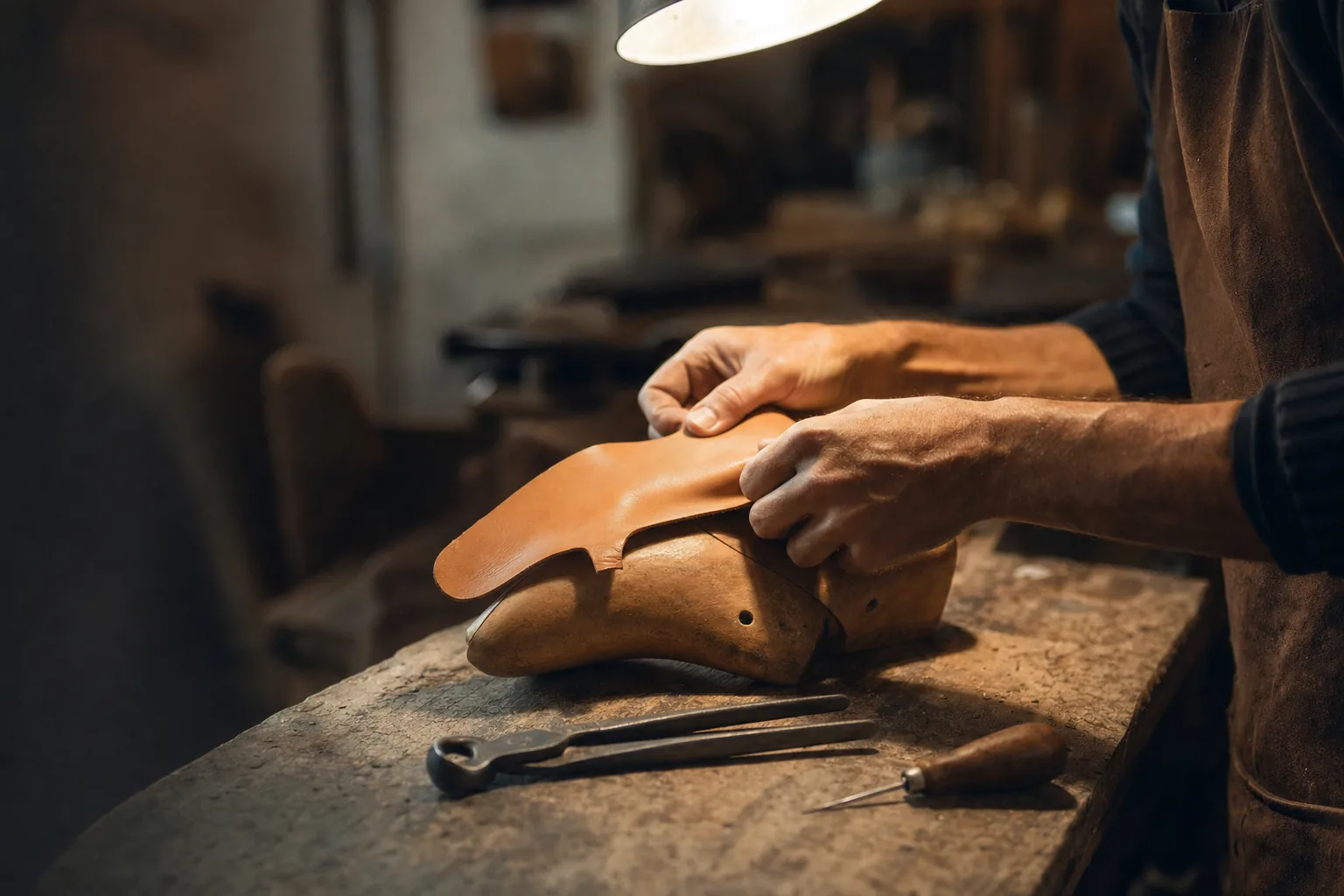
The production philosophy differs in one concrete way: M.Lab's team wore and tested prototypes for about a month before signing off on the 576 MIJ, adjusting construction details based on how the shoe actually behaved on foot. That kind of iterative hand-fitting is not part of a scaled production line's workflow. The result shows up in how the upper conforms to the foot — the lasting tension is set by hand, and the collar padding and heel counter are positioned to suit the last shape rather than a production average.
| Spec | Made in USA | Made in UK (Flimby) | Made in Japan (M.Lab) |
|---|---|---|---|
| Domestic content requirement | At least 70% by value | ~70–75% by value | Effectively 100% |
| Production volume | High (millions of pairs/year) | High (premium line) | Very limited, raffle-only |
| Upper leather sourcing | Domestic nubuck/suede | UK/European suede and leather | Tochigi vegetable-tanned leather |
| Construction method | Hand-assembled, machine-stitched | Hand-assembled, machine-stitched | Handmade, hand-lasted |
| Prototype testing | Standard QA | Standard QA | Extended wear-testing by artisans |
| Price point (recent releases) | $330 (1300JP, 2025) | Varies by model | $495–$522 (996, 1500 MIJ) |
Which New Balance models are made in Japan and what makes them special?
Only a handful of silhouettes have received the M.Lab treatment, and each one is a milestone release rather than a regular colorway. The most significant are the 1300JP, the M996JP, the 327 MIJ, and the 1500 MIJ. Since 2018, M.Lab has partnered with New Balance to manufacture special Made in Japan releases, including the prestigious 1300 and more recently the 327 and 996 anniversary editions.
The M996JP (released December 2023) is the clearest illustration of what the treatment does to a familiar silhouette. New Balance Japan's 996 isn't just a reissue of the retro sneaker but a true special edition, produced entirely in Japan — a rarity reserved for only the most significant Japanese New Balance releases. The upper uses Japanese-sourced suede and mesh, the sockliner is leather rather than synthetic foam, and the C-CAP midsole compound is retained from the original 1988 spec rather than updated to a modern substitute.
The 1300JP is the model that started the modern MIJ conversation. The 1300 is constructed from an upper stitched together by artisan shoemakers and built from Japanese steerhide leather and durable nylon, with the same top-quality leather used for the liners and insoles. The 2020 M1300JPJ version — the fully Japan-made variant built by M.Lab — replaced the standard mesh-and-suede upper entirely with full vegetable-tanned leather, a material the standard 1300JP does not use.
The 327 MIJ (released October 2022 at approximately ¥71,500) took a modern lifestyle silhouette and rebuilt it from scratch in Tochigi leather, from the toe box to the hand-cut medial "N" logo. For the shoe's construction, M.Lab selected the finest Tochigi leather, which has been produced in Japan since the late 1930s — a material whose surface develops a unique patina over time.
If you're tracking which Japan-market New Balance releases exist at all — not just how they're built — the broader picture of Japan-only sneaker releases that never reach the US covers the full scope of what stays exclusive to the Japanese market.
Is the leather on MIJ New Balance genuinely better quality?
Yes, and the difference is structural, not cosmetic. The key supplier is Tochigi Leather Co., a tannery established in 1937 that specializes entirely in full-vegetable tanning — a process that less than 10% of the world's leather production uses. Tochigi Leather employs a traditional pit tanning system using 160 pits filled with plant-derived tannin solution at varying concentrations, with hides immersed sequentially over approximately 20 days before being air-dried and re-tanned.
The full production cycle takes a minimum of around 90 days from start to finish. Chrome-tanned leather — which is what the overwhelming majority of sneaker uppers use, including standard New Balance models — is processed in roughly a day using chromium salts. The difference in the finished material is real: Tochigi's vegetable-tanned leather is one of the few remaining tanneries still producing leather this way, and the result is a hide that is denser, more structurally intact, and capable of developing a patina that chrome-tanned leather cannot replicate.
On the M1300JPJ, the standard mesh-and-suede upper was discarded entirely in favor of a full vegetable-tanned leather construction supplied by Tochigi Leather, with the material offering a natural tone designed to patina with age and use. The standard 1300JP — the US-made version — uses premium nubuck overlays over mesh. Both are quality materials. They are not the same material.
Used MIJ New Balance pairs hold their condition unusually well for the same reason Japanese sneaker culture more broadly produces better-preserved pre-owned stock — a pattern documented in detail in the piece on why used sneakers from Japan look nearly new.
If you're sourcing a specific MIJ model and want it evaluated before purchase, FindLuxuryJapan's Tokyo team can locate and assess the pair against current market pricing and condition standards.Why does the fit feel different on a Japan-made pair?
The last shape used in MIJ production is narrower and lower-volume through the midfoot than the standard last New Balance uses for its US and UK lines. New Balance's American production is built around a wider fit standard that reflects the brand's heritage as a running shoe for wider feet — a selling point since its founding. The Japanese market has historically preferred a slimmer silhouette, and M.Lab's lasts reflect that preference.
Beyond the last, hand-lasting produces a different fit outcome than machine-lasting. When a skilled craftsperson pulls the upper over the last and sets the lasting margin by hand, the tension across the toe box and midfoot is adjusted to the specific piece of leather rather than to a machine's fixed pull. The result is a shoe that fits more precisely to its own last shape — which is either an advantage or a disadvantage depending on whether that last shape matches your foot.
The practical implication: buyers who run wide should check the width options carefully before pursuing an MIJ pair. The standard MIJ release comes in D width only. The US-made 1300JP offers 2A through 2E — a range M.Lab does not match. If fit precision across the range matters to you, the US line is actually the more accommodating option. If you want the narrower, slimmer silhouette and the hand-lasted construction, the MIJ is the correct choice.
What does the 'J' suffix on a model number tell you about the shoe?
The "J" suffix on a New Balance model number originally designated Japan as the intended market — not the manufacturing origin. The 1300JP, for instance, is produced once every five years starting from 2000, using the model code 1300JP referring to Japan, the country where the sneaker achieved worldwide success. The standard 1300JP is Made in USA; the "JP" tells you it was designed for and first released in the Japanese market, not that it was sewn in Japan.
The M1300JPJ (note the second J) is the Japan-manufactured variant — the extra letter indicating Made in Japan production by M.Lab. The same logic applies to the M996JP: the "JP" marks it as a Japan-market release, and the M.Lab production makes it genuinely Made in Japan. When both conditions are true — Japan market and Japan manufacture — the shoe is the full MIJ specification. When only the first is true, you have a Japan-market shoe built to standard (usually US) spec.
The tongue label is the clearest tell. The differentiating feature of the Japan limited edition is the "Made in Japan" text above the embroidered model number on the tongue label. A "JP" suffix without that tongue text means Japan-market, not Japan-made.
Are Japan-made New Balance worth the price difference?
The price gap is significant. The M996JP retailed at ¥74,800 (around $500 USD at release) against a standard Made in USA 996 that sits well under $200. The MIJ 1500 released in November 2024 at 79,200 JPY (approximately $522 USD). The Made in USA 1300JP — itself a premium release — retailed at $330 USD for its 2025 edition.
Whether the premium is "worth it" depends on what you're buying. If the question is cushioning performance, the standard MiUSA line is not meaningfully inferior — the ENCAP midsole compound is the same technology. If the question is leather quality, patina potential, and the specifics of hand construction, the MIJ pair is a categorically different object. Tochigi vegetable-tanned leather will develop character over years of wear that chrome-tanned nubuck cannot replicate. The hand-lasted upper will conform differently to the foot. These are real differences, not marketing ones.
The secondary market reflects the gap. The M996JP was trading between $550 and $610 in the 12 months after release — a premium over retail that the standard 996 does not sustain. That premium is partly scarcity and partly the fact that the shoe itself is harder to replace with anything equivalent.
The same logic that makes Japanese-made luxury goods hold their value — material quality, production discipline, and a collector market that understands the difference — applies here. It's the same dynamic that makes Converse Japan a genuinely different shoe from its American equivalent, even when the silhouette looks identical.
Why is it so hard to find MIJ New Balance outside Japan?
MIJ New Balance releases are structured as Japan-market drops from the start. The M996JP released exclusively in Japan on December 1, 2023, through New Balance's Japanese channels. The 327 MIJ was similarly available only via New Balance Japan's website, through a raffle draw. The 1500 MIJ launched at the New Balance Harajuku store in Tokyo, again via raffle.
The combination of raffle-only allocation, Japan-exclusive release, and very limited production means that most pairs never leave Japan through official channels. What does reach international buyers comes through the Japanese secondary market — domestic auction platforms, consignment specialists, and individual sellers — and the condition standards of that market are notably high. Japan's pre-owned grading conventions, which are stricter and more granular than Western equivalents, mean that even a pair that has been worn is likely to be in better condition than a "used" pair sourced elsewhere. The Japanese pre-owned grading system is worth understanding before you buy from any Japanese source.
The practical barrier for most buyers outside Japan is not finding the shoe — it's navigating the raffle system, the Japanese-language listings, and the logistics of getting a pair out of Japan without paying resale premiums that erase the value of buying close to retail.
Finding a specific MIJ New Balance pair at a fair price, evaluated against current market conditions, is exactly the kind of request FindLuxuryJapan handles — our Tokyo team sources through Japan's domestic channels and ships globally with tracking and insurance.