· 11 min read
Japanese Luxury Brands by Lifestyle: Shoes, Leather, and Fashion Picks
A category-by-category guide to Japan's finest shoe, leather goods, and fashion makers—with specific model lines, grading tiers, and the structural reasons most of these pieces never appear in Western retail.
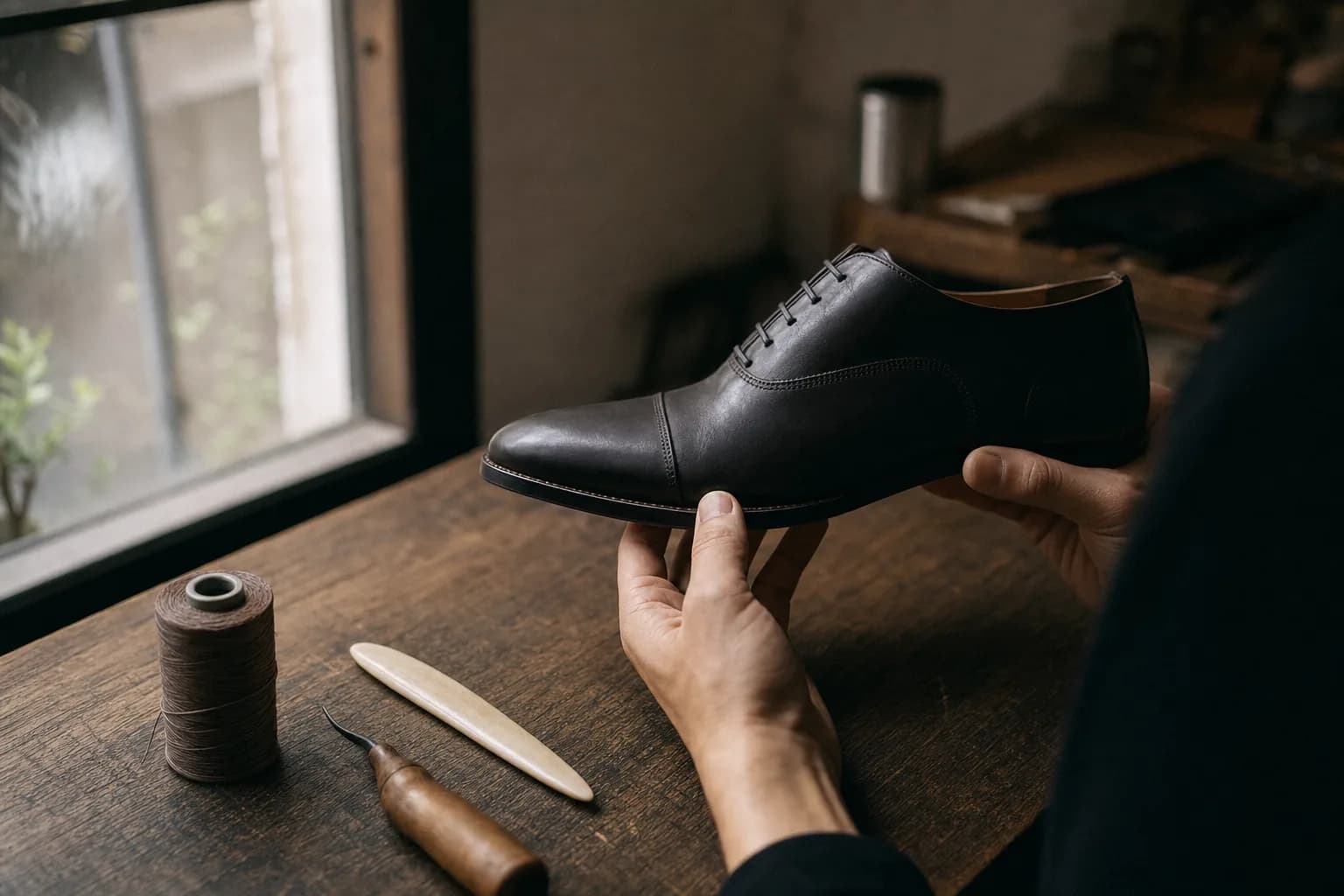
The Yohei Fukuda Heritage Collection oxford is not sold in a single US or European boutique. It is made to order at a Shibuya showroom, produced in runs of roughly 60 pairs a year, and the only route to one is Tokyo, an occasional Hong Kong trunk show, or a sourcing partner who can reach the Japanese market directly. That pattern—extraordinary craft, deliberate scarcity, zero export infrastructure—repeats across Japanese luxury shoes, leather goods, and fashion at every price tier. This guide maps the right maker to your priorities before you start looking.
The lifestyle-organized comparison of Japanese luxury brands across all categories in the definitive category verdict covers the full field; what follows goes deeper into the three categories where Japan's domestic-only distribution is most consequential for Western buyers.
What makes Japanese luxury shoes different from European alternatives?
Japan's shoe culture is rooted in the shokunin philosophy—the master artisan's relentless pursuit of perfection—applied to a craft that only arrived from the West during the Meiji era. Japanese makers did not invent the Oxford or the Derby; they spent a century deconstructing and perfecting them. The result is a distinct aesthetic: thinner welts, more beveled waists, closer sole stitching, and a restraint in ornament that reads differently from the heavier English tradition or the more decorative Italian one.
The structural difference is also in scale. There are somewhere between 35 and 40 bespoke shoemakers in Japan, and almost all are essentially sole operators—one person founded the house, is in charge, and has little interest in building a larger operation. That keeps quality consistent and prices lower than comparable European bespoke work, but it also means output is tiny and export distribution is structurally impossible.
Which Japanese brands make the best men's dress shoes?
For bespoke and made-to-order work, Yohei Fukuda and Marquess (Shoji Kawaguchi) are the two names that come up first in serious shoemaking circles. Both trained in England—Fukuda learned shoemaking in Northamptonshire and worked for several years for London firms before returning to Japan. His made-to-order service is offered exclusively at his Tokyo store, with MTO shoes available in widths D through G. The Classic Collection models start at around ¥280,000 and Heritage models at around ¥300,000 (prices as documented in buyer guides from 2016; current pricing should be confirmed directly with the maker).
Marquess bespoke shoes were priced at ¥346,000 plus tax as of the mid-2010s, with Shoji traveling within Japan and occasionally to Hong Kong. Neither maker has a US or European retail presence.
At the ready-to-wear tier, Scotch Grain manufactures Goodyear-welted dress shoes entirely in-house at its Sumida Ward factory in Tokyo, using lasts built for Japanese feet and leathers sourced directly from European tanneries by the company president himself. The brand was founded in 1978 in Tokyo's Taito Ward and operates from its original Sumida factory. It has no international retail distribution; the official online shop ships within Japan only.
| Maker | Tier | Key model lines | International retail? |
|---|---|---|---|
| Yohei Fukuda | Bespoke / MTO | Classic Collection (Cobalt, Foliage, Willow); Heritage Collection (Teal, Celeste, Guethe) | No — Tokyo store and occasional HK trunk show only |
| Marquess (Shoji Kawaguchi) | Bespoke | Full brogue, seamless-heel constructions | No — Japan and occasional HK visits |
| Hiro Yanagimachi | Bespoke / MTO | Over 50 types including classic and original designs | Occasional overseas trunk shows only |
| Scotch Grain | RTW Goodyear-welt | Oxford, Derby, loafer in multiple widths | No — Japan domestic only |
Hiro Yanagimachi, also London-trained, operates from Tokyo and offers more than 50 types of shoes and boots across three order methods, with occasional overseas trunk shows. The range is broader than Fukuda's, which makes it a better starting point for buyers who want to explore silhouettes before committing to a specific house style.
Are there Japanese luxury sneakers worth sourcing from Japan?
Visvim sits at the intersection of luxury craft and sneaker culture in a way no European brand has matched. The FBT moccasin, which debuted in the early 2000s, combines naturally dyed leathers and hand-sewing techniques with EVA foam cushioned Vibram soles—each pair's vegetable-dyed upper ensures no two are identical. Designer Hiroki Nakamura founded the brand in 2002, inspired by traditional craft techniques from across cultures. While Visvim has a North American web store, the full Japanese domestic range—including colorways and seasonal exclusives released only through the Tokyo flagship and select domestic stockists—is substantially wider than what reaches export channels. For Japan-only releases across the sneaker category more broadly, the dedicated guide to Japan-only sneaker releases covers the mechanics of how these drops work and why they stay domestic.
The FBT's style number (0119101001009) appears in sand and black colorways through international channels, but limited seasonal variants in indigo, natural dye, and collaboration editions circulate almost exclusively in the Japanese domestic market and its pre-owned ecosystem.
What Japanese leather goods brands rival the European heritage houses?
Ganzo is the benchmark. Ganzo pursues the concept of "genuine" throughout the entire process—from material selection to cutting, skiving, stitching, and polishing—without compromise. Its cordovan series uses leather treated with a laborious immersion-dyeing process and an oil finish; the ROCADO cordovan it sources comes from a workshop in Tuscany's Santa Croce that integrates traditional leatherworking methods to craft fine cordovan from cowhide. The koba (edge) finishing on Ganzo pieces is a reference point in Japanese menswear publishing. Ganzo's mastery of cordovan and bridle leather is considered unmatched, and its repair service means these wallets are built to be used and maintained for an entire lifetime.
Ganzo sells exclusively through its own boutiques, with no wholesale distribution—a deliberate decision that keeps craftsman focus over volume. That also means no international stockists, no international e-commerce, and no path to purchase outside Japan without a local intermediary.
Tsuchiya Kaban operates at a different register. The brand started by making schoolbags and has a simple, unpretentious identity—its L-zip and small leather goods in nude leather start stiff and gradually soften into the exact shape of your hand. Its briefcases and totes use vegetable-tanned leather sourced from premium tanneries, with each piece passing through more than 100 production steps and carrying a lifetime repair guarantee. The domestic price range runs from around ¥80,000 to ¥200,000 for flagship briefcases.
CYPRIS is the closest rival to Ganzo in technical quality at a more accessible price point, with its signature "kikuyose" (chrysanthemum gather) stitching producing wallets that are thin yet highly durable. Their proprietary Shirasagi leather develops a distinctive uneven patina as it ages. Like Ganzo and Tsuchiya Kaban, CYPRIS has no meaningful international retail footprint.
The structural reason all three stay close to home is the same: Japanese leather brands compete almost entirely on construction quality rather than logo recognition. That makes them difficult to market through international channels, where brand awareness drives purchasing decisions. The full context for how this plays out across all Japanese luxury categories is in the definitive category verdict.
Which Japanese fashion brands sit at true luxury level—not just premium?
Three houses have maintained Paris Fashion Week presences for decades while keeping their most significant pieces in Japan: Comme des Garçons, Yohji Yamamoto, and Issey Miyake. The distinction between "luxury" and "premium" here is not price—it is conceptual authority. These brands have shaped how fashion thinks about construction, silhouette, and material in ways that European houses have borrowed from rather than influenced.
Yohji Yamamoto presented his first collection in Tokyo in 1977 and his first Paris collection in 1981. His work across four decades centers on deconstruction, asymmetry, and monochrome severity. The domestic Japanese range of Yohji Yamamoto Pour Homme—the mainline men's collection—includes pieces that are produced in limited quantities and sold through the Tokyo flagship and select department store concessions that do not ship internationally. Archive pieces from significant seasons (the mid-1980s Paris debut era, the early 1990s reconstruction period) circulate almost exclusively in Japan's pre-owned market.
Comme des Garçons operates through multiple lines with different distribution profiles. CDG SHIRT, CDG PLAY, and the diffusion lines reach international stockists. The mainline Comme des Garçons Homme Plus runway collection and the Rei Kawakubo signature line are produced in smaller quantities, with the strongest selection available at the Dover Street Market Tokyo location and Japanese department store concessions. Certain seasonal drops and collaboration pieces—including the KAWS collaboration Homme Plus pieces—were Japan-market weighted at release.
Visvim's garment line, sold through its Tokyo F.I.L. (Free International Laboratory) flagship, includes pieces in indigo-dyed Japanese fabrics, hand-woven textiles, and natural dye colorways that are not part of the North American web store assortment. The price differential between Japanese domestic retail and what reaches international gray-market channels for these pieces is significant.
How does the Japanese pre-owned market change what is available in each category?
For shoes, leather goods, and fashion, Japan's pre-owned infrastructure is the most consequential access point for international buyers. Japan uses a standardized S/A/B/C/D grading scale across most major resale stores, with rank S or SA meaning virtually unused—a transparency level that Western markets lack.
For shoes specifically, this means Scotch Grain oxfords in excellent condition, Yohei Fukuda MTO pairs from previous clients who have upgraded, and Visvim FBT colorways that never reached export channels all circulate through Japan's domestic auction platforms and specialist pre-owned stores. The condition grading applies directly: an S-rank Fukuda pair means unworn or near-unworn; an A-rank pair shows minimal use consistent with careful ownership.
For Comme des Garçons, Yohji Yamamoto, and Visvim in particular, Japan's authenticated pre-owned market offers remarkable pieces in excellent condition at significantly reduced prices compared to what the same items command through Western archive dealers. A Comme des Garçons Homme Plus runway jacket from a significant season, graded A-rank, will typically be priced lower in Tokyo than the same piece would be at a Paris or New York archive specialist—because the supply is larger and the domestic buyer base, while sophisticated, is not competing with global collector demand in the same way. The complete guide to buying second-hand luxury in Japan covers the infrastructure in full.
What condition grades and model references should I know before I start looking?
The general framework across major Japanese resale chains is consistent and widely understood: S or SA means virtually unused; A means minimal signs of use; AB means light wear visible on close inspection; B means moderate wear appropriate for the item's age; C and below indicate significant wear or damage. For shoes, "S-rank" is rare—most pre-owned Goodyear-welt shoes that have been worn at all drop to A or AB. For leather goods, an S-rank Ganzo wallet means the piece was purchased and stored rather than carried.
Model references matter most in the shoe category. For Scotch Grain, the Hiroki last (wider, built for Japanese foot proportions) and the Annonay calf series are the references that come up most often among serious buyers. For Ganzo, the Cordovan series (shell cordovan, immersion-dyed) and the Bridle series (English bridle leather exterior, shoulder Nume leather interior) are the two flagship lines to know. For Visvim FBT, the style reference 0119101001009 covers the core moccasin silhouette; colorway and season matter more than the base style number for pre-owned valuation.
The dedicated guide to Japan's pre-owned grading system goes deeper on how grades translate across different item categories and what the written condition notes on Japanese price tags actually mean.
Why is it hard to find these specific brands and pieces outside Japan?
The distribution gap is structural, not accidental. Japanese luxury makers in these three categories share a common business model: small production volumes, direct-to-consumer domestic sales, and no appetite for the wholesale relationships that would get them into international multi-brand retail. A Ganzo atelier that produces a limited number of pieces per year has no reason to negotiate with a foreign buyer—the domestic waiting list absorbs everything made. A bespoke shoemaker producing 60 pairs annually has no infrastructure to manage international orders, returns, or warranty claims.
For fashion, the dynamic is slightly different. Comme des Garçons and Yohji Yamamoto do have international distribution, but the domestic Japanese range is consistently wider—more lines, more colorways, more collaboration pieces, and the full depth of each season's production rather than the edited selection that reaches export markets. The pieces that are hardest to find abroad are not necessarily the most expensive ones; they are the ones that were produced in small quantities for a domestic audience that understood the context.
The practical consequence is that reaching these makers requires either being in Japan, knowing someone who is, or working with a sourcing service that can navigate domestic platforms and evaluate condition accurately. The reasons Japanese sellers sometimes decline to engage with international buyers directly—language, payment systems, and the logistics of international returns—are covered in the guide to why Japanese sellers refuse international buyers.