· 13 min read
Second-Hand Luxury Shopping in Japan: How to Authenticate Designer Pieces Before You Buy
Japan's pre-owned luxury market runs on a formalized authentication infrastructure — specific grading scales, police-issued dealer licenses, and brand-specialist appraisers — that most Western buyers have never encountered.
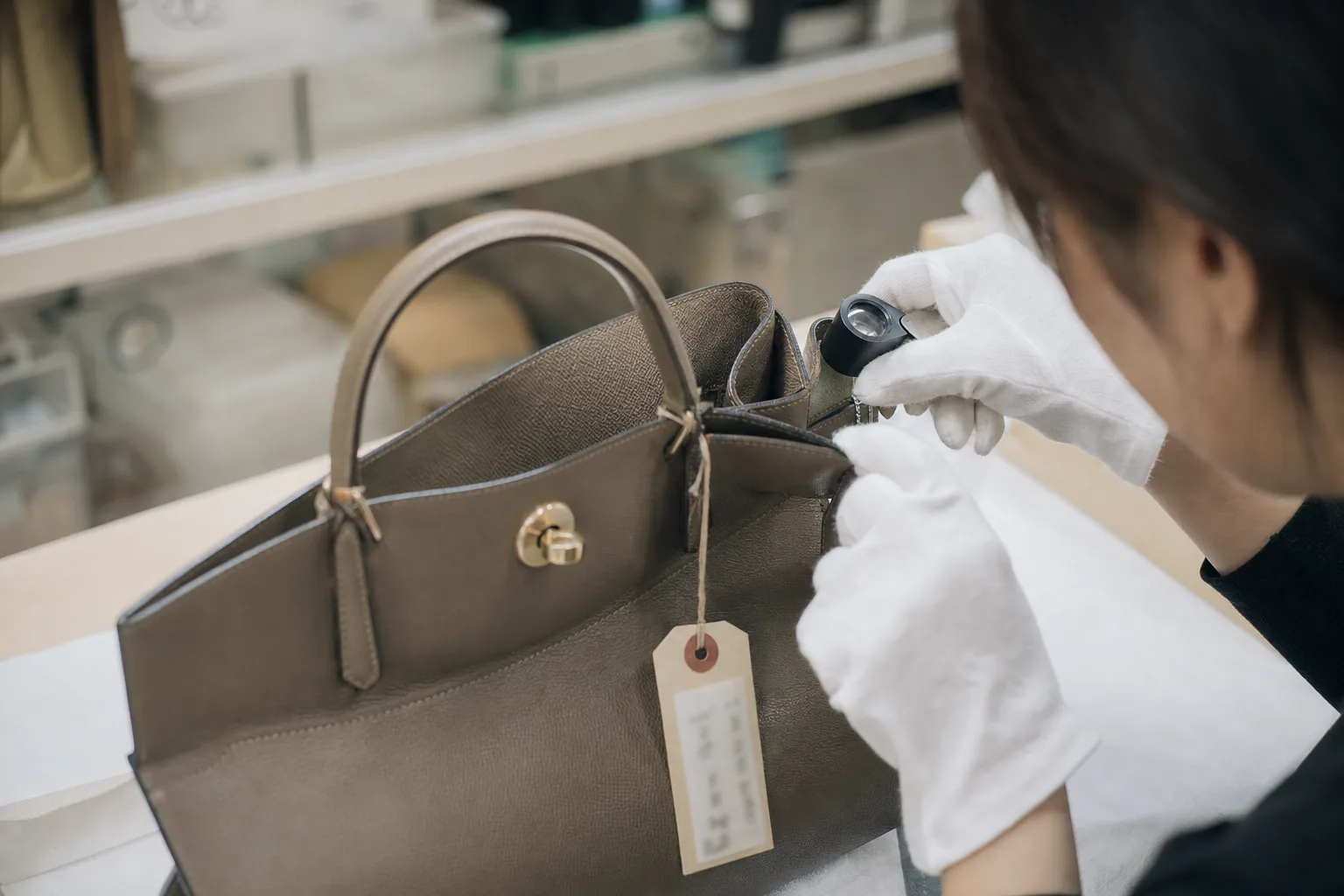
A Chanel Classic Flap listed at an S-rank in a Ginza consignment specialist carries a paper trail that most Western buyers have never seen: a condition tag written in Japanese, a store authentication certificate, a transaction record filed under a police-issued dealer license, and — if the original owner kept everything — a purchase receipt from the Chanel boutique where it was first sold. Each of those documents means something specific. This article explains what.
Understanding that infrastructure matters before you buy, not after. The grading vocabulary, the appraiser credentials, and the physical markers on a Japanese authentication certificate are not interchangeable with what you are used to at home. They are a different system, and a better one — but only if you know how to read it.
If you want to understand how Japan's pre-owned market compares to Western resale channels at a higher level, the complete guide to buying second-hand luxury in Japan covers the broader landscape before you get into authentication specifics.What makes Japan's pre-owned authentication system different from the West?
The structural difference is legal, not cultural. Every business that buys secondhand goods for resale in Japan must hold a Kobutsusho Kyoka (古物商許可) — a secondhand dealer license issued not by a trade ministry but by the local police station. That choice of licensing authority is deliberate: the body that issues the license is also the body that investigates stolen goods and counterfeit offenses.
Licensed dealers must maintain a transaction ledger — the kobutsu daichō — recording the date, item description, quantity, price, and seller identity verification for every acquisition of secondhand goods. That ledger is subject to police inspection. Dealers operating online must submit their URL to the police, and the police maintain a publicly searchable database of licensed dealers. Trading secondhand goods without this license is punishable by imprisonment for up to three years, a fine of up to ¥1 million, or both.
Inside licensed Japanese chains, authentication is a professional function with dedicated headcount. Many major chains employ specialists who focus exclusively on a single brand category — one person for Hermès, another for Chanel, another for Rolex. Items that fail authentication are rejected entirely rather than sold at a discount — a practice that differentiates Japanese chains from many Western consignment operations.
Jewellery specialists at established Tokyo boutiques are required to hold formal credentials. Staff at heritage-pawnshop operations must pass the Jewellery Coordinator Certification Level Three Qualification from the Japan Jewellery Association, and watch staff hold a Certified Watch Coordinator (CWC) qualification from Japan's Watch Importers' Association. These are not in-house training certificates — they are governed qualifications from industry bodies.
What do the Japanese condition grades actually mean — and how do they map to what I'd expect at home?
The Japanese grading scale runs S → SA → A → AB → B → BC → C → D, and it is broadly consistent across the major licensed chains. The consistency matters most for remote buyers: a B-grade piece from one licensed chain and a B-grade piece from another will be in roughly comparable condition, because the industry has normalized around shared expectations.
Western platforms use inconsistent terminology. "Excellent" on one US platform does not mean the same as "Excellent" on a European one. There is no governing body enforcing a shared vocabulary, and no licensing framework that makes misrepresenting condition a criminal matter. In Japan, both of those things exist.
| Japanese Grade | What it means in practice | Rough Western equivalent |
|---|---|---|
| S / SA | Virtually unused; often with tags, box, or original receipt. No visible wear. | "Mint" or "New with tags" |
| A | Light use; very faint surface marks only, hardware bright, lining clean. | "Excellent" (at its best) |
| AB | Moderate light use; minor scuffs or corner wear, still presentable. | "Very good" |
| B | Visible signs of use — scratches, hardware tarnish, possible interior marks. | "Good" |
| BC / C | Significant wear; may need cleaning or minor repair. Still authentic, still usable. | "Fair" or "Acceptable" |
| D | Heavy wear, damage, or missing components. Priced accordingly. | "Poor" / parts value |
The grade is not the whole story. Japanese price tags for resale items typically list the grade, specific condition notes, original accessories included, and whether the original receipt is present. A tag reading 角スレあり (corner scuffing present) or 金具くすみ (hardware tarnish) is a sign of honest, detailed grading — not a warning to avoid the item. That transparency is a feature of the system. For a deeper breakdown of every grade level and how to use them when evaluating a specific piece, Japan's pre-owned grading system, decoded goes through each tier in detail.
What physical checks do Japanese appraisers carry out on a luxury handbag or watch before grading it?
The inspection begins before the shop commits to buying the piece — not after. At the acquisition stage, an appraiser examines the item against the claimed brand, model, and condition. Only pieces that clear authentication are purchased; those that fail are returned to the seller without entering the inventory.
In-house authenticators check everything from the nature of the materials to barely visible hallmarks, assisted by cutting-edge technology for high-tech identification. For a handbag, the physical inspection typically covers:
- Hardware weight and engraving. Genuine hardware has a specific weight and depth of engraving. Counterfeit hardware is lighter and the engraving shallower or less precise.
- Stitching count and thread color. Authentic Hermès items are handmade, with intricacies based on the craftsman and leather. Stitch counts and thread colors are documented for each model and era; deviations flag a problem.
- Date codes and blind stamps. The appraiser checks that the code format matches the claimed production era, that the factory code matches the "Made in" stamp, and that the font is correct for the period.
- Lining condition and odor. Interior lining is checked for ink transfer, staining, and odor — issues that affect grade assignment and that an honest grader notes explicitly.
- Leather texture and patina. Genuine leather ages in predictable ways. Pre-aged replica materials behave differently under inspection.
For watches, the inspection adds movement verification (where caseback access is possible), crown and pusher function, crystal condition, and serial number cross-referencing against production records.
What should I look for on an authentication certificate or grading tag issued in Japan?
A Japanese authentication certificate from a licensed chain is not a generic document. It carries specific information that makes it meaningful and traceable. The key elements to look for:
- The dealer's Kobutsusho license number (古物商許可番号). This is the police-issued license number. Its presence means the seller is operating within Japan's secondhand dealer framework. You can verify it against the police's publicly searchable database of licensed dealers.
- Brand, model, and reference number. A legitimate certificate names the specific item — not just "Hermès bag" but the model, leather type, color, and hardware finish.
- Condition grade. The grade assigned at inspection, consistent with the grading scale described above.
- Specific condition notes. Any flaws identified — corner wear, hardware tarnish, lining marks — should be listed explicitly. A certificate that describes a piece as "good condition" without any specifics is less useful than one that says AB with noted corner scuffing.
- Appraiser's name or staff code. Larger chains identify the appraiser responsible for each piece. This creates accountability and allows the grading decision to be reviewed.
- Date of appraisal. Condition degrades over time. A certificate issued years before purchase is less informative than a recent one.
Most major chains issue their own authentication documentation with each purchase. When original brand documentation — purchase receipts, authenticity cards, dust bags — is present, it is noted on the certificate and typically included with the item. Its absence is noted too, which is itself useful information.
How do brand-specific tells — serial numbers, date codes, hardware stamps — differ by maker?
Each major house uses a different identification system, and Japanese appraisers are trained to the specifics of each. The variation matters because a check that works for one brand is irrelevant for another.
Louis Vuitton uses date codes, not serial numbers. The date code is a stamped identifier showing the manufacturing factory and production date, following a two-letter, four-digit format. The first two letters identify the manufacturing country and factory; these letters must match the "Made in" country on the Heat Stamp inside the piece. A mismatch between the factory code and the Heat Stamp is a significant red flag in authentication. The format of the code itself changed in 2007 — post-2007 pieces use a week-of-year format rather than a month format, so a claimed 2010 piece with a month-format code is immediately suspect. Authentication requires checking the date code alongside stitching consistency, hardware weight and engraving precision, material quality, and Heat Stamp font — no single element is conclusive on its own.
Chanel uses serial numbers, not date codes. On bags made between 1986 and 2021, the serial number is on a white sticker with a hologram, typically located inside the bag's interior pocket or behind the zippered compartment. On bags made from 2021 onward, Chanel replaced stickers with a metal plate featuring a microchip. The CC lock has a specific overlap: right C over left on top, left C over right on the bottom. Quilting alignment, hardware weight, leather grain, and the heat-stamp must all agree. Phillips-head screws on the hardware are an immediate fake indicator — Chanel has never used them. For a detailed look at what authenticated Chanel pieces can conceal even after passing initial inspection, spotting undisclosed repairs on authenticated Chanel bags covers the specific tells that even graded pieces can carry.
Hermès does not issue authenticity cards. Authentication relies on the blind stamp — a letter in a shape that identifies the production year. Hermès uses letters in alphabetical order to date the bags, surrounded by a shape: a circle from 1971 to 1996, a square from 1997 to the present. Authentic Hermès hardware is plated in precious metal and will not tarnish. A small hallmark appears next to the "Paris" stamping on gold-plated hardware. The blind stamp location, the craftsman's stamp, and the hardware hallmark are cross-referenced together — no single marker is sufficient.
Why does provenance documentation matter more in Japan's resale channel than elsewhere?
Japanese consumers keep documentation. Original purchase receipts, authenticity cards, dust bags, boxes, and brand care booklets are retained at rates that are unusual by Western standards — a reflection of both the cultural emphasis on item care and the awareness that documentation affects resale value. In Japan, stores carefully note whether the original box, dust bag, authenticity card, and receipt are included. Items with full original packaging command higher prices but offer better resale and authentication value.
A purchase receipt from the original Japanese boutique is particularly useful. It establishes where and when the item entered the market, which eliminates one category of risk — the piece was not imported from a grey-market source or assembled from components. For high-value pieces like a Hermès Birkin or a Rolex Daytona, that provenance chain is the foundation of the authentication case, not a supplementary detail.
What are the red flags that a piece has not gone through proper Japanese authentication?
The absence of a Kobutsusho license number on any certificate or seller profile is the first and most significant flag. A seller operating without a license is outside the regulatory framework entirely — no transaction ledger, no police oversight, no criminal accountability for selling counterfeits under Japan's Trademark Law.
Other flags to watch for:
- A grade with no supporting condition notes. Legitimate Japanese grading is specific. A certificate that says "A rank" without naming any flaws — or explicitly confirming there are none — is incomplete. Real graders note what they found, not just a letter.
- Condition claims that conflict with the piece's age. An S-rank on a bag that was produced fifteen years ago and shows no use is plausible only if the original owner stored it unused. If provenance documentation cannot support that story, the grade should be questioned.
- A price significantly below market for the grade. Japan's pre-owned market is price-efficient. Pieces at licensed chains are priced to reflect condition and provenance accurately. A piece priced 40% below comparable graded inventory is not a find — it is a question.
- Missing original documentation on a piece claimed to be S or SA rank. A virtually unused piece that comes with no original packaging, no receipt, and no authenticity card is inconsistent with the grade. S-rank pieces almost always retain at least some original documentation.
- Brand-specific markers that don't align with the claimed production era. A date code format that doesn't match the year, a serial number digit count that's wrong for the claimed period, a blind stamp shape that doesn't correspond to the claimed decade — any of these indicate either a fake or a mislabeled piece.
Why is sourcing through a specialist concierge the only reliable way to apply this knowledge from outside Japan?
The authentication infrastructure described in this article operates in Japanese, within Japan's legal framework, and through relationships with licensed dealers that take years to build. Reading about the kobutsu daichō is not the same as being able to verify that a specific seller's license number appears in the police database. Understanding what 角スレあり means on a condition tag is not the same as being able to read the full tag on a piece listed in a domestic-only auction.
The practical gap between knowing the system and being able to apply it from outside Japan is significant. Japan's domestic auction platforms — where some of the best-graded pre-owned inventory moves — are not accessible to international buyers directly. The licensing requirement for participation applies to the buyer's agent, not just the seller. Consumer-to-consumer platforms carry the risks described above, and the pieces on them are not subject to the same authentication standards as licensed chain inventory.
FindLuxuryJapan's Tokyo-based sourcing team locates pieces through licensed Japanese dealers, domestic auction platforms, and a network of vetted partners who guarantee authenticity. Every piece is evaluated through pricing, condition, and authenticity models before a purchase is confirmed. The sourcing fee is 10% of the item price, with a minimum of ¥5,000, quoted before approval and fixed after that. Pre-owned and auction items typically take one to three weeks from match to dispatch, because the process waits for the right piece rather than buying the first available.
The knowledge in this article is the foundation. Applying it to a specific piece, in a specific condition, from a specific seller in Japan, is what the concierge model exists to do. For buyers who want to understand the broader context of what is available — and why certain pieces surface only in the Japanese market — the guide to luxury thrift and vintage shopping in Japan covers the supply side of that equation.