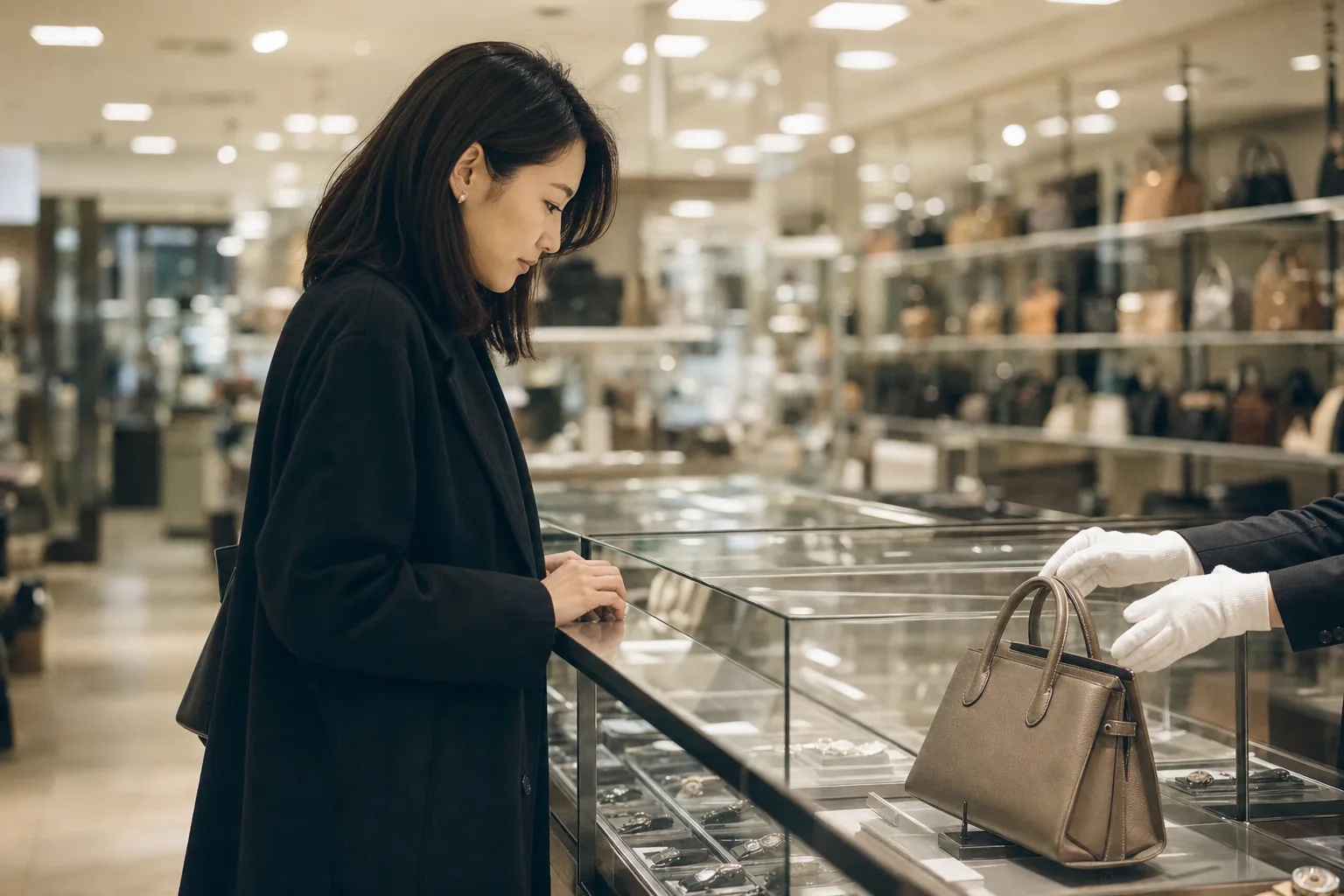
A Hermès Birkin 25 in Bleu Indigo Togo sits in a glass case in Komehyo's Shinjuku store, priced in yen, with its original box, clochette, and dust bag. The same bag in London or New York would require a waitlist, a relationship with a sales associate, and a retail price that has climbed past any reasonable secondary comparison. In Japan, it is simply for sale — authenticated, graded, and sitting next to thirty others. That is the market this article maps.
Japan's pre-owned luxury scene is not a niche. It is a parallel retail economy with its own chains, laws, grading standards, and online platforms. Understanding what exists — and why it exists in this form — is the starting point for any serious international buyer.
The Japan-market inventory available through FindLuxury Japan's Tokyo sourcing team covers exactly this ecosystem — submit a request and we'll locate, evaluate, and ship the item to you.What makes Japan's second-hand luxury market unlike any other?
The depth comes from two interlocking forces: a cultural habit of treating possessions with unusual care, and a legal framework that has professionalized resale for over seven decades. Japanese consumers buy luxury goods at high rates, maintain them meticulously, and sell them through formal channels rather than informal ones. The result is a supply of pre-owned items that arrive at resale counters in near-mint condition, with original packaging intact, at a frequency that no Western market can match.
The yen's sustained weakness against the dollar and euro through 2024 and 2025 added a currency layer on top of an already favorable price structure. A buyer converting from dollars or euros is effectively getting a discount on a discount. That combination — deep supply, high condition standards, and currency advantage — is what makes Japan's market structurally different, not just marginally better.
Five items illustrate the point concretely:
- Hermès Birkin 25 (Bleu Indigo Togo, palladium hardware) — Not available for direct purchase at any Hermès boutique outside Japan without a purchase history. In Japan's resale market, it circulates freely through licensed dealers.
- Chanel Classic Flap Medium (21S collection, iridescent calfskin) — Seasonal colorways from Japanese boutiques enter the resale market within months of release, often with full provenance documents.
- Louis Vuitton Speedy Bandoulière 25 (pre-March 2021, with date code) — Authenticating pre-2021 Louis Vuitton relies partly on the date code system that Louis Vuitton discontinued in March 2021, replacing physical stamps with embedded RFID microchips. Japan's resale market holds the largest global stock of these date-code pieces in documented condition. For a thorough breakdown of how to read those codes, Bagaholic's date code guide covers every factory code from the early 1980s through the 2021 changeover.
- Grand Seiko SBGW231 — A hand-wound dress watch sold exclusively through Grand Seiko's Japanese domestic network. It does not appear in US or European authorized dealer inventories; it surfaces in Japan's resale market when Japanese collectors upgrade or consolidate.
- Issey Miyake Pleats Please archive pieces (1990s) — Japanese fashion archive items from designers like Issey Miyake and Comme des Garçons circulate in specialist boutiques in Aoyama and Harajuku at prices that reflect local market conditions rather than international collector premiums.
Which major retail chains dominate Japan's pre-owned luxury scene?
Three chains operate at a scale that puts them in a category of their own: Komehyo, Brand Off, and Daikokuya. Each has a distinct positioning, and together they account for a significant portion of the authenticated second-hand luxury sold through physical retail in Japan.
| Chain | Founded | Store count | Positioning | Strength |
|---|---|---|---|---|
| Komehyo | 1947 (Nagoya) | 294 stores in Japan | Premium resale, large format | Watches, fine jewelry, bags |
| Daikokuya | 1947 | 24 stores (Kanto, Chubu, Kansai, Kyushu) | Pawnshop heritage, competitive pricing | Hermès, Rolex, Chanel |
| Brand Off | — | 30+ locations | Wide price range, accessible entry | European luxury across categories |
| Brand Collect | — | Multiple Tokyo locations | Fashion-forward, designer clothing | Yohji Yamamoto, CDG, Saint Laurent |
Komehyo is the most frequently cited and the most broadly stocked. Founded in Nagoya in 1947, it has grown into Japan's largest luxury reuse company, now operating 294 stores across Japan, with a further 40 overseas. Its Shinjuku and Shibuya Tokyo stores run across multiple floors, with separate sections for watches, bags, jewelry, and apparel. The Nagoya main store remains one of the largest single-location second-hand luxury stores in the world, and Komehyo employs over 500 brand-name specialists — staff trained to assess a single brand category, often for years.
Daikokuya operates 24 stores across the Kanto, Chubu, Kansai, and Kyushu regions, with over 30,000 items in stock at any given time. Its flagship is in Shinjuku, with additional branches in Shibuya, Ginza, Roppongi, Azabujuban, Ikebukuro, Ueno, and Machida. The company has operated since 1947 and built its reputation on pre-owned Hermès, Rolex, and Chanel — categories where authentication expertise is non-negotiable.
What specialist and boutique shops exist beyond the big chains?
The boutique tier is where rarer inventory surfaces. Aoyama is the most productive neighborhood for European designer clothing and shoes, with several consignment boutiques that receive items from Tokyo's fashion-industry insiders. Rare and limited-edition pieces appear here more regularly than in chain stores. Brand Collect — part of the Trefac Group — operates in Shibuya and Omotesando, with the Omotesando location leaning toward structured pieces like Lady Dior bags and Hermès Kelly bags, and the Shibuya store carrying trendier labels including Balenciaga and Saint Laurent.
Ginza hosts the most premium tier of independent dealers. These stores attract authenticated luxury with verified provenance documents and cater to buyers who prioritize certainty. Ragtag, which operates across Tokyo including a well-known Harajuku location, specializes in designer clothing and is particularly strong for Japanese labels at the archive end. For a detailed breakdown of which Tokyo neighborhoods yield which categories, the guide to Japan's luxury shopping districts maps the geography in full.
What online platforms carry Japanese pre-owned luxury?
Three platforms dominate online pre-owned luxury in Japan: Mercari, Yahoo Auctions Japan, and Rakuten Rakuma. Each has a different structure, and none of them is straightforwardly accessible to international buyers.
Mercari is Japan's largest consumer-to-consumer resale app, with over 20 million monthly users. It is fixed-price and strongest for clothing, bags, and accessories from both private sellers and professional dealers. Yahoo Auctions Japan operates on a bidding model and is the platform of choice for watches, luxury goods, rare collectibles, and vintage items — categories where competitive bidding reflects true market value. Both platforms operate in Japanese and ship only within Japan, which means international buyers need a local intermediary to access them at all.
Rakuten Rakuma, owned by Rakuten, functions similarly to Mercari but with a different commission structure that can result in slightly lower seller pricing for the same item. All three platforms carry professional licensed dealers alongside private sellers, and the quality of listings varies accordingly. The language barrier and domestic-shipping restriction are the primary reasons international buyers cannot use these platforms independently — not any legal restriction on the goods themselves.
For buyers who want access to this inventory without navigating the platforms in Japanese, FindLuxury Japan's Tokyo team sources directly from these marketplaces, partner shops, and auction networks on your behalf.
How does Japan's licensing law protect buyers of second-hand goods?
Every professional reseller of second-hand goods in Japan must hold a Kobutsushō license (古物商許可) — a permit issued not by a trade body or commerce ministry, but by the local police station with jurisdiction over the business. As RSM Global's Japan practice explains, the application is submitted to the police station with jurisdiction over your business office — "a unique feature of the Japanese system compared to business licensing in many other countries." Ongoing compliance — including record-keeping, seller identity verification, and cooperation with hold orders on suspected stolen goods — is enforced by the same authority.
The Secondhand Articles Dealer Act (古物営業法), which created this framework, was enacted with the explicit purpose of preventing the trade of stolen goods. Licensed dealers must maintain a transaction ledger recording purchase details, item descriptions, and seller identity. The requirement applies equally to brick-and-mortar stores, online resellers, consignment shops, and businesses purchasing used goods in Japan for export. A dealer who stops operating for six months or more risks having their license revoked.
The practical effect for buyers is significant. A licensed Japanese reseller has been vetted by law enforcement, is legally obligated to verify the provenance of what they buy, and faces criminal consequences for non-compliance. That accountability sits behind every transaction at Komehyo, Daikokuya, Brand Off, and the hundreds of smaller licensed dealers operating across Japan. The question of whether a given Japanese reseller is trustworthy is, in large part, answered by whether they hold a valid Kobutsushō license — a matter of public record.
What authentication standards do licensed Japanese resellers follow?
Japanese resale stores use a standardized condition grading scale — S (or SA), A, B, and C — applied consistently across chains. S or SA means near-mint or unused; A means lightly used with minimal marks; B means noticeable wear; C means heavy wear or damage. This grading is applied before pricing, which means the condition is disclosed rather than buried in listing language. International buyers accustomed to Western consignment platforms, where condition language is often vague, find the Japanese system unusually precise.
Authentication practices at the major chains go beyond visual inspection. For Hermès pieces, Japanese authenticators check the saddle stitch density: authentic Birkins and Kellys carry consistent stitch spacing along the primary seams, with the stitching running at a characteristic slant rather than vertically. Counterfeit stitching is typically machine-made, producing a loop pattern visible from the underside of the seam. The blind stamp — indicating year of production and the artisan's mark — is examined under magnification. Hardware is tested for weight and finish consistency.
For Louis Vuitton, the authentication picture changed in March 2021, when the brand discontinued its date code system and replaced physical stamps with embedded RFID microchips that can only be scanned at Louis Vuitton boutiques. Japanese resellers who authenticated pre-2021 pieces by date code have had to adapt their processes for post-2021 items, which carry no visible code. The detailed breakdown of counterfeiting risk in Japanese resale covers how the major chains have adjusted their LV authentication protocols since 2021.
Which categories and brands are most abundant in Japan's resale market?
Hermès, Louis Vuitton, and Chanel dominate by volume. Rolex, Patek Philippe, and Grand Seiko lead the watch category. Cartier and Van Cleef & Arpels are the most frequently stocked fine jewelry brands. Japanese domestic labels — Issey Miyake, Comme des Garçons, Yohji Yamamoto, Junya Watanabe — circulate in Japan's resale market at prices that reflect local demand rather than the international collector premium these labels command abroad. Komehyo, for instance, stocks Junya Watanabe and Kenzo at prices that are substantially lower than equivalent pieces command in overseas stores.
The watch category deserves particular attention. Japan has a dense collector culture for mechanical watches, and pieces that are Japan-market exclusives — including certain Grand Seiko references sold only through the domestic network — appear in resale only in Japan. The overview of Japanese luxury watches covers which references are domestic-only and why they matter to international collectors.
Vintage and archive fashion is another category where Japan's market is structurally deeper than anywhere else. Pieces from 1990s Japanese designer collections — Rei Kawakubo-era Comme des Garçons, early Issey Miyake Pleats Please, archive Yohji — surface in Aoyama and Harajuku boutiques at prices set by Japanese collectors, not by international auction houses. That gap between local pricing and international demand is one of the clearest structural advantages the Japanese market offers. For buyers interested in the full range of what Japanese labels produce at the luxury end, the guide to Japanese luxury brands by lifestyle covers the new-market context that feeds the resale pipeline.
Why do international buyers struggle to reach this inventory on their own?
The obstacles are practical, not legal. Yahoo Auctions Japan and Mercari run entirely in Japanese, require a Japanese billing address, and ship only within Japan. Physical stores in Ginza, Shinjuku, and Aoyama are straightforward to visit in person, but the inventory turns over quickly and is not reliably catalogued in English online. Specialist boutiques in Aoyama rarely maintain English-language web presence at all. The result is that a buyer in New York, London, or Sydney can see that the market exists but cannot reach it without either traveling to Japan or working with someone already inside it.
The licensing framework adds another layer. Purchasing second-hand goods in Japan for the purpose of resale requires a Kobutsushō license — the requirement is triggered by where the goods are acquired, not where they are sold. This means that unlicensed personal shopping services operating informally are in violation of Japanese law, regardless of where the buyer is located. Working with a licensed sourcing operation is not just more reliable; it is the legally correct way to access this market from outside Japan.
FindLuxury Japan holds the necessary licensing and has operated its Tokyo sourcing network since 2018. A request takes a description, a reference number, or a link to a listing — within two business days, matched options are returned for approval before anything is purchased. The sourcing fee is 10% of the item price, with a minimum of ¥5,000, quoted before approval and fixed thereafter. Shipping and insurance are charged at cost. For pre-owned and auction items, the timeline is typically one to three weeks, because the team waits for the right match rather than buying the first available piece.
The inventory this article describes — Birkins in glass cases, date-code Louis Vuitton, Grand Seiko domestic references, 1990s Japanese archive fashion — is real and accessible. The question for international buyers is not whether it exists, but how to reach it reliably.


