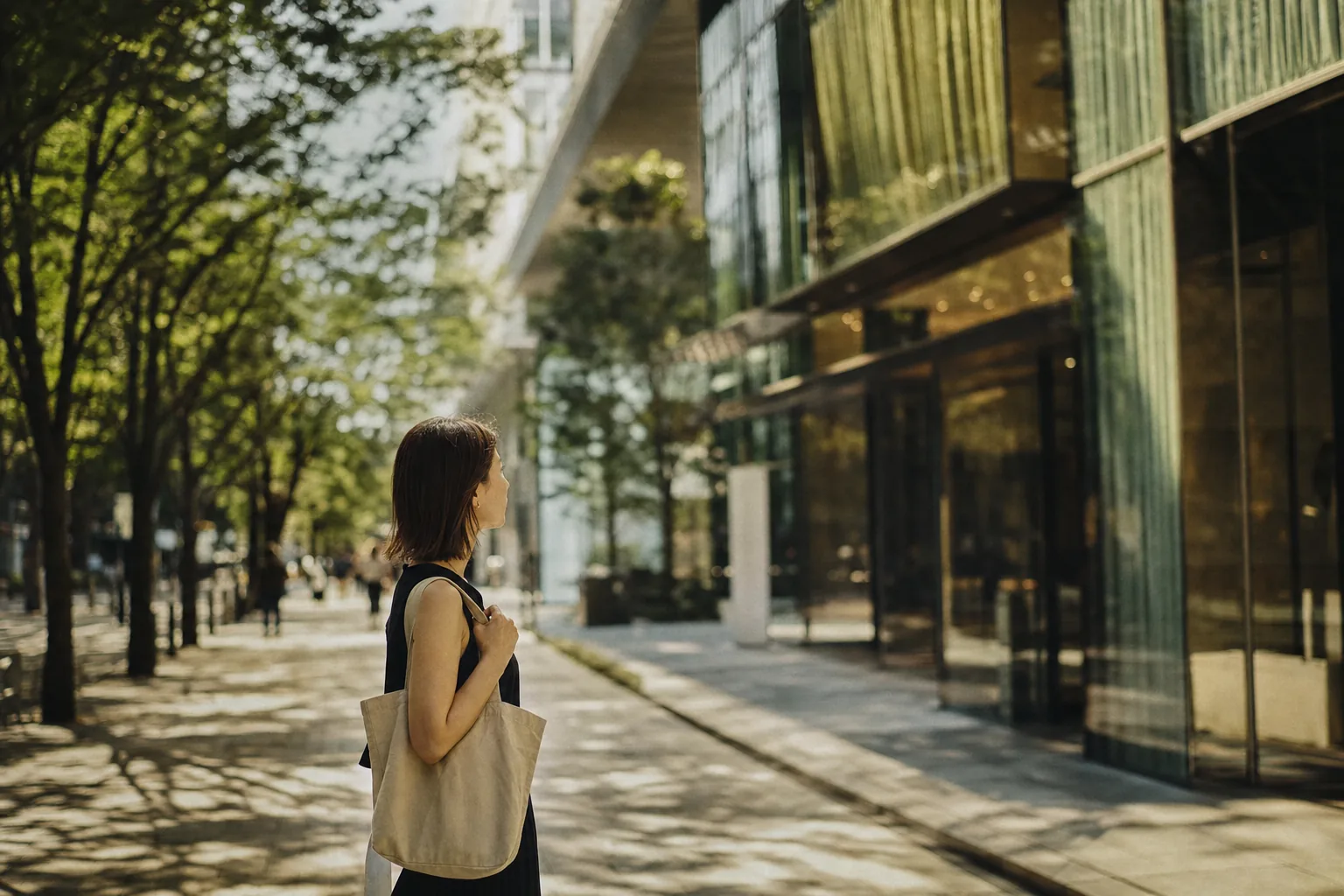
The Hermès Omotesando boutique carries colourways and leather combinations — including certain Togo and Epsom configurations — that do not appear in the brand's European or American door allocations. That single fact explains why a buyer who already owns the standard range makes the trip. Japan's luxury districts are not interchangeable stops on a sightseeing loop. Each one has a structural reason for the stock it carries, and targeting the wrong district for a specific category wastes time that could be spent at the counter that actually has it.
The four specific items below illustrate the pattern before the district-by-district breakdown. The Grand Seiko SBGW231, a hand-wound dress watch in Zaratsu-polished steel, is sold exclusively through Grand Seiko boutiques and select Japanese retailers and does not enter the standard export channel. The Issey Miyake Pleats Please pieces sold at Isetan Shinjuku include seasonal colourways produced for the Japanese market only. Comme des Garçons lines stocked at the Ginza flagship differ from the export range in both cut and fabric selection. And Kyoto lacquerware from Zohiko — a house operating inside Teramachi — is not exported through any retail partner. In each case the reason is the same: Japan's domestic luxury market is large enough to support product that never needs to leave.
What makes Japan's luxury districts different from flagship streets in New York or Paris?
The difference is not prestige — every city has prestige. It is depth of specialisation within a single geography. Tokyo's official tourism guide notes that Omotesando and Aoyama alone combine flagship stores of major fashion brands with the backstreets of Aoyama housing small boutiques and highly acclaimed dining spots — two distinct retail registers within walking distance of each other. New York's Madison Avenue and Paris's Rue du Faubourg Saint-Honoré concentrate the international maisons but carry little that is market-specific. Japan's districts, by contrast, stock products calibrated to a domestic buyer who already owns the standard range and wants what comes next.
The second structural difference is the department store buyer. Japan's major department stores — Isetan, Mitsukoshi, Matsuya — operate buying teams with enough leverage to negotiate Japan-exclusive colourways, limited runs, and in-store exclusives that do not exist in the brand's global catalogue. That leverage is a function of volume: Japan remains one of the largest luxury markets in the world, and the stores earn the product by selling it. For the buyer outside Japan, the practical implication is that the item you want may exist only here, and only in one or two locations within the country.
Ginza: which brands anchor Chuo-dori and what can you actually find there?
Ginza is the address for the international maisons at their most complete. Along Chuo-dori Avenue, flagship stores of Louis Vuitton, Chanel, Dior, Gucci, and Hermès sit within a few blocks of each other, each occupying an architecturally significant building. The concentration matters because these flagships carry deeper inventory than the brand's regional outposts — private lounges, capsule pieces held for established clients, and seasonal releases that do not reach secondary markets.
The anchoring institutions are Ginza Mitsukoshi, Matsuya Ginza, and GINZA SIX. GINZA SIX houses flagship stores including Dior's House of Dior, Saint Laurent, Valentino, Van Cleef & Arpels, Fendi, and Celine — several in maisonette formats spanning two to five floors. Matsuya Ginza and Mitsukoshi carry the domestic Japanese luxury brands alongside the international houses, which is where the market-specific product lives. Comme des Garçons, Issey Miyake, and Yohji Yamamoto maintain boutiques in Ginza where the Japanese-market range differs from what those designers export. The category to target in Ginza: high jewellery, the major European maisons at full depth, and Japanese designer lines that have no equivalent abroad.
On weekends and public holidays, Chuo-dori closes to traffic from noon to 6pm (April through September) and noon to 5pm (October through March), turning the boulevard into a pedestrian promenade — a useful practical detail for anyone planning a methodical walk between boutiques.
If you are sourcing a specific Ginza-stocked item from outside Japan, FindLuxuryJapan's Tokyo team can locate, evaluate, and ship it directly — send us a reference number or a link to a listing you've already found.Omotesando and Aoyama: what does this corridor stock that Ginza does not?
The Omotesando–Aoyama corridor is where Japanese designers hold their primary retail presence, and where the vintage and pre-owned market for luxury goods reaches its most sophisticated form. Omotesando is renowned for its stunning modern architecture, with flagship stores designed by world-famous architects such as Tadao Ando, SANAA, and Toyo Ito — the buildings themselves are part of the product. Louis Vuitton opened its Omotesando flagship in 2002, and the street's identity as a luxury address followed from that anchor.
The distinction from Ginza is the presence of Japanese-market-specific boutiques and the density of high-end pre-owned specialists. Vintage boutiques in the Omotesando and Aoyama area include AMORE Vintage Aoyama, which focuses on classic luxury brands and their vintage editions — Hermès, Louis Vuitton, Chanel, Dior — in a Moroccan-style interior that is itself part of the experience. Kottō-dōri, the antique street in Aoyama, runs parallel to the main boulevard and carries antique shops, art galleries, and interior design stores. Omotesando Hills, designed by Tadao Ando, houses around 130 stores across a spiral-sloped atrium and includes Visvim — the Japanese cult footwear label — alongside Comme des Garçons and Maison Margiela. The category to target here: Japanese designer ready-to-wear at full domestic depth, pre-owned luxury from authenticated specialists, and bespoke jewellery ateliers.
For a detailed comparison of how these two districts stack up against Shinjuku across specific product categories, the Ginza vs. Omotesando vs. Shinjuku breakdown covers the differences in depth.
Shinjuku: why do serious buyers go to Isetan specifically?
Isetan Shinjuku is the reason serious buyers go to Shinjuku. The store's buying team operates with a distinct aesthetic vision that produces a product selection — and Japan-exclusive special items — not available at other department stores carrying the same brands. The Men's Building at Isetan Shinjuku boasts the largest sales floor area in Asia, with men's items selected through the store's own buyer perspective, making it a destination for male shoppers from both Japan and abroad.
The ground floor of the main building carries around 60 brands — Gucci, Prada, Fendi, Bottega Veneta — in a single concentrated space. Floors two through four are devoted to women's clothing, where, alongside global luxury names, you find formal and casual wear by Issey Miyake and Yohji Yamamoto in Japan-specific configurations. The store also carries Isetan-exclusive limited-edition sweets and traditional crafts alongside fashion — a range that reflects how the Japanese department store model differs from its Western equivalent. The category to target at Isetan: men's luxury fashion at the widest domestic selection in Asia, Japan-exclusive colourways from global brands, and Japanese designer pieces in full domestic range.
Shibuya: what did the Hikarie and Scramble Square openings add to the luxury offer?
Shibuya's luxury offer was reshaped by two openings: Hikarie in 2012 and Scramble Square in 2019. Hikarie opened in April 2012 as one of the first skyscrapers of the Greater SHIBUYA urban modernisation project and positioned itself as a luxury-adjacent destination for working women in their twenties to forties — a demographic with specific tastes in fashion and cosmetics that differs from Ginza's international tourist traffic.
Scramble Square opened on November 1, 2019, as a 47-floor facility directly connected to Shibuya Station, with over 200 stores across its commercial floors. The luxury brands placed there — Givenchy, sacai, Saint Laurent, United Arrows, Tatras — were selected specifically for a millennial and younger buyer who shops Shibuya rather than Ginza. The distinction matters: sacai, the Japanese label founded by Chitose Abe, carries Japan-specific pieces at Scramble Square that do not appear in the brand's international wholesale. The category to target in Shibuya: Japanese streetwear-adjacent luxury, younger-skewing Japanese designer labels, and limited-edition sneaker and sportswear collaborations unavailable outside Japan.
Daikanyama and Nakameguro: what category of buyer makes the detour worthwhile?
Daikanyama and Nakameguro reward buyers hunting independent Japanese labels and pre-owned luxury that has been edited rather than simply accumulated. Daikanyama's backstreets are lined with small and very exclusive boutiques — a format that attracts stock that would not survive in a department store context. Daikanyama caters to the connoisseur, with boutiques leaning into carefully edited racks of designer ready-to-wear, rare accessories, and niche European labels.
Nakameguro along the canal is Tokyo's most concentrated strip of independent design and lifestyle shops, with a distinctly local, non-tourist character. The area's pre-owned and vintage specialists — including J'antiques, which sells chic American clothing and furniture from its Nakameguro base — operate on a different model from Ginza's polished resale counters: smaller inventory, deeper knowledge, and willingness to source specific pieces. The category to target here: pre-owned Japanese designer pieces, niche European labels not stocked by department stores, and independent Japanese lifestyle brands. Buyers interested in the full pre-owned landscape should also read the complete guide to luxury thrift and vintage shopping in Japan, which maps the pre-owned ecosystem across Tokyo and beyond.
Kyoto: what does Nishiki Market actually specialise in, and how does it differ from Teramachi?
Nishiki Market is a food market, not a luxury shopping destination. That distinction matters because the two are often conflated in travel writing. Nishiki Market specialises in all things food-related, including fresh seafood, pickled vegetables, tea, sweets, tofu, knives, and cookware — a 400-year-old covered street running five blocks east of Kawaramachi, barely wide enough for two people to pass. The kitchen knives sold there are genuinely worth examining: several vendors carry professional-grade carbon-steel blades by small Kyoto smiths that are not exported.
Teramachi is where the craft and luxury shopping actually happens. Teramachi is known for selling traditional crafts — folding fans, ceramics, and textiles — while the adjacent Shinkyogoku carries a younger mix. Zohiko, one of Kyoto's most respected lacquerware houses, operates a boutique inside Teramachi; small pieces start around ¥4,000 JPY, with quality sets running ¥20,000 JPY and up. Teramachi arcades stay open until 21:00, later than most craft boutiques in the historic districts. On Shijo-dori nearby, Takashimaya and Daimaru carry international luxury brands including Louis Vuitton — the department store offer for buyers who want the maisons rather than craft. The category to target in Kyoto: Japanese lacquerware, ceramics, textiles, and folding fans from makers with no export presence.
Which district should you target based on what you are looking for?
| If you are hunting… | Go to | Why |
|---|---|---|
| Major European maisons at full inventory depth | Ginza (Chuo-dori, GINZA SIX) | Deepest flagship stock; private client access; Japan-exclusive capsule pieces |
| Japanese designer lines at domestic range | Omotesando / Aoyama | Primary retail presence for Comme des Garçons, Issey Miyake, Visvim |
| Pre-owned luxury from authenticated specialists | Omotesando / Aoyama | Highest density of high-end vintage boutiques; Kottō-dōri antique street |
| Men's luxury fashion, widest domestic selection | Isetan Shinjuku (Men's Building) | Largest men's floor in Asia; Japan-exclusive buys; Isetan-exclusive items |
| Streetwear-adjacent luxury and Japanese labels for younger buyers | Shibuya (Scramble Square, Hikarie) | sacai, Givenchy, Saint Laurent in millennial-targeted concept stores |
| Niche European labels and edited pre-owned | Daikanyama / Nakameguro | Independent boutiques; connoisseur-grade resale; non-tourist inventory |
| Traditional Japanese craft — lacquerware, ceramics, textiles | Kyoto (Teramachi) | Zohiko lacquerware; folding fans; ceramics from makers with no export channel |
| Professional kitchen knives from small Japanese smiths | Kyoto (Nishiki Market) | Carbon-steel blades from Kyoto smiths not sold abroad |
The table above treats each district as a category specialist rather than a geographic stop. In practice, Ginza and Omotesando are 20 minutes apart on the Ginza subway line, and Daikanyama is a 15-minute walk from Shibuya — so a buyer targeting two adjacent categories can cover both in a single day. The Kyoto trip is a separate decision: the craft category there does not overlap with anything in Tokyo, which means the detour is only worth making if traditional Japanese craft or Kyoto-specific food products are on the list.
One practical note: the items that are hardest to find — Japan-exclusive colourways, limited department-store runs, small-maker craft with no export channel — are also the ones that sell fastest to the domestic market. Timing matters, and the seasonal guide to when Japan's luxury market moves product covers the sale windows and restocking patterns that affect availability across all of these districts.
For items that are already sold out in-store or require sourcing across multiple Tokyo locations, FindLuxuryJapan's Tokyo team searches auctions, Japanese marketplaces, and partner shops — describe what you're looking for and we'll send matched options within two business days.

