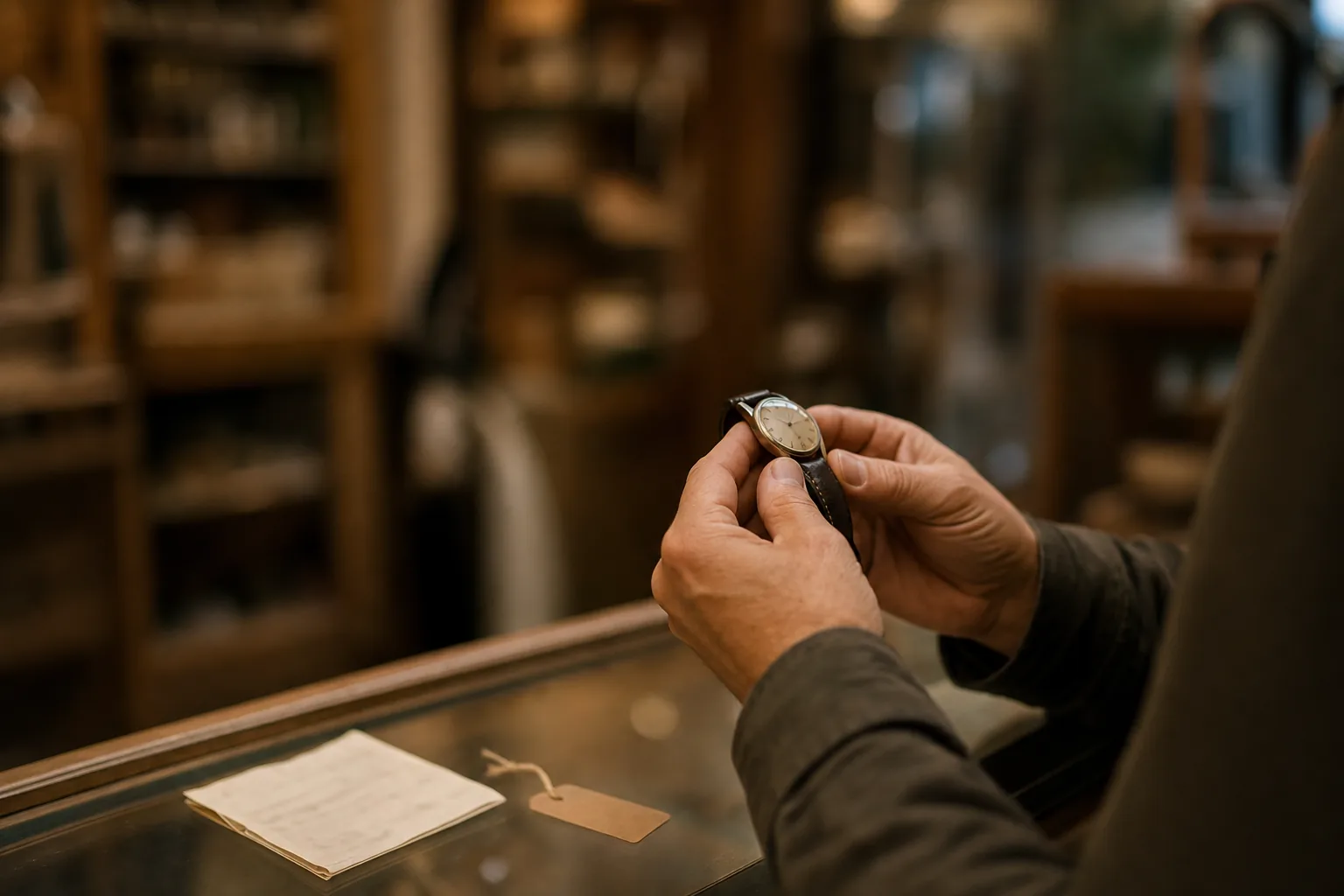
The Grand Seiko SBGW235 — cream dial, blued seconds hand, Gay Frères-style bracelet — was only sold mostly in Japan. It is not a limited release. It simply was not distributed elsewhere. The same is true of the SBGJ231, a hi-beat GMT with a midnight-blue Iwate dial: some of the best recent Grand Seiko releases have only been circulated in Japan. Add to those the STGF285 and STGF375 women's models that appear on Japanese retailer listings but not on the global boutique site, and the SBGX344 slim quartz dress piece stocked by domestic specialists — and you have a category of objects that cannot be sourced at home regardless of budget.
That is the draw. The complication is what happens after the sale. Japan's post-purchase landscape is genuinely different from the US or EU, and understanding it changes how you should approach every transaction.
If you are still mapping out which channels to use before you buy, the complete guide to buying second-hand luxury in Japan covers the full market structure. This article picks up where that one ends: at the moment the receipt is in your hand.
What does a 'no returns' policy actually mean at a Japanese luxury boutique?
At a brand boutique in Japan — Hermès, Louis Vuitton, Chanel, Cartier — "no returns" means exactly that: the sale is final the moment you walk out. This is not an aggressive policy choice; it is the legal default. According to the Japanese Civil Code, stores have no obligation nor is there a legal basis requiring them to accept returned products or exchange them once they have been sold. Whether a store accepts a return at all is entirely at the store's discretion.
In practice, most brand boutiques in Japan will consider a return only if the item is demonstrably defective or if there was a material error in the sale — a wrong item delivered, a description that was factually incorrect. A change of mind, a size that doesn't fit, a color that looks different at home: none of these are grounds for a return under the default framework. In Japan, if you purchase an item from a store, you generally cannot return it for your own reasons, like "it was cheaper at another store" or "it was not what I had imagined."
Some boutiques do have internal policies that go beyond the legal minimum — Louis Vuitton's global in-store terms, for instance, allow returns within 30 days for new and unused products in pristine condition with original receipt and documentation. But those terms are administered locally, and for refunds, the item must be returned exclusively to the store of purchase in the original method of payment and to the original client. For a buyer who has since left Japan, that condition is essentially impossible to meet.
Do department store luxury floors in Japan accept returns, and under what conditions?
Department stores — the depāto that anchor Ginza, Shinjuku, and Omotesando — operate their luxury floors differently from standalone boutiques, but not dramatically more flexibly. Most department stores accept returns for defective items, but changing your mind is not always grounds for a return. The window, where one exists, is typically printed on the receipt and must be read carefully at the point of purchase.
The structure matters for international buyers. A purchase made at a luxury counter inside a department store is governed by both the department store's policy and the brand's own rules. Louis Vuitton's terms are explicit: merchandise purchased at a department store may only be refunded at the same department store brand. So a bag bought at a Mitsukoshi counter cannot be returned to a freestanding Louis Vuitton boutique, and it certainly cannot be returned to a Louis Vuitton store in your home country.
The practical implication: even where a return window technically exists, the geography closes it for anyone who has already boarded a flight home. The window starts on the purchase date, not the arrival date. By the time an item clears customs and you have had a chance to examine it properly, the window may already have passed.
How do the large chain resellers handle returns on pre-owned watches, bags, and jewellery?
Japan's large pre-owned luxury chains — the multi-floor operations with separate sections for watches, jewellery, bags, and clothing — are where most international buyers encounter the starkest policies. The standard position across the major chains is: no returns unless the item was materially not as described. In Japan the rules for returning a purchased item are much stricter — at the very least, if an item has been used to a certain degree it is then impossible to return it as long as the product was not defective and functioned properly.
For pre-owned goods, "as described" is defined by the condition grade assigned at intake. Japan's pre-owned grading system — typically running S (unused) through A, B, C, with detailed notes — is consistent and taken seriously by the major chains. If the grade is accurate, the sale stands. The chains do not accept returns on the basis that a buyer changed their mind, found a better price elsewhere, or decided the item did not suit them after purchase.
The one exception that does exist in practice: if an item was misgraded — if a bag sold as Grade A has undisclosed damage, or a watch sold as running has a movement fault — the chain will typically accept the return or exchange. But that requires the buyer to be present, with the item, within a very short window. For someone who purchased remotely and received the item weeks later in another country, enforcing even this narrow right is genuinely difficult.
Understanding how Japanese condition grades work before you buy is essential — the pre-owned grading system decoded explains exactly what each rank means and what disclosures you should expect at each level.
What exchange options exist at consignment specialists and second-hand department store floors?
Consignment specialists — the smaller Ginza and Omotesando boutiques that focus on a single category like vintage Hermès or estate jewellery — operate on even tighter terms than the chains. Sales are typically final. The specialist's value proposition is curation and authenticity, not flexibility, and their margins do not accommodate the cost of reverse logistics on high-value items.
The second-hand floors inside department stores occupy a middle ground. They benefit from the department store's service culture, which in Japan is genuinely exceptional, but they apply the same fundamental rule: returns are for defects, not for preference. Where exchange is offered, it is usually store credit against another item of equal or greater value, and it requires the original item to be returned in the same condition it left in — tags, pouches, authentication cards, and all original packaging intact.
The table below maps what typically exists across the four main channels. These are the conventions; individual stores vary, and policies change.
| Channel | Return for defect | Return for preference | Exchange option | Typical window |
|---|---|---|---|---|
| Brand boutique (new) | Generally yes | Rarely | Sometimes, same store | Varies; often 7–30 days |
| Department store luxury floor | Generally yes | Rarely | Sometimes, same chain only | Varies; often 7–14 days |
| Large chain reseller (pre-owned) | Yes, if misgraded | No | Rarely | Very short; often same-day or 3–7 days |
| Consignment specialist | Case by case | No | Rarely, store credit only | Very short or none |
Why are return windows so much shorter in Japan than in the US or EU?
The gap is structural, not cultural stubbornness. In Japan there are no laws that "require businesses to accept returned items from consumers" — whether to offer such a service is a decision left to the sole discretion of the store. In the US and EU, consumer protection frameworks impose minimum return rights that retailers must honour. Japan's framework works differently.
Japan does have a cooling-off system, but it is narrow. The cooling-off system gives consumers the opportunity to reconsider purchases — but door-to-door sales, telephone solicitation sales, and certain other specified transaction types are the cases it covers. Over-the-counter retail sales at a physical store are explicitly excluded. The cooling-off period does not apply to over-the-counter sales. A purchase made at a boutique or department store counter — which is how almost every luxury transaction in Japan works — falls outside the cooling-off rules entirely.
The result is that return windows, where they exist at all, are set entirely by the retailer. Most Japanese luxury retailers set them short — often 7 days, sometimes 14 — because the law does not require them to do otherwise, and the retail culture does not expect it. The expectation embedded in Japanese retail is that the buyer examines the item thoroughly before purchase and makes a considered decision. Returns are accommodations, not rights.
What condition and documentation requirements can void a return even within the allowed window?
Even where a return window exists, the conditions attached to it are strict enough that many attempted returns fail on documentation grounds alone. If stores do accept returns, you will still need a receipt — and items must be maintained in as clean a condition as possible from the time of purchase.
For new items at brand boutiques, the standard requirements typically include: the original receipt, all original packaging (box, dust bag, tissue, inserts, care cards), any warranty documentation, and the item in unworn, unaltered condition. Louis Vuitton's terms are representative of what most maisons require: new and unused products in pristine condition, accompanied by the original receipt and tax-free form (if any and if the tax has not been refunded). If the tourist tax exemption has already been processed, it complicates the return further — the tax component may need to be repaid.
For pre-owned items, the requirements are equally unforgiving. The item must be returned in the same condition it was sold in, with the same accessories noted on the purchase documentation. A watch missing its original tags, a bag returned without its authentication card, or a piece of jewellery with a scratch that was not present at sale — any of these can void the return entirely. The grading documentation issued at point of sale is the reference point, and it is interpreted strictly.
The documentation question is one reason why authenticating and inspecting a piece before you buy matters more in Japan than anywhere else — because once the sale is done, the documentation locks in the condition record.
How does an international buyer realistically enforce a return or exchange from abroad?
Honestly: with great difficulty, and in most cases not at all. The practical barriers are significant even before you consider the policy restrictions.
First, the item must be physically present at the selling store within the return window. International shipping from your home country back to a Tokyo boutique takes days at minimum, costs money, and carries customs risk in both directions. The return window — often 7 days — may expire before the package arrives. Second, the return must typically be initiated by the original buyer in person, or at minimum by someone presenting the original receipt and identification. Third, for new items purchased with a tourist tax exemption, returning the item may trigger a requirement to repay the consumption tax that was refunded at point of sale.
For pre-owned items purchased through the large chains, there is an additional layer: the chain's return acceptance is conditional on the item being in the same condition as sold, which is verified against their own intake records. If there is any question about whether the condition changed in transit, the return will not be accepted.
The one scenario where enforcement is more realistic: if the item was demonstrably misrepresented — wrong reference number, undisclosed damage, authentication failure — and the buyer has documentation to prove it. In that case, a formal complaint through Japan's Consumer Hotline for Tourists (operated by the National Consumer Affairs Center) is an avenue, but it requires time, Japanese-language communication, and the ability to return the item. It is not a quick resolution.
This is also one of the structural reasons why Japanese sellers are cautious about international transactions in the first place — the logistics of post-sale disputes across borders create risks that domestic transactions do not carry.
Why getting the item right before purchase matters more in Japan than anywhere else
Everything above points to the same conclusion: the post-sale safety net that Western buyers rely on — the 30-day return window, the right to change your mind, the ability to return online purchases without explanation — does not exist in Japan's luxury retail channels. The system is built on the assumption that buyers do their due diligence before the transaction, not after.
That assumption is reasonable when you are standing in a Ginza boutique and can examine the item under good light, ask questions, and walk away if something feels wrong. It becomes a significant risk when you are buying from abroad, relying on photographs and descriptions, and cannot physically inspect what you are purchasing.
The risk profile differs by channel. New items at brand boutiques carry lower condition risk — the item is new — but higher geographic risk, since any return requires physical presence at the store of purchase. Pre-owned items at chain resellers carry both condition risk (the grade may not match your expectations) and the same geographic barrier. Consignment specialists carry the highest combined risk: narrowest return terms, most varied condition, and least standardized documentation.
The practical response to this landscape is not to avoid Japan's market — the items available here, at the prices they trade at, justify the sourcing effort. The response is to front-load all the verification that a Western buyer would normally do after receiving an item. Condition, authenticity, documentation completeness, reference number confirmation — all of that needs to happen before the purchase is confirmed, not after. In Japan, pre-purchase diligence is not a nice-to-have. It is the only available protection.
For buyers who want to understand what the pre-owned luxury market in Japan looks like across all its channels before committing to any channel, the complete guide to luxury thrift and vintage shopping in Japan maps the full landscape, from chain stores to independent specialists.


