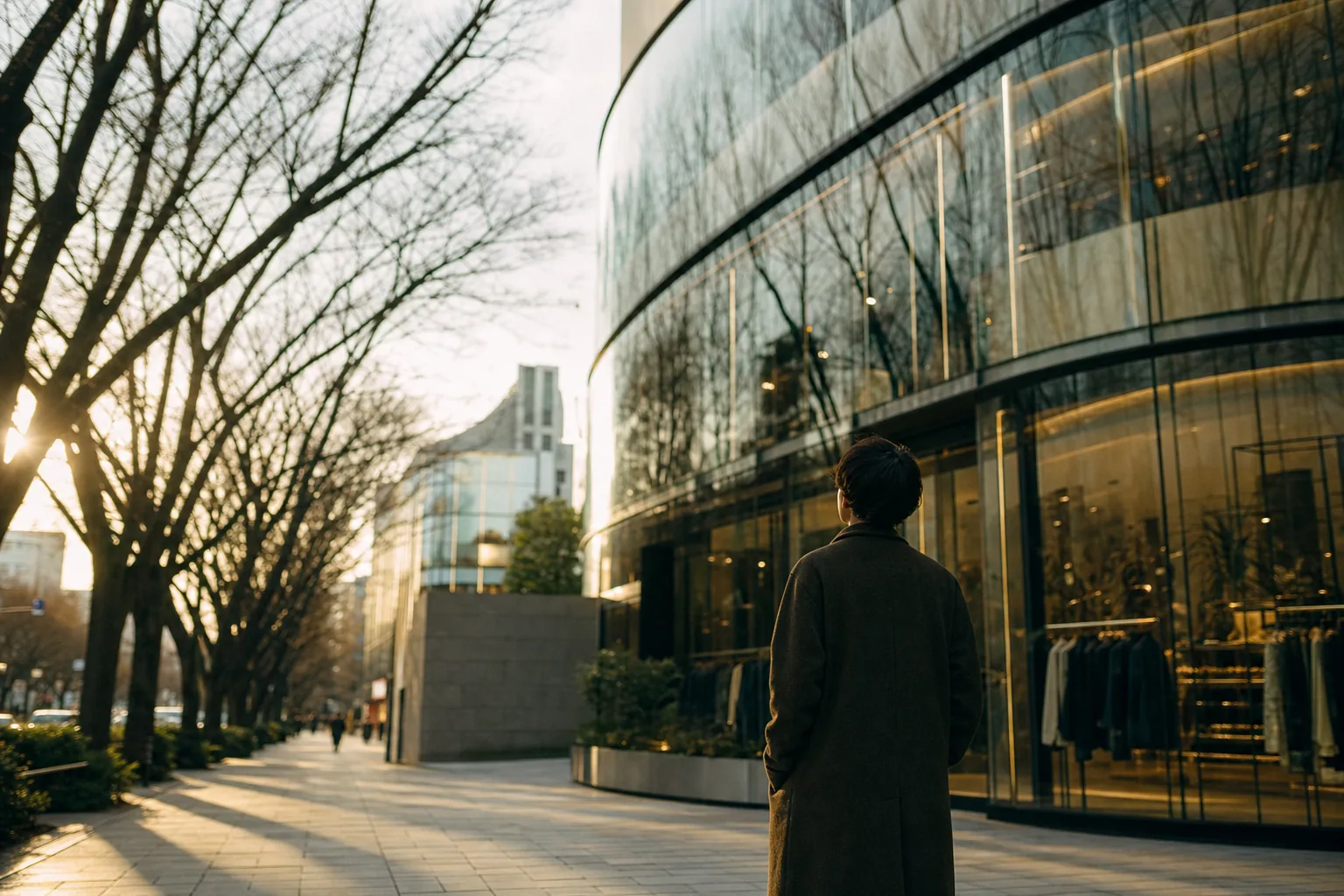
The Prada Aoyama Epicenter — designed by Herzog & de Meuron and completed in 2003 — is six stories of diamond-patterned glass in Minami-Aoyama, a ten-minute walk from Omotesando Station. It is not in Ginza. It is not in Shinjuku. That distinction matters more than it sounds, because the three districts that dominate Tokyo luxury retail are not variations on a theme. They are structurally different markets, and the serious buyer who treats them as interchangeable will miss what each one is actually for.
This article compares them directly: what each district specialises in, which buildings and experiences are exclusive to each, and where the specific errors in most existing guides begin.
If you want to source specific items from any of these districts without being in Tokyo, our concierge team can locate and evaluate them on your behalf.What makes Ginza, Omotesando, and Shinjuku different from each other?
The three districts serve different primary functions. Ginza is Tokyo's oldest and most formal luxury corridor — a place built around European flagship stores, major Japanese department stores, and the kind of retail real estate that commands some of the highest per-square-meter prices in the country. Ginza tops every other borough in Tokyo for real estate cost, which is both cause and consequence of the concentration of international luxury houses there. Omotesando is an architectural showcase as much as a shopping district — a tree-lined avenue where brands commission signature buildings from world-class architects as acts of brand expression, not just retail fit-outs. Shinjuku is the volume market: the largest footprint, the densest concentration of pre-owned specialist shops, and the city's most competitive environment for watches and bags at every price point.
Each district has a character that shapes what you will find there. Ginza rewards formal, appointment-style shopping at flagship level. Omotesando rewards walking and looking — the buildings are part of the experience. Shinjuku rewards comparison shopping, particularly for pre-owned goods, because the density of competing dealers keeps prices honest.
What does Ginza specialise in that the other two districts don't?
Ginza is where the European houses put their most significant Japanese flagships. Along Chuo-dori Avenue, flagship stores of Louis Vuitton, Chanel, Dior, Gucci, and Hermès sit in architecturally commissioned buildings with private client lounges and Japan-only capsule pieces. The Maison Hermès building on Chuo-dori — designed by Renzo Piano — is one of the most cited examples of a luxury brand treating its retail building as a cultural statement rather than a shop fit.
The department store infrastructure in Ginza is also without parallel in the other two districts. Mitsukoshi Ginza, with roots in the district going back to 1904, and Matsuya Ginza, a century-old landmark, both carry the kind of broad luxury assortment — from high jewelry to regional Japanese crafts — that no single-brand boutique can match. Ginza Mitsukoshi offers an extensive selection ranging from high-fashion apparel to exquisite jewelry and regional specialties from across Japan. GINZA SIX, which opened in 2017, added a large-scale mixed complex to the district, with a rooftop garden and a Noh theater alongside its luxury tenant roster.
Dover Street Market Ginza — Rei Kawakubo's multi-level concept store — is also Ginza-specific, and functions less like a conventional boutique and more like an installation that changes with each season. It carries exclusive Comme des Garçons pieces and brand collaborations not available in the brand's other retail channels.
What Ginza cannot offer as readily is the kind of independent Japanese designer presence that defines Omotesando, or the pre-owned volume that defines Shinjuku. It is a district optimised for flagship-level European luxury and the formal Japanese department store experience.
Why do architects like Herzog & de Meuron, SANAA, and Toyo Ito have flagship buildings in Omotesando?
Omotesando became a showcase for architect-designed retail buildings in the late 1990s and early 2000s, when several luxury brands simultaneously decided that their Tokyo presence needed to be a piece of architecture rather than a leased floor in a department store. The street's zelkova trees, generous sidewalks, and relatively low building heights created conditions where a freestanding building could be seen whole — something impossible in the denser blocks of Ginza or Shinjuku.
The sequence of significant buildings on and around Omotesando Avenue is now a substantial architectural itinerary in itself. The Dior Omotesando building is a trapezoid box designed by the Japanese practice SANAA (Kazuyo Sejima and Ryue Nishizawa), completed in 2003. Its double skin — an outer layer of clear glass and an inner layer of translucent acrylic — gives the facade a glowing blankness that reads differently at day and at night. Tod's Omotesando was designed by Toyo Ito and completed in 2004; its concrete-and-glass facade is structured as a series of interlocking tree-shaped columns, directly referencing the zelkova trees that line the avenue. The Prada building was designed by Swiss firm Herzog & de Meuron and features diamond-shaped convex glass panels that the architects described as comparable to a contact lens resting on the pupil of an eye.
A note on attribution that circulates incorrectly in many guides: the Tod's building is by Toyo Ito, not Tadao Ando. Ando designed Omotesando Hills — a different building, a few hundred meters along the same street. The two architects have distinct practices and the buildings are architecturally nothing alike. Conflating them is a persistent error in travel content about the district.
What is inside Omotesando Hills and who designed it?
Omotesando Hills was designed by Tadao Ando, who built the main structure to approximately the same height as the zelkova trees lining the avenue — achieved by pushing much of the building underground. The defining interior feature is a 700-meter spiral slope, built at almost exactly the same gradient as Omotesando Avenue itself, which wraps around a six-story atrium connecting three basement floors to three above-ground floors. Retail spaces line the slope, so walking through the building replicates the experience of walking the street outside.
The complex is a redevelopment of the Dojunkai Aoyama Apartments, a 1920s housing block that had become a protected landmark. Ando's solution — to preserve the memory of the original while replacing the structure — involved extensive underground construction and rooftop gardens to maintain the low-rise profile the street requires. The result is a mixed-use building: roughly 130 shops across the commercial floors, and 38 apartments on the upper levels.
Inside Omotesando Hills you will find a mix of international labels and Japanese designers. The building's value for the serious buyer is less about any specific brand and more about the concentration of mid-to-upper luxury in a single architectural space — and the fact that the building itself is worth the visit regardless of what you buy.
What does Shinjuku offer that Ginza and Omotesando can't match?
Volume and competition. Shinjuku is one of the most competitive areas in Tokyo for luxury watch shopping, with pre-owned dealers clustered densely enough that a buyer can compare the same reference across multiple shops in an afternoon. The same dynamic applies to bags, jewelry, and accessories: the concentration of competing resellers — rather than the presence of any single exceptional shop — is what makes Shinjuku distinctive.
Isetan Shinjuku, the district's anchor department store, is also one of the most significant in Japan for fashion buyers. Its men's building, in particular, carries a depth of Japanese designer and international contemporary labels that goes beyond what most Ginza department stores offer in this category.
For pre-owned luxury specifically, KOMEHYO Shinjuku Women is a large pre-owned fashion store near Shinjuku Station's east exit, spanning from the basement level to the 4th floor, with dedicated sections for jewelry, bags, and apparel. A vintage collection covering the 1980s to early 2000s — including rare Chanel pieces that have become collector's items — runs alongside the standard pre-owned inventory. KOMEHYO Shinjuku is the flagship Tokyo store of KOMEHYO, a chain founded in 1947 with its headquarters in Nagoya.
What Shinjuku cannot offer is the architectural experience of Omotesando or the formal flagship gravitas of Ginza. It is a working retail district, not a destination for the building facades.
The FindLuxuryJapan team sources items from all three districts — new retail, pre-owned specialist shops, and auction channels — and can locate specific references you have already identified.Which district is best for Japanese luxury brands versus European houses?
| Category | Ginza | Omotesando | Shinjuku |
|---|---|---|---|
| European flagship stores | Strongest — Chanel, LV, Dior, Hermès, Gucci on Chuo-dori | Strong — architect-designed standalone buildings | Present but secondary |
| Japanese designer labels | Dover Street Market, Issey Miyake, Comme des Garçons | Yohji Yamamoto, MIHARA YASUHIRO, emerging designers | Isetan men's building; strong contemporary selection |
| Japanese department stores | Mitsukoshi, Matsuya, GINZA SIX | Omotesando Hills (mixed-use) | Isetan Shinjuku, Takashimaya |
| Pre-owned luxury | Some dealers; less competitive pricing | Limited; not a pre-owned district | Strongest — KOMEHYO and multiple specialist dealers |
| Luxury watches (new) | Brand boutiques along Chuo-dori | Some boutiques | Isetan; multiple brand boutiques |
| Luxury watches (pre-owned) | Some dealers | Very limited | Strongest — highest density of competing dealers |
| Architectural interest | Maison Hermès (Renzo Piano) | Prada (H&de M), Dior (SANAA), Tod's (Toyo Ito), Omotesando Hills (Ando) | Minimal |
For European houses at flagship level, Ginza is the primary answer. The brands with the most significant Japanese operations — Hermès, Chanel, Louis Vuitton — tend to put their most important stores there, often with Japan-exclusive products and private client services not replicated elsewhere. For Japanese luxury brands, the picture is more distributed. A full ranking of Japanese luxury brands by category shows how differently they approach retail geography: some concentrate in Omotesando, others in Ginza, and several maintain their most important presence in department stores across both districts.
How do the three districts compare for pre-owned and vintage luxury?
Shinjuku leads for volume and price competition. The density of pre-owned dealers near Shinjuku Station's east exit — including KOMEHYO and several specialist watch shops — creates a market where you can genuinely comparison-shop the same item across multiple sellers in a short walk. This is the condition that produces competitive pricing; it does not exist in Omotesando, and it is less pronounced in Ginza.
Ginza has pre-owned dealers, but they tend toward the higher end of the pre-owned market, with pricing that reflects the district's real estate costs. The pre-owned Ginza experience is more considered and less competitive than Shinjuku. Omotesando has almost no pre-owned presence worth noting — it is a new retail district, and the economics of its retail space push out the lower-margin resale model.
For buyers focused specifically on pre-owned goods, the full guide to luxury thrift and vintage shopping in Japan maps the broader landscape beyond these three districts — including Shimokitazawa and Nakameguro, which serve a different vintage buyer than the Shinjuku specialist shops. And if you are evaluating condition before committing to a pre-owned piece, the authentication guide for pre-owned Japanese luxury covers what to look for at each price point.
Why is it still hard to reach the best of all three districts from outside Japan?
The practical answer is that the most interesting items in each district — Japan-exclusive colorways from a European house, a specific pre-owned reference in verified condition, a limited-edition piece held for established clients — are not listed anywhere accessible to a buyer outside Japan. They exist in physical stores, in auction houses, and in the inventory of specialist dealers who do not publish English-language catalogues or ship internationally as a standard service.
The three districts are also genuinely far apart in character. A buyer who flies to Tokyo and allocates one afternoon to "luxury shopping" will cover one district adequately at best. Covering all three properly — Ginza's flagships, Omotesando's architectural boutiques, Shinjuku's pre-owned market — requires multiple days and a clear sense of what each one is actually for. Most travel guides collapse this into a single undifferentiated recommendation, which is why buyers arrive expecting one district to do the work of three.
The Japan luxury market's pricing advantage — which applies to both new retail and pre-owned — is also not automatically accessible from abroad. Timing matters significantly: seasonal sales cycles and the yen's position against major currencies both affect the effective price a foreign buyer pays. Understanding when to buy, and through which channel, is as important as knowing which district to target.
For buyers who want access to specific items across all three districts without being in Tokyo, FindLuxuryJapan's concierge sourcing service locates, evaluates, and ships items from new retail, pre-owned specialists, and auction channels. Every request is sourced individually — there is no catalogue — and items are assessed for condition and authenticity before purchase is confirmed. The sourcing fee is 10% of the item price, with a minimum of ¥5,000, quoted before you approve anything.


